🇫🇷 Cet article est également disponible en français : Lire en français
The Alpine A390 is one of the most closely watched models of the year: the brand’s first fully electric sporting family car, the Renault Group’s first three-motor drivetrain, and above all the first real test of whether Alpine’s DNA can survive far from the lightweight berlinette that made its name.
This road test, carried out on the demanding routes of Málaga and the Sierra Blanca, offers the perfect terrain to understand what this new model truly delivers: handling, performance, efficiency, onboard experience, technology — and, perhaps most importantly, the sensations it gives its driver.
A true Alpine, or simply a sporty electric family car wearing an Alpine badge?
That’s exactly what this in-depth review sets out to answer.
I. PROLOGUE
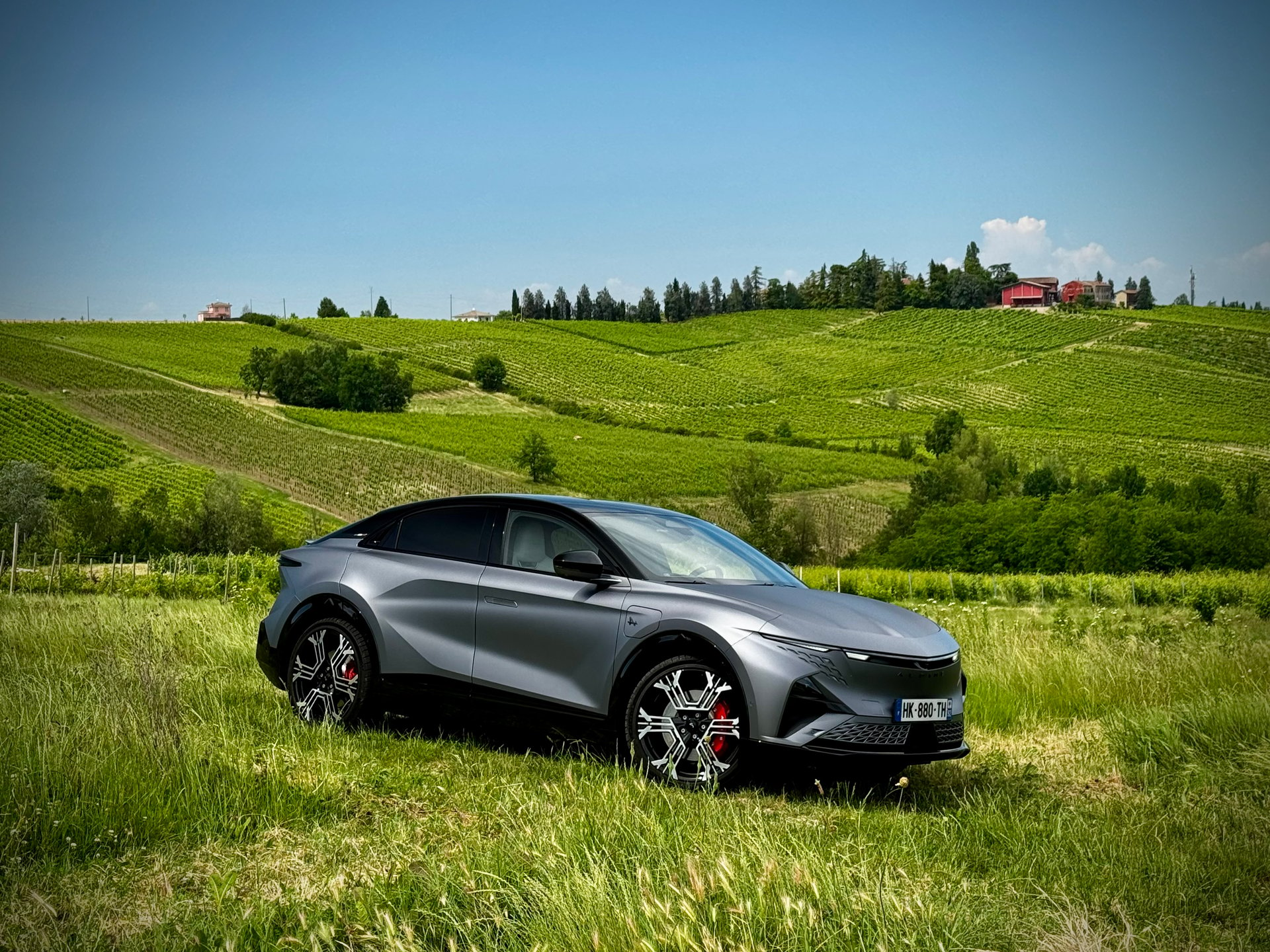
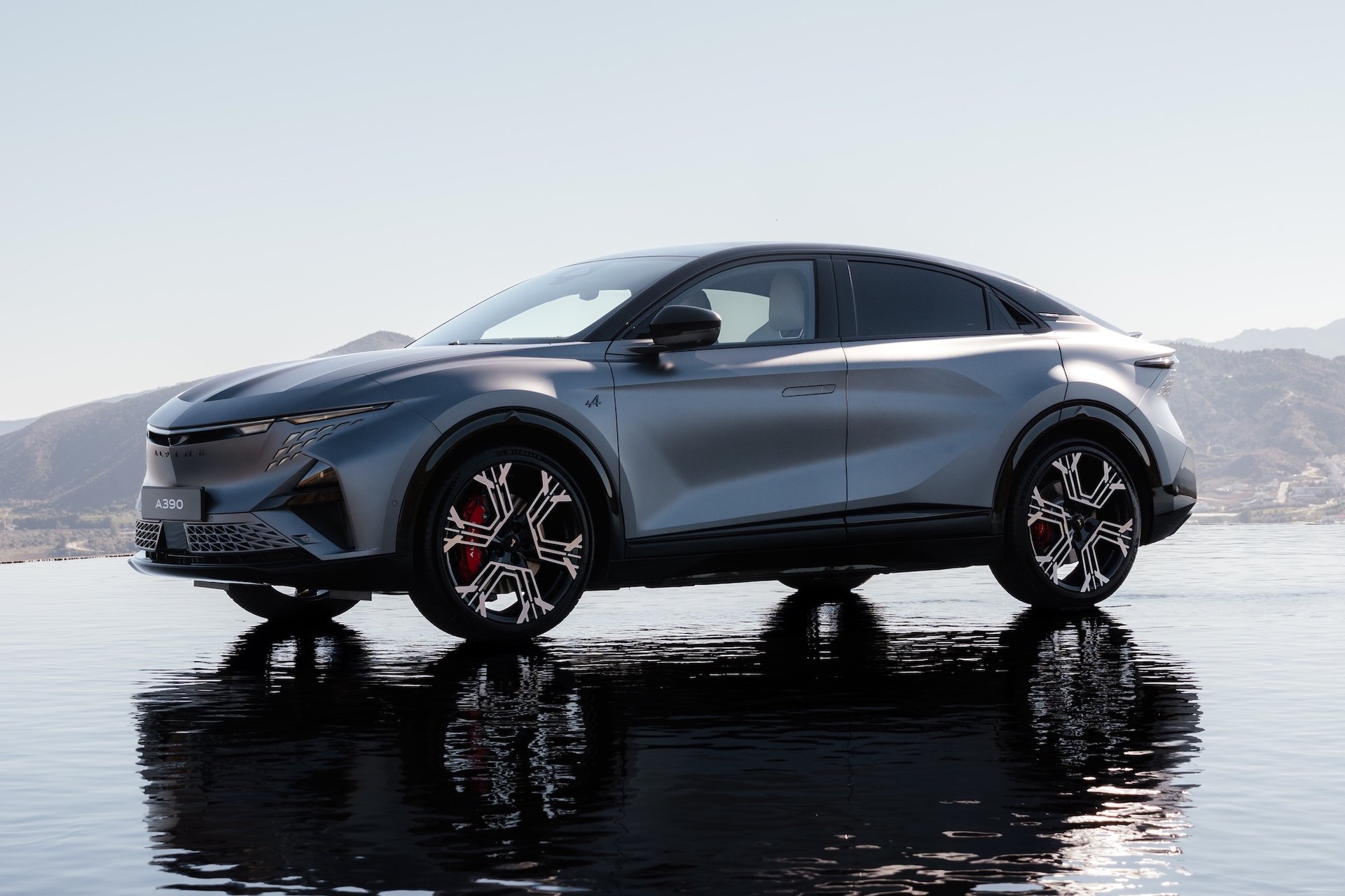
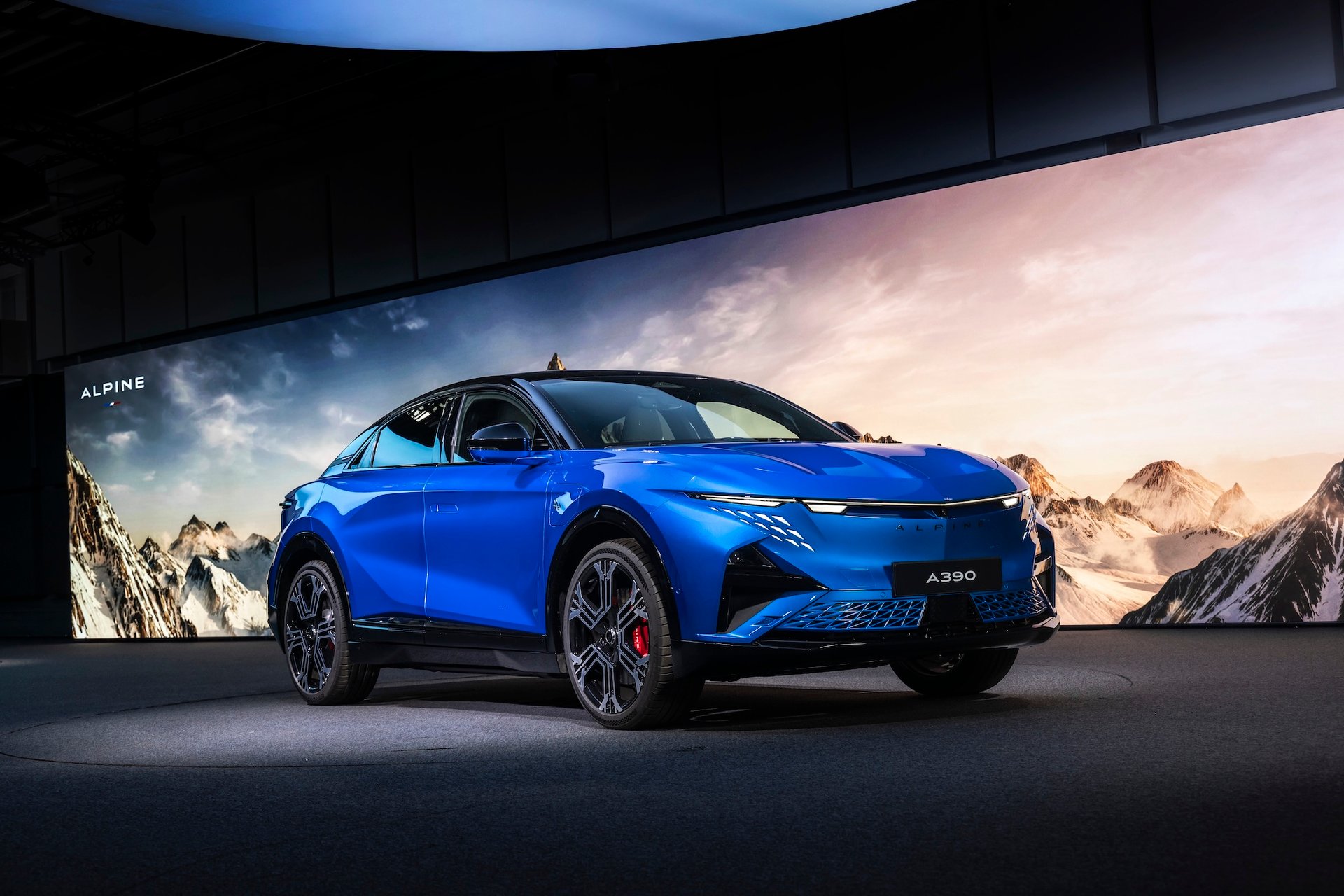
Some test drives begin long before you press a starter button. The Alpine A390’s story starts on the tarmac of Málaga airport, the moment the car finally appears without studio lights or staged angles. And the first surprise comes instantly: it looks more compact, lower, tighter than expected. Less “crossover”, more stance. A taut, almost athletic silhouette that catches the Andalusian light with a confidence the official photos never quite conveyed.
There was, admittedly, a hint of apprehension. An electric Alpine, slightly raised, five doors, five seats… and officially not an SUV — though the temptation to call it one lingers. Nobody really knew whether this car would spark desire, or simply tick the right market boxes.
But what if this A390, despite its size and weight, truly carried something Alpine in its bloodstream?
The answer, as always, would be revealed on the road.
II. Design
In photos, one might have imagined it taller, bulkier, almost constrained by its own proportions. In reality, it looks more compact, better contained, more coherent in its stance. The silhouette leans downward rather than upward. The eye travels from the hood to the rear haunches as it would on a sports car, not on an SUV — a term Alpine rejects, and rightly so, since the vehicle adopts neither the posture nor the visual inertia of one.
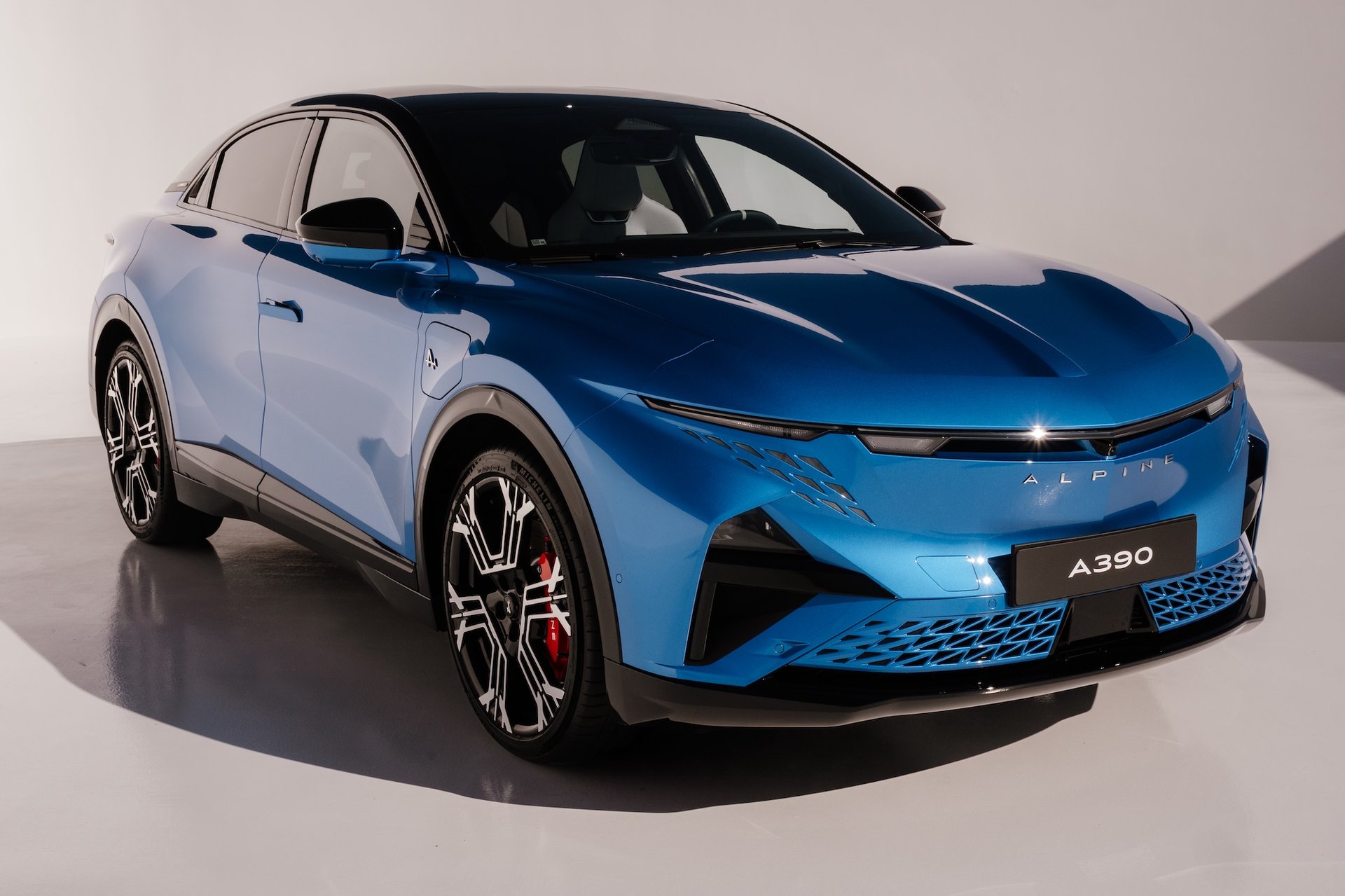
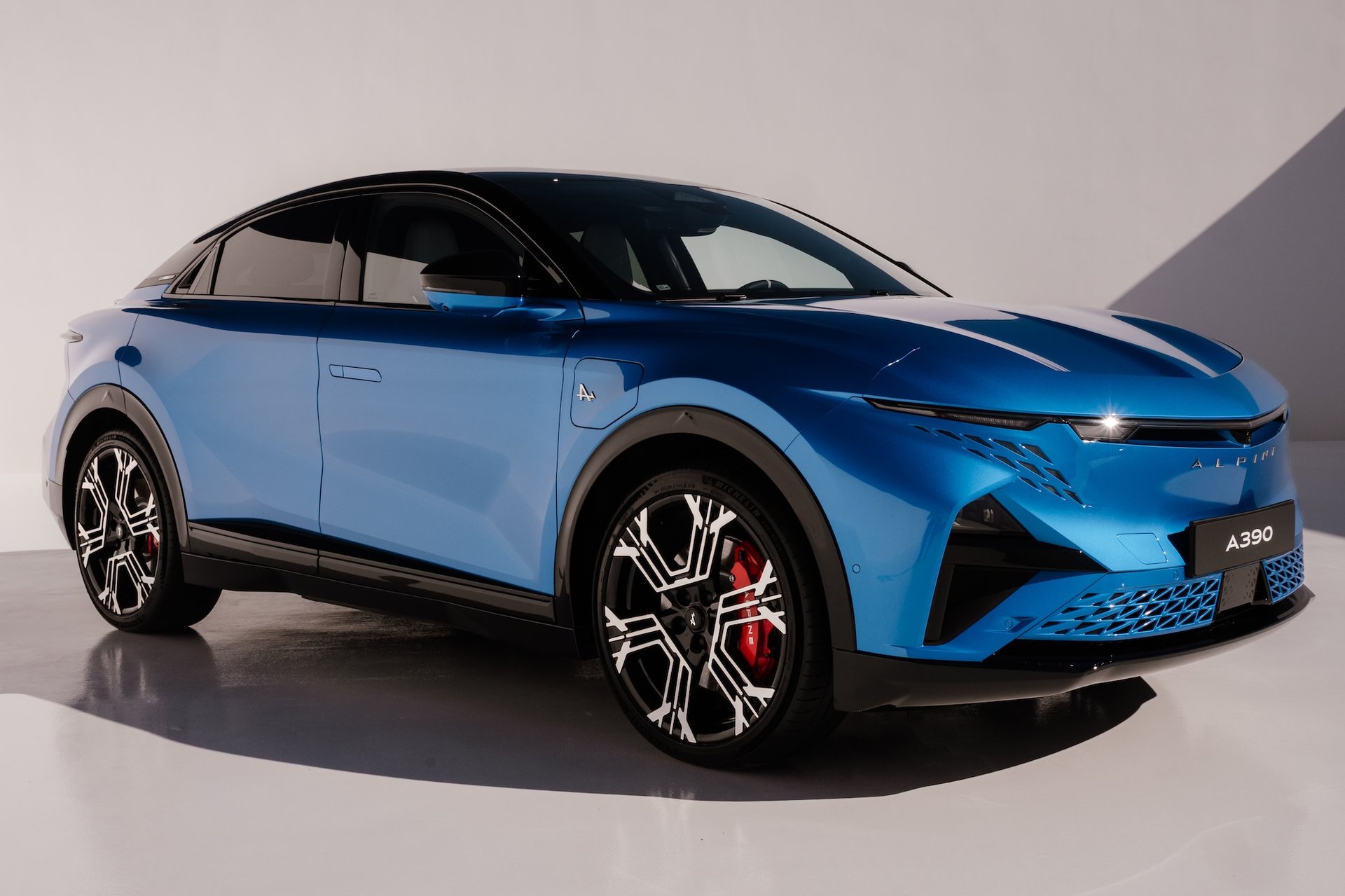
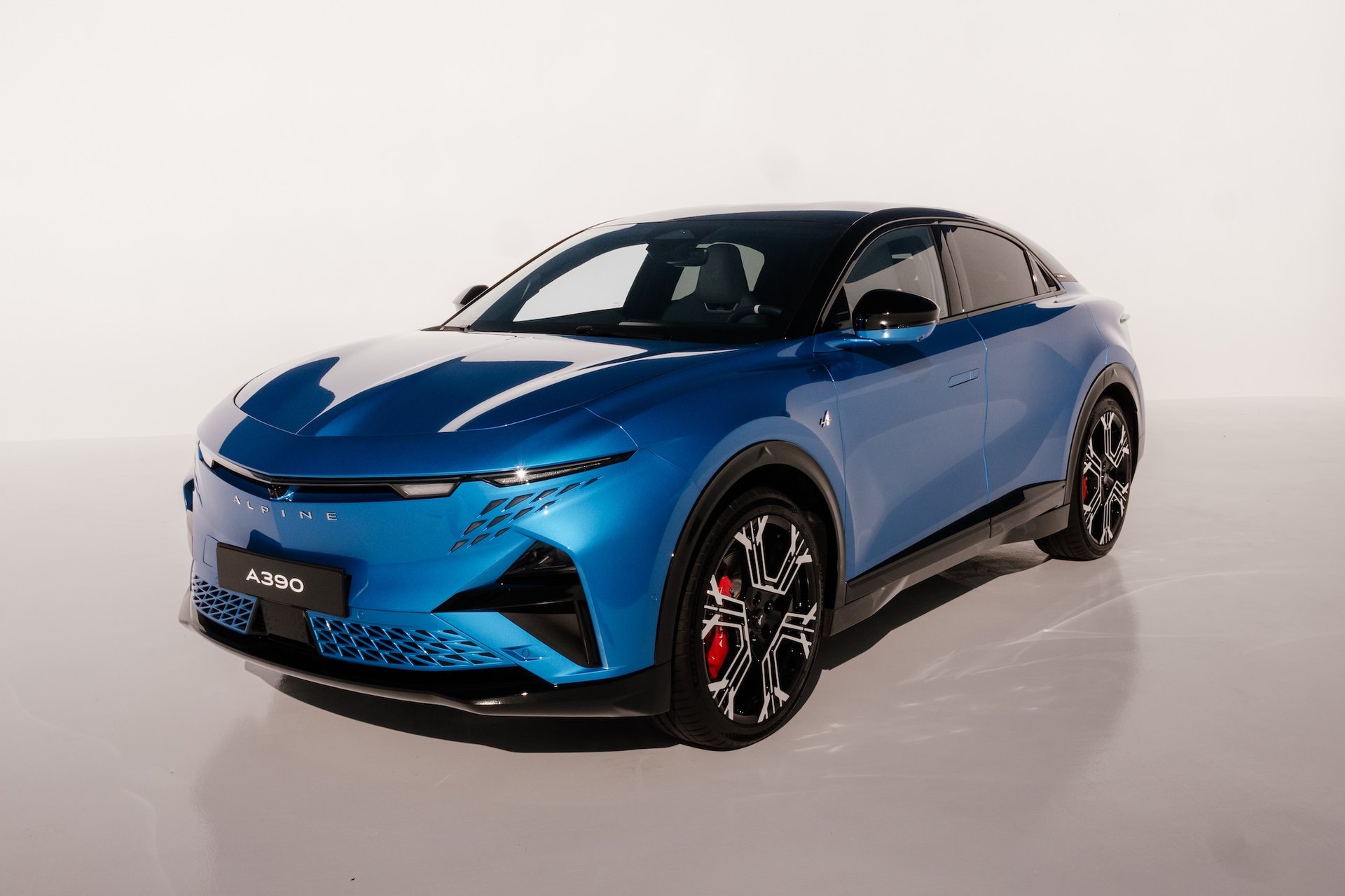
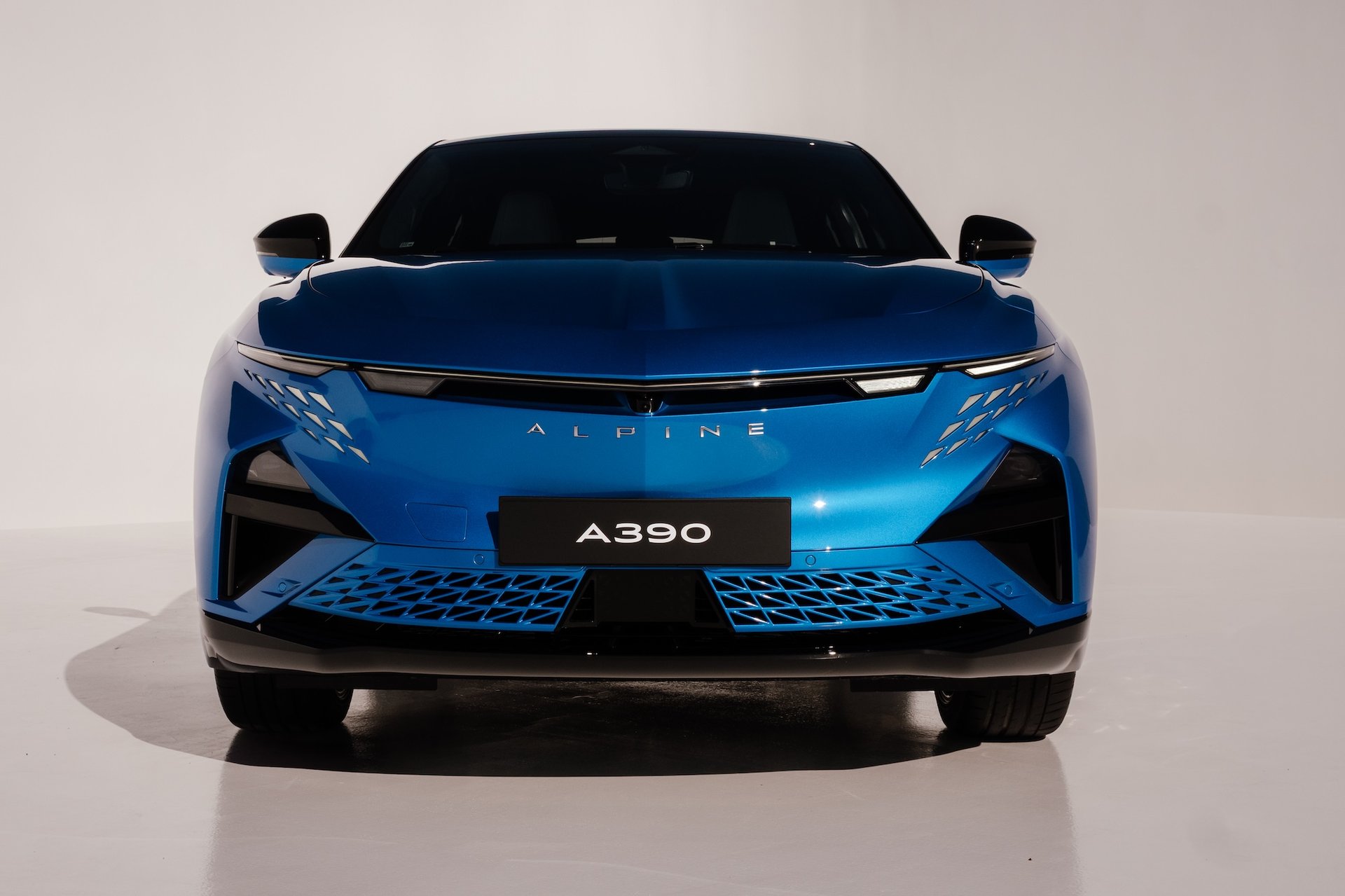
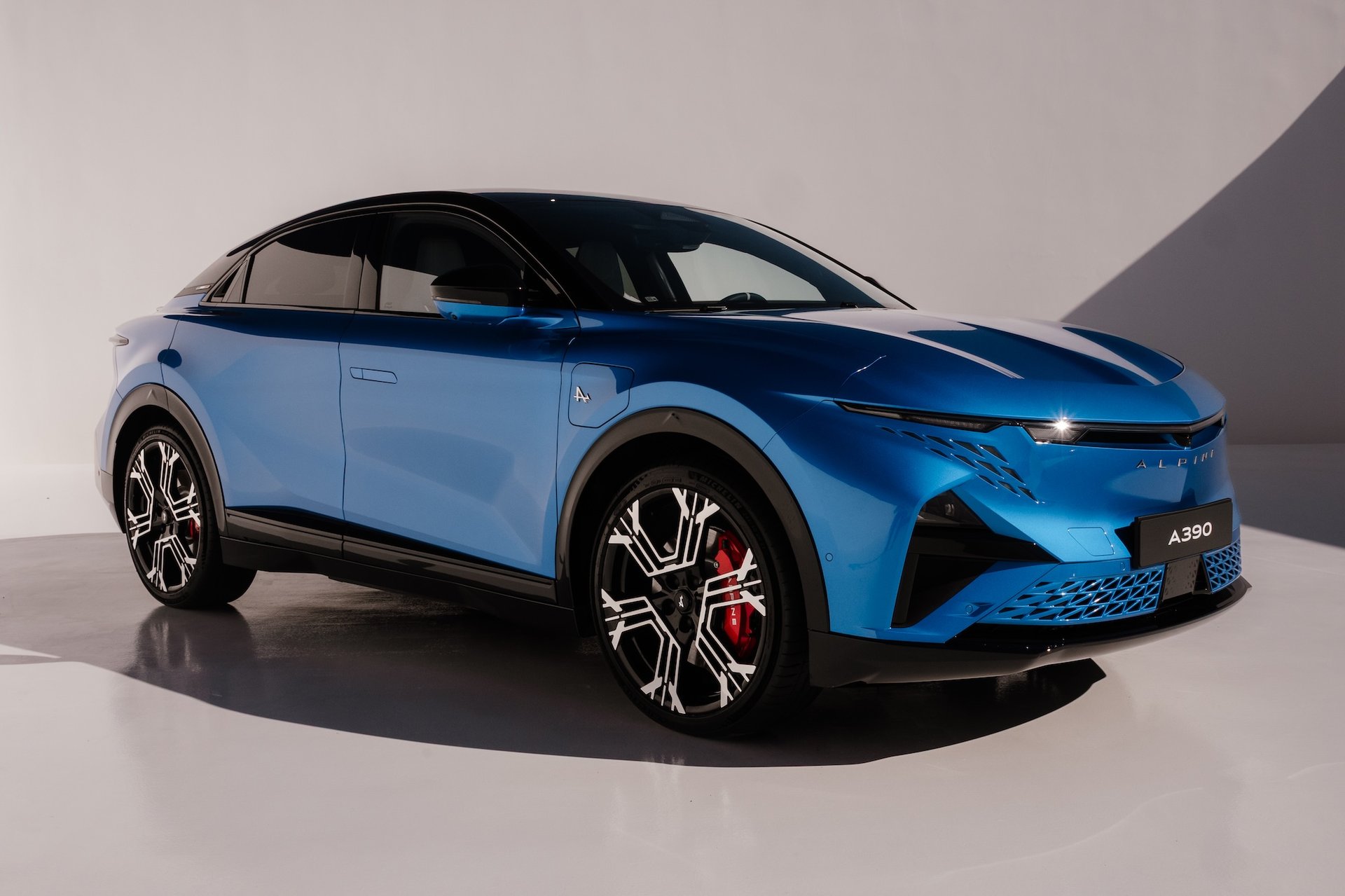
The front end immediately sets the tone. Wide — very wide — almost ostentatious in its use of taut surfaces and bold lighting signatures. The horizontal light bar and triangular motifs create a resolutely futuristic language, far from the nostalgic nods some might have expected. You sense a desire to establish a new Alpine design grammar: more graphic, more assertive, almost theatrical.
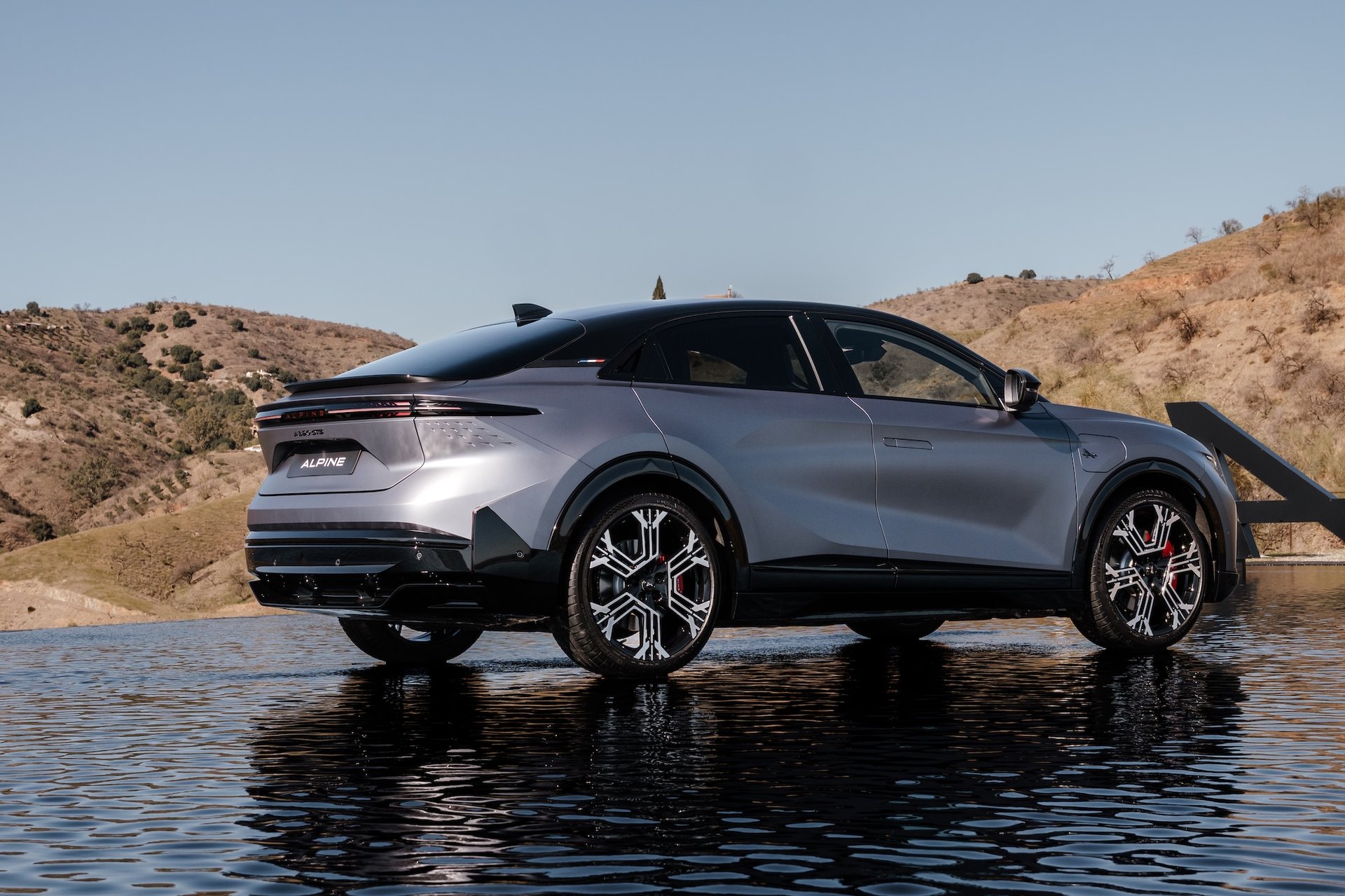
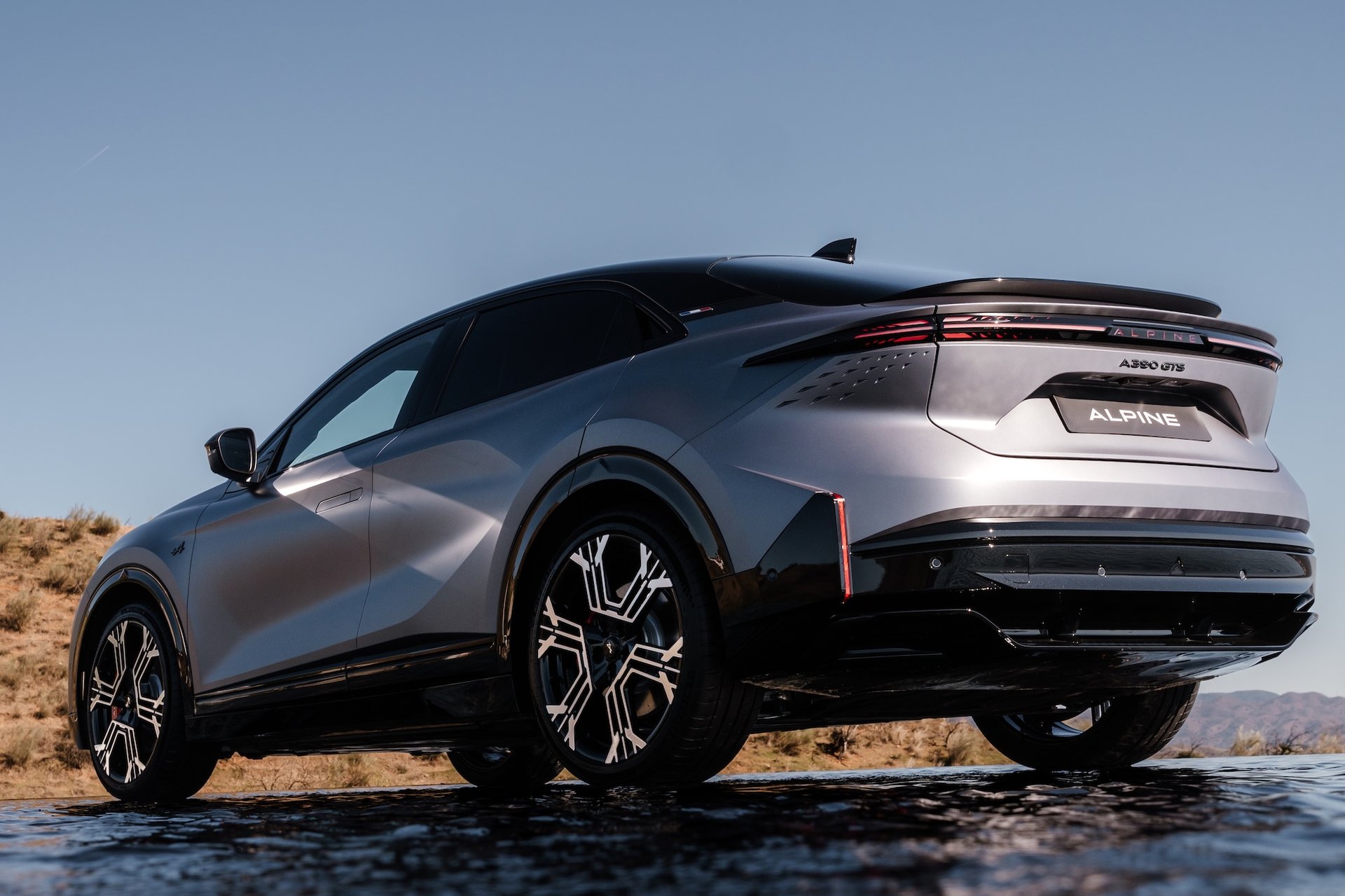
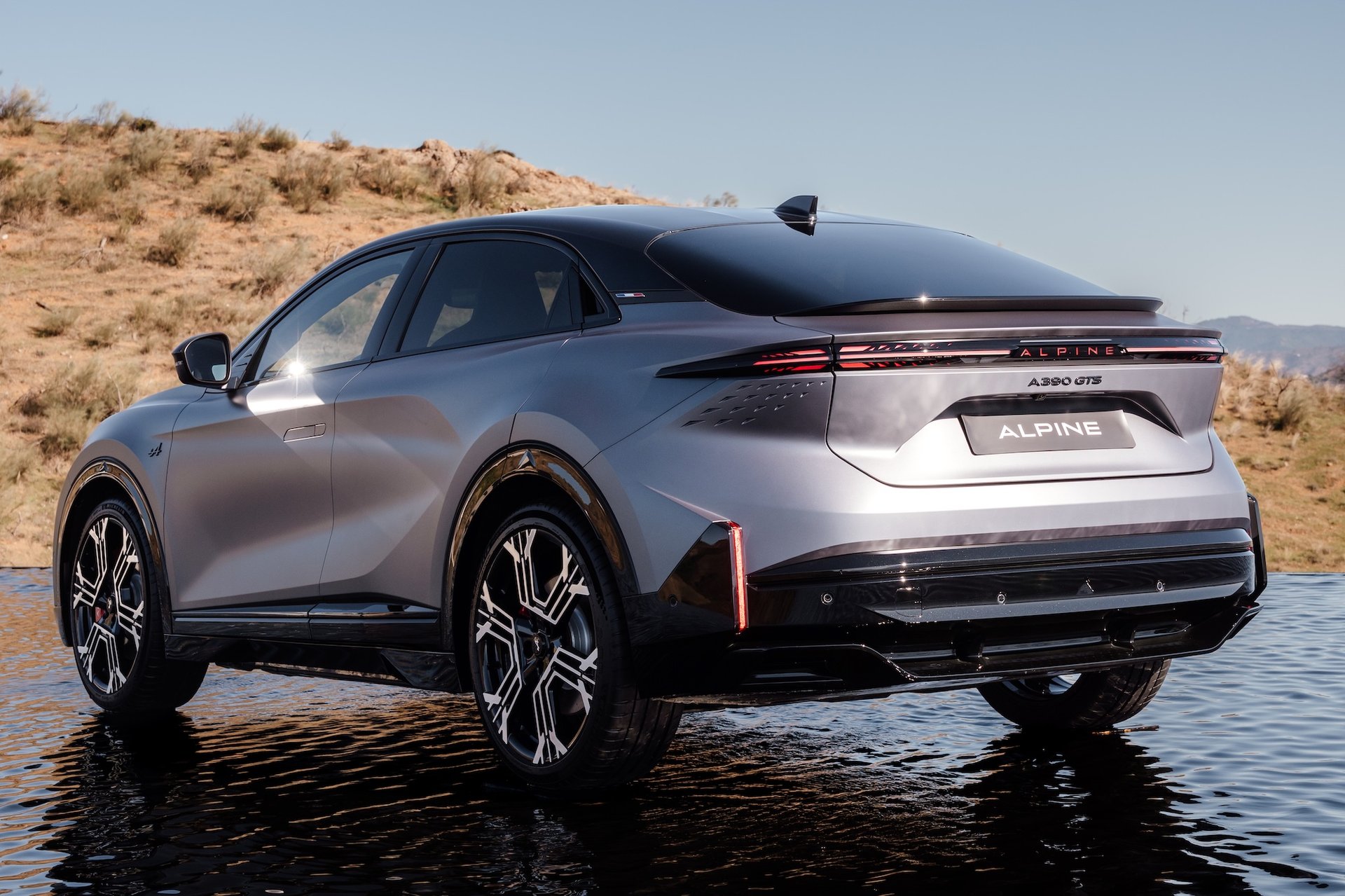
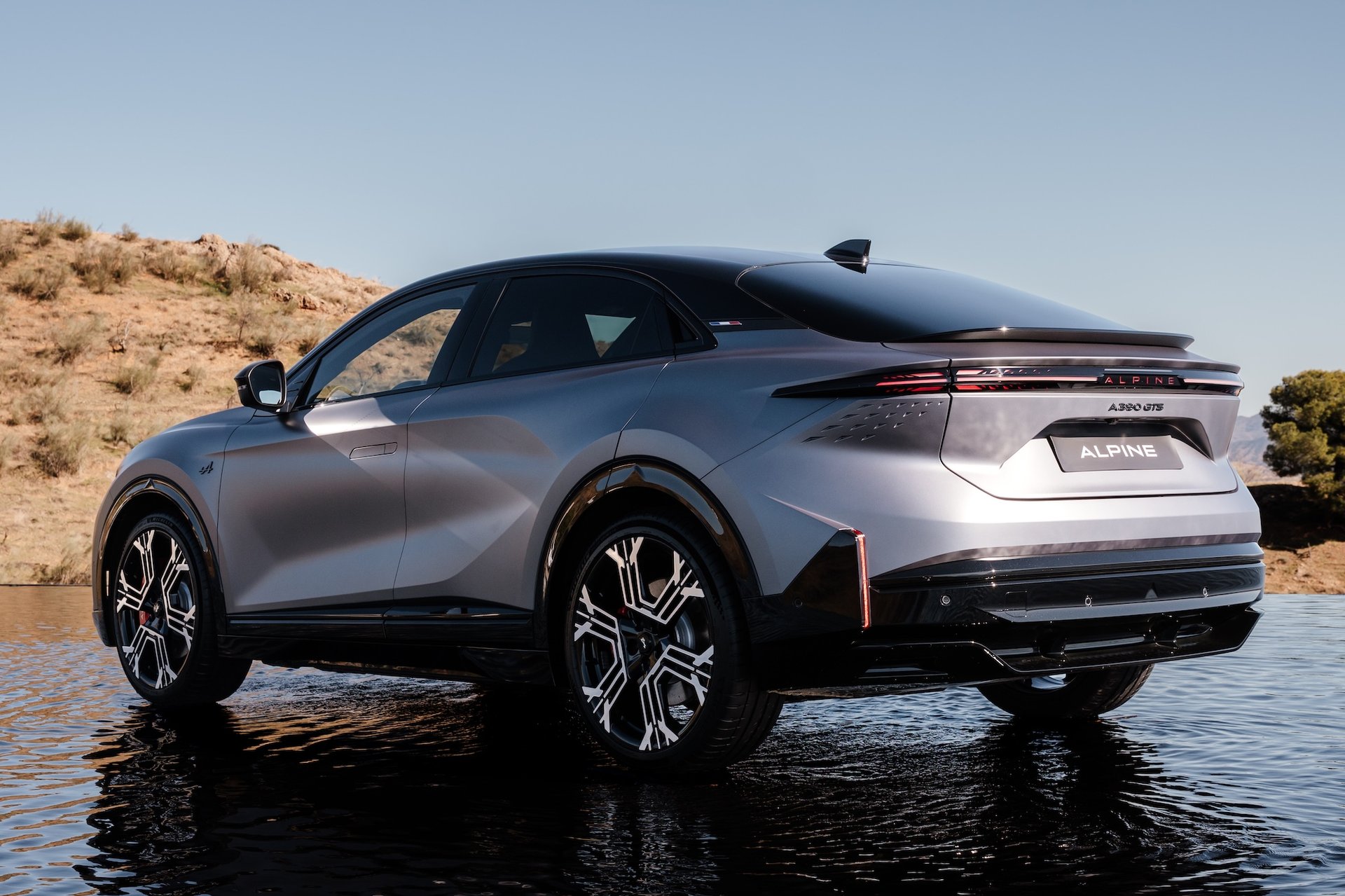
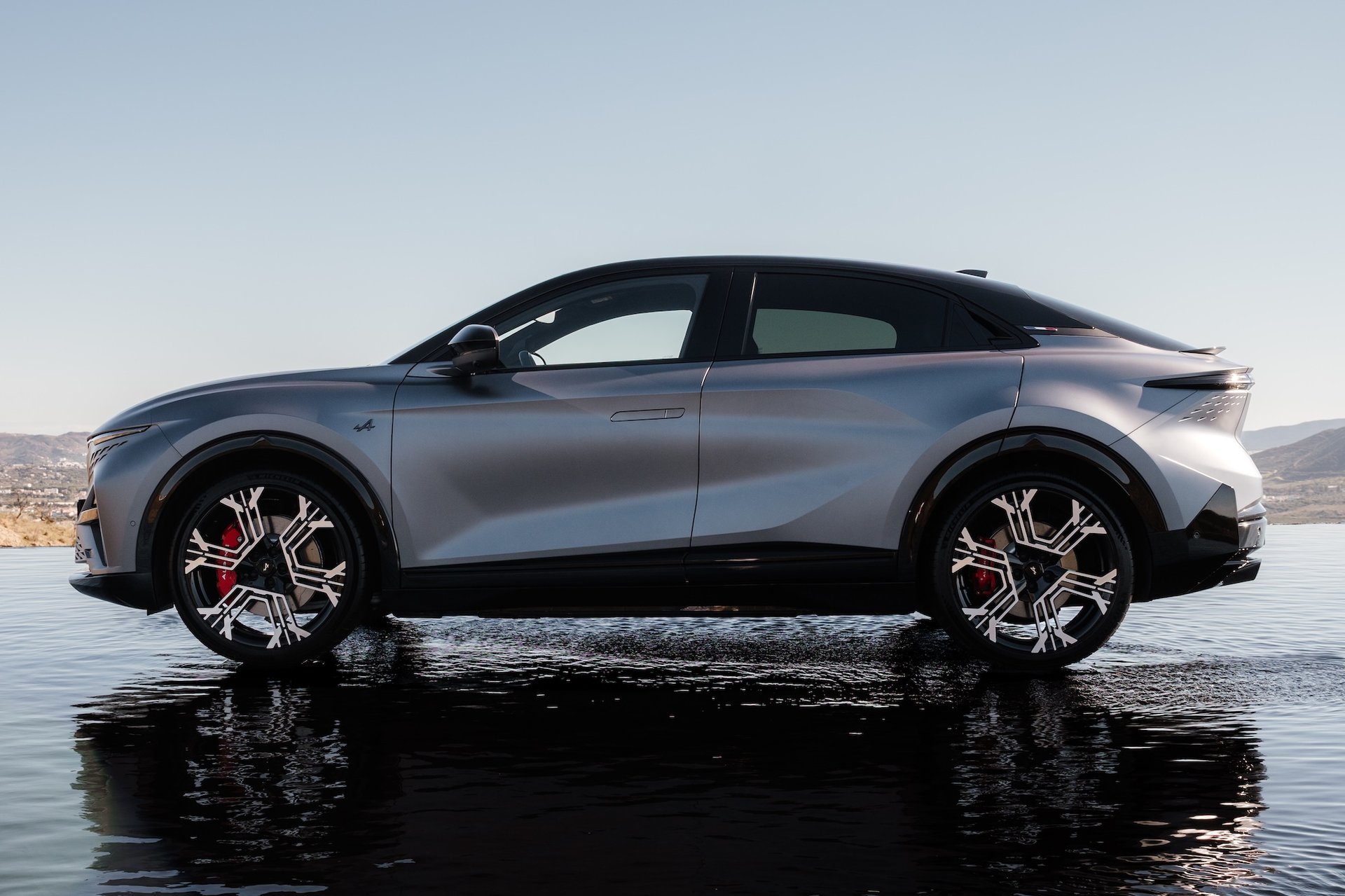
The profile tells a different story — subtler, more heir-like. The roofline flow, the continuous rear pillar that melts into the wing, the way the side stretches without weighing itself down: these are true designer gestures, and they discreetly echo the A110. Not a copy, not an emphatic quotation, but an unmistakable kinship. The whole gains tension where it loses bluntness: muscular but not aggressive, sculpted rather than merely drawn.
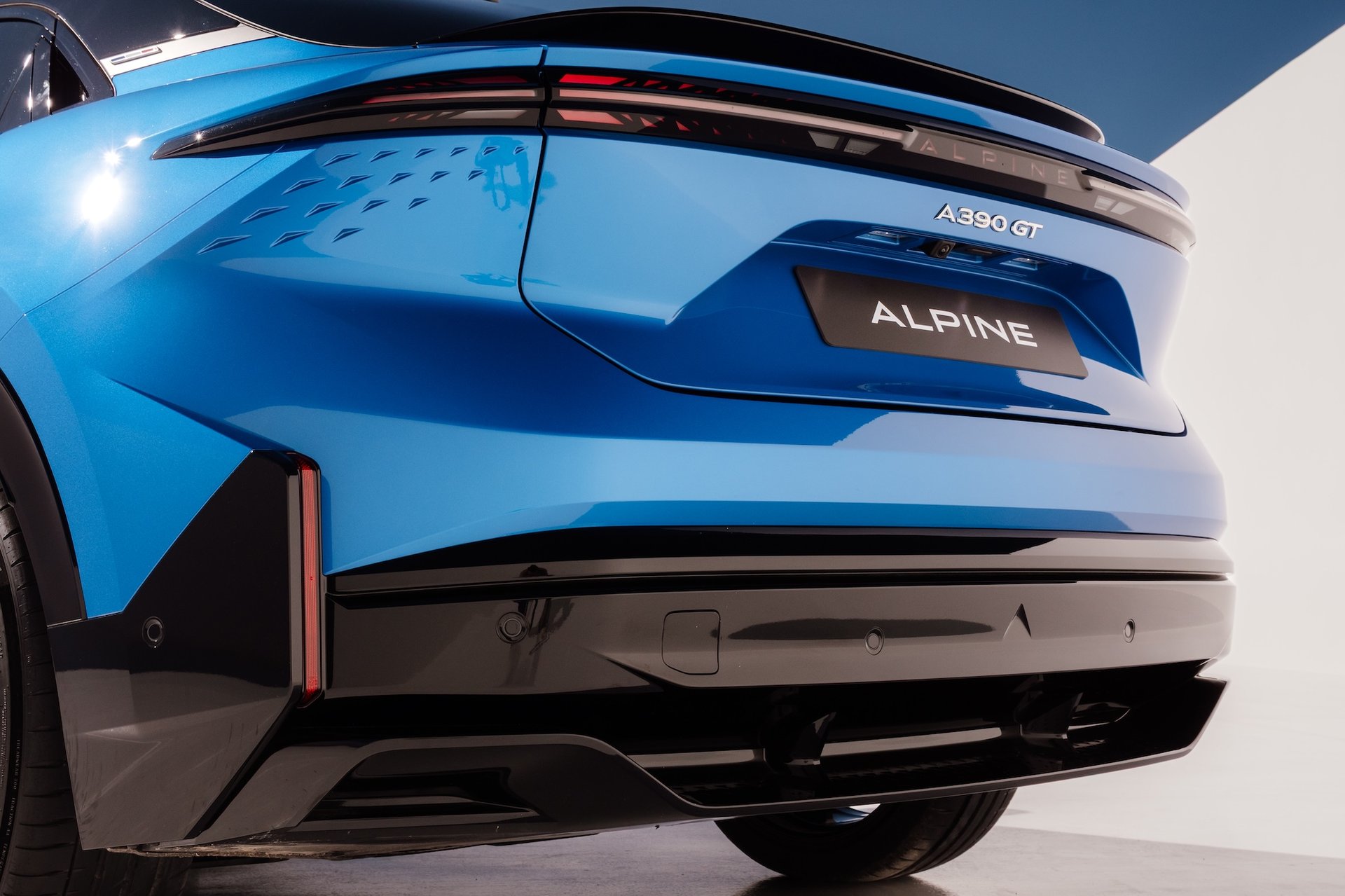
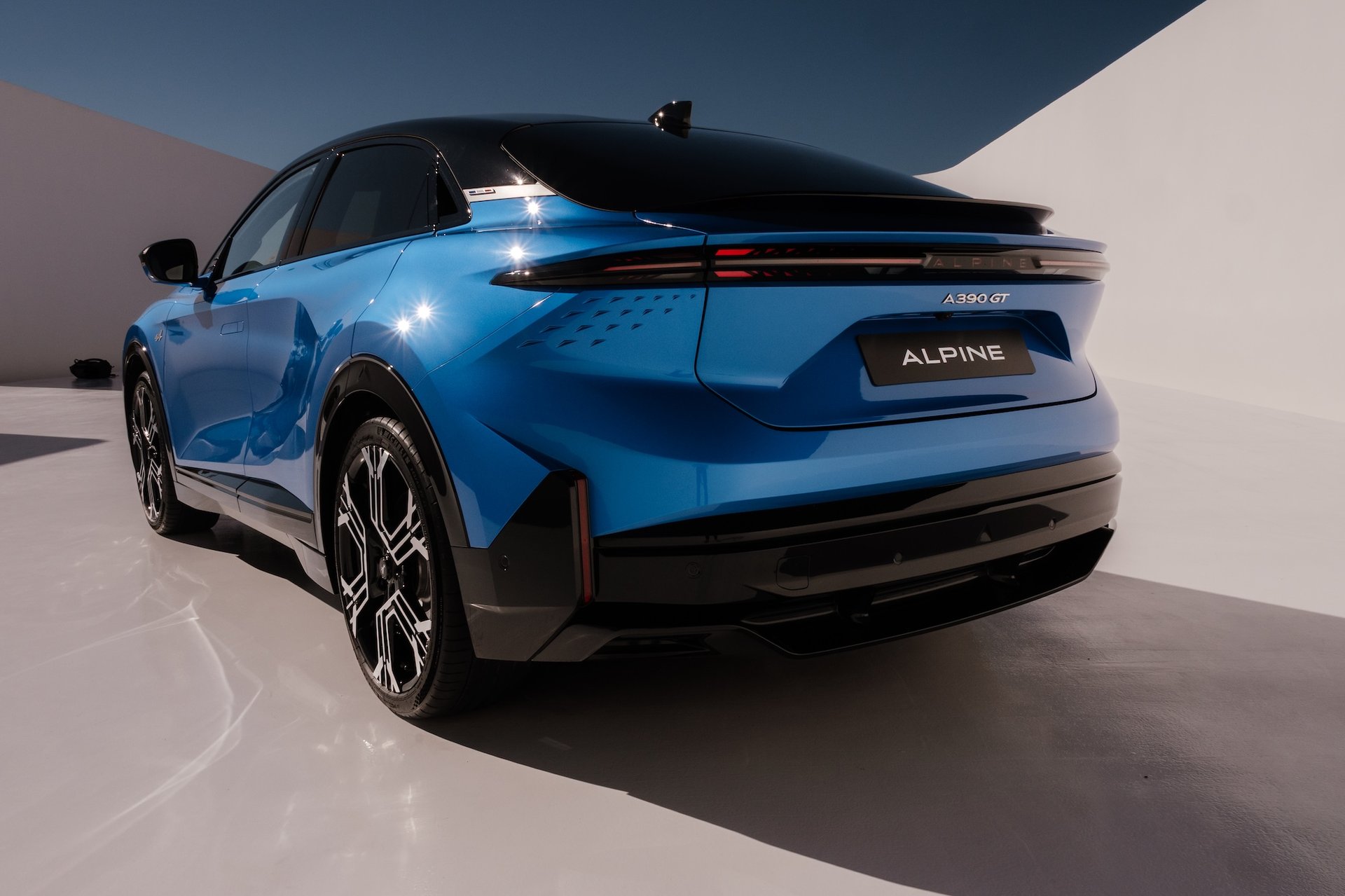
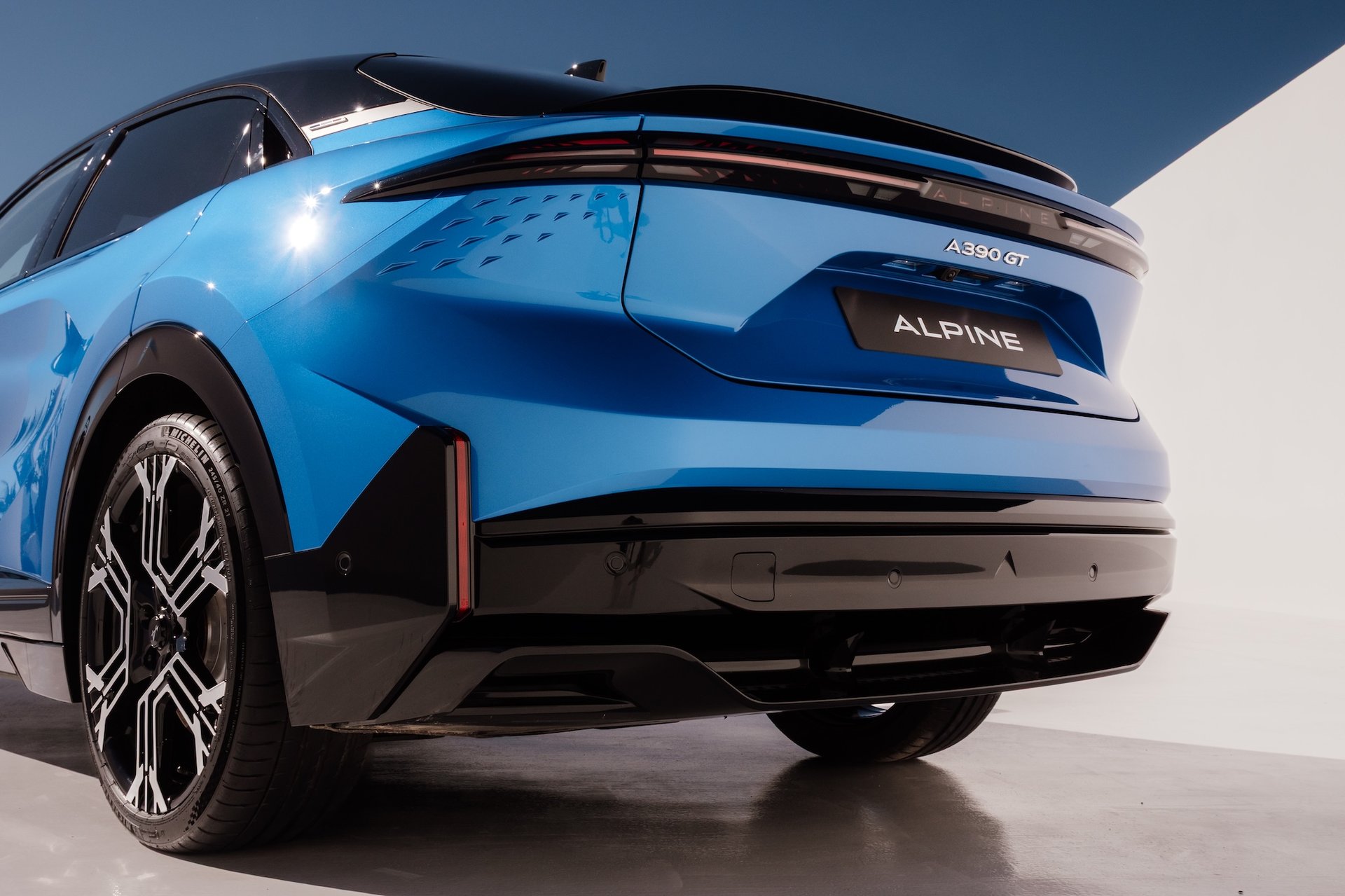
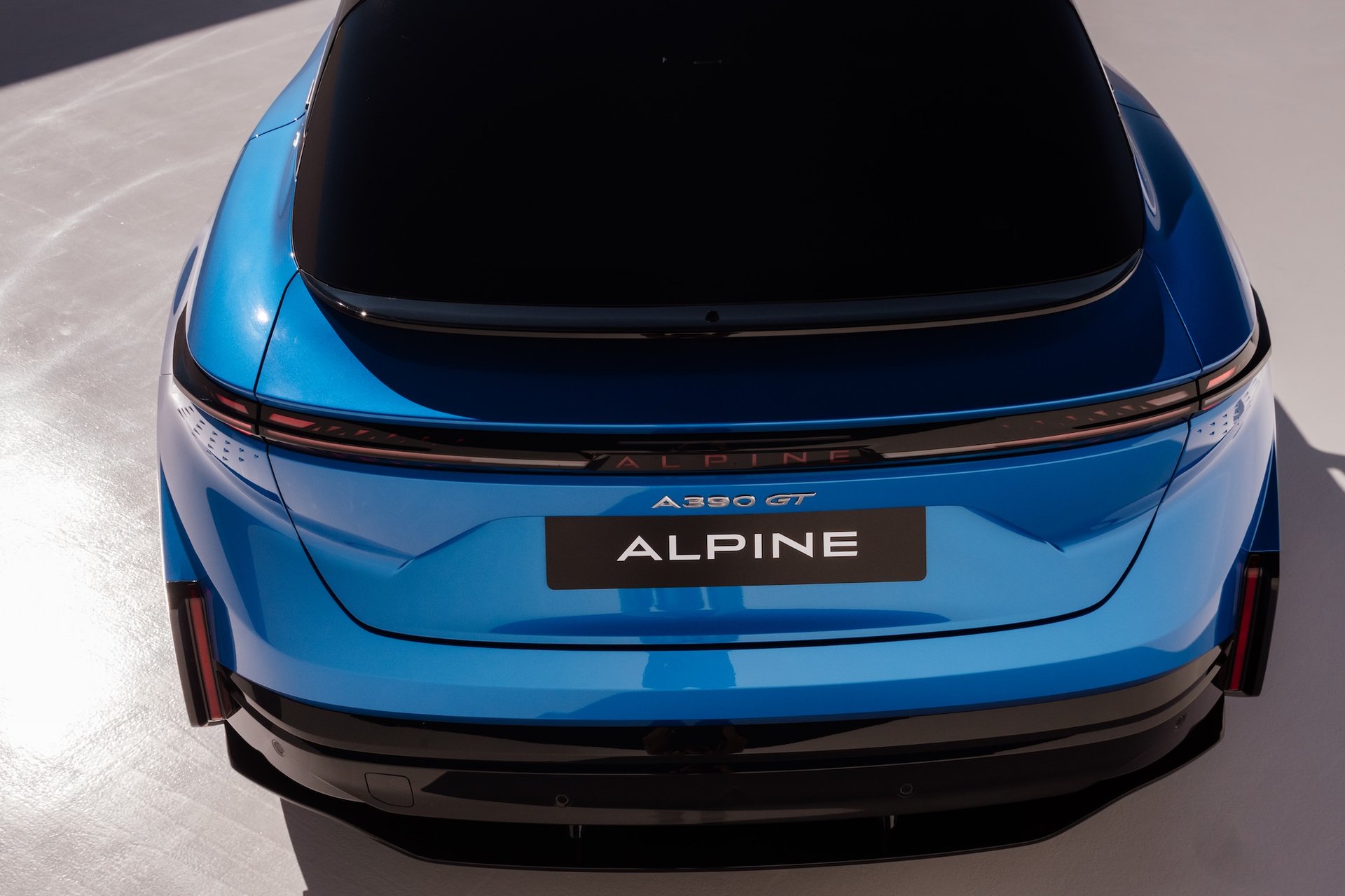
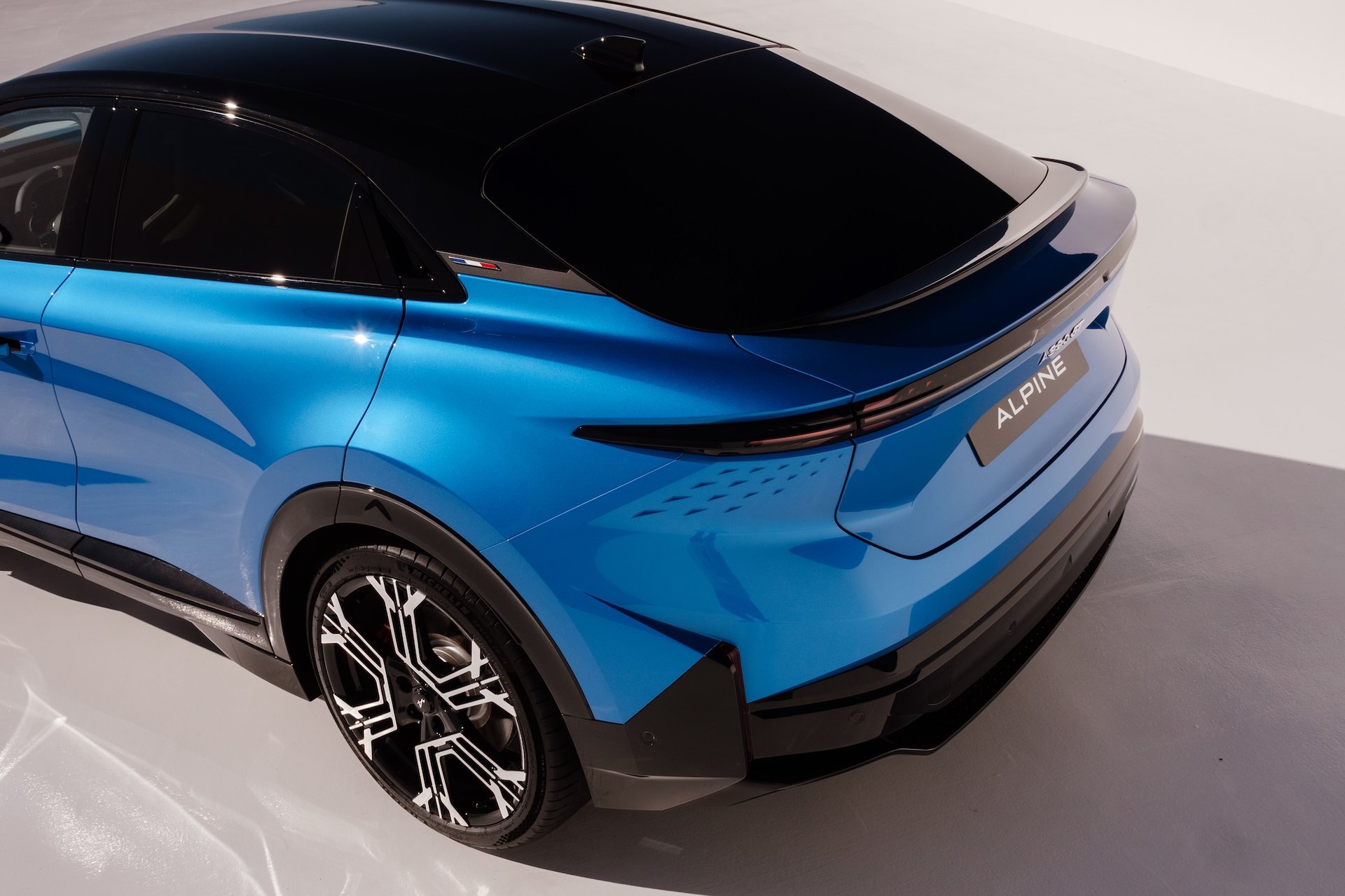
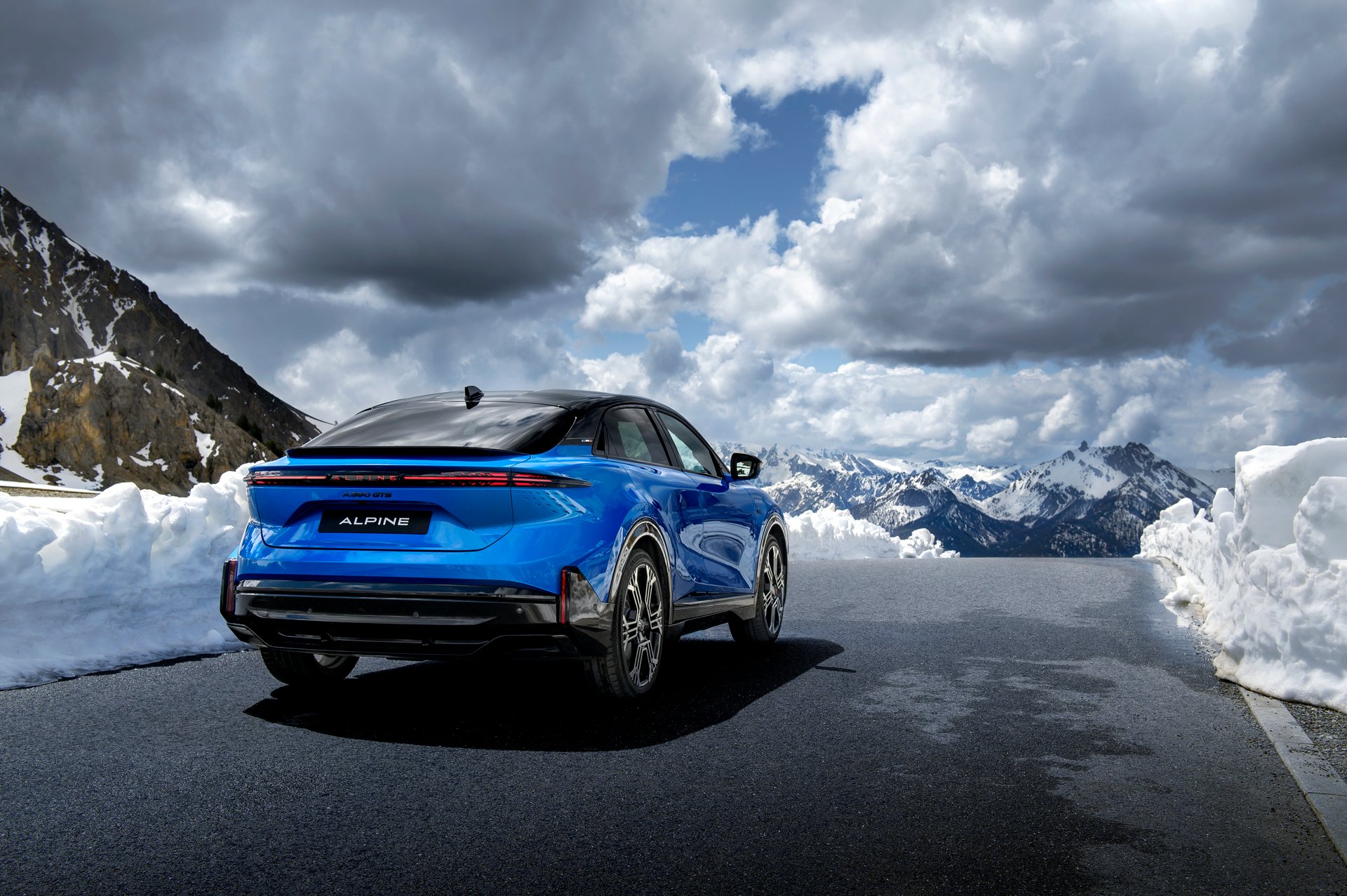
The rear stands in deliberate contrast to the boldness of the nose. More restrained, more horizontal, almost calm. Slim lights, a sharply raked rear window, and that horizontal ALPINE signature form a clear break: theatricality up front, understatement at the back.
But it is also here that the gap between the Alpine A390 β show car and the production reality becomes most evident.
The concept promised an almost sculptural rear end, shaped like an integrated aerodynamic element, with a pronounced diffuser and carved volumes giving the fastback a near-supercar attitude. Production, inevitably, required choices: streamlined components, simplified surfaces, farewell to the spectacular diffuser — impossible to homologate and too costly to manufacture at scale.
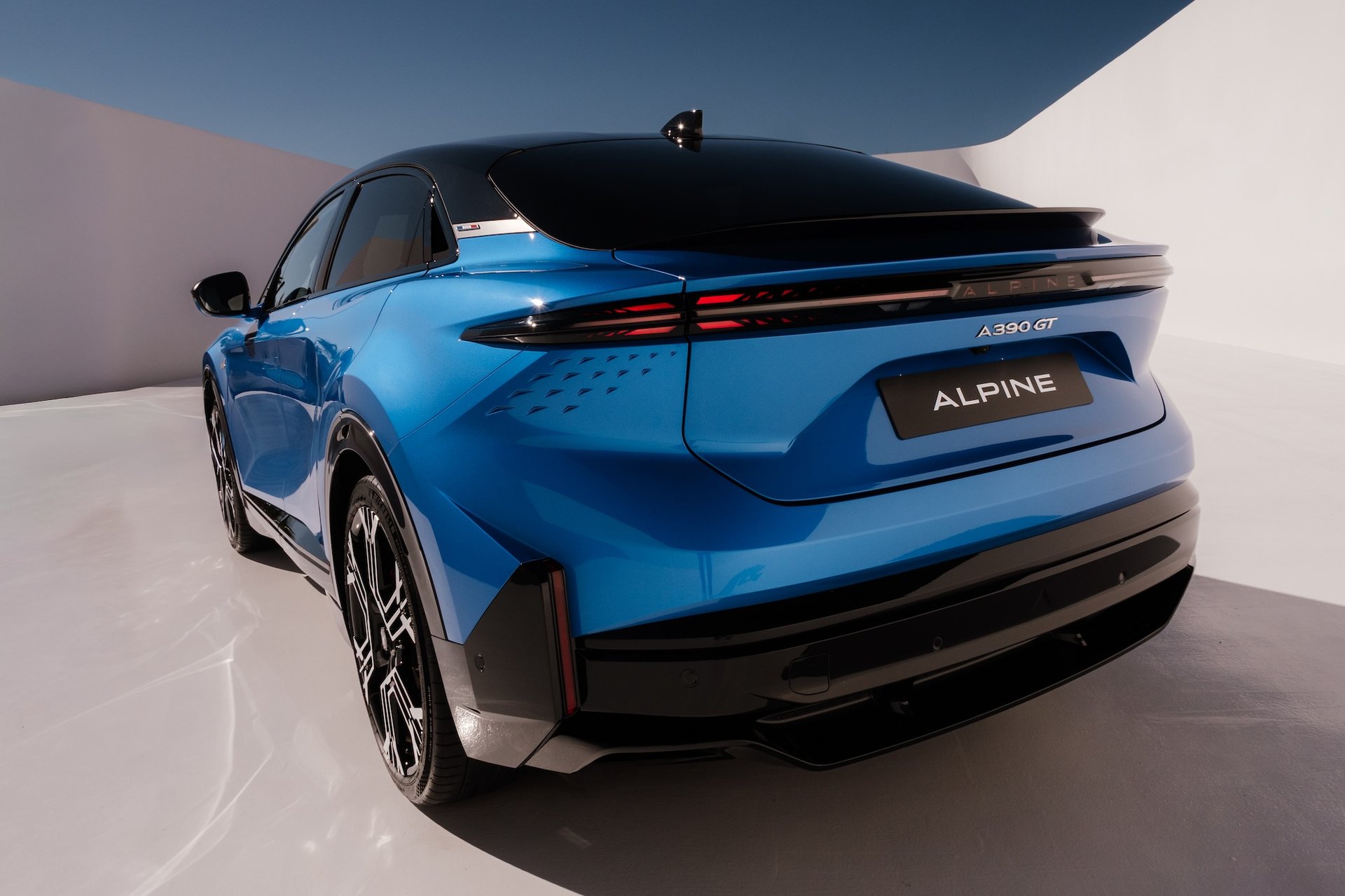
The light bar remains, faithful to the original idea, but the rear bumper has been reduced to its essentials, animated only by slender lateral flaps meant as much for aero management as for visually lightening the mass.
It isn’t a failure — just more measured than what Alpine once hinted.
In this GT configuration, the large wheels significantly influence the car’s stance. They fill the arches perfectly and visually lower the silhouette, giving the impression of a car more planted, almost lower than its actual ground clearance suggests. Their design — split spokes with small chamfers — subtly evokes a snowflake motif.
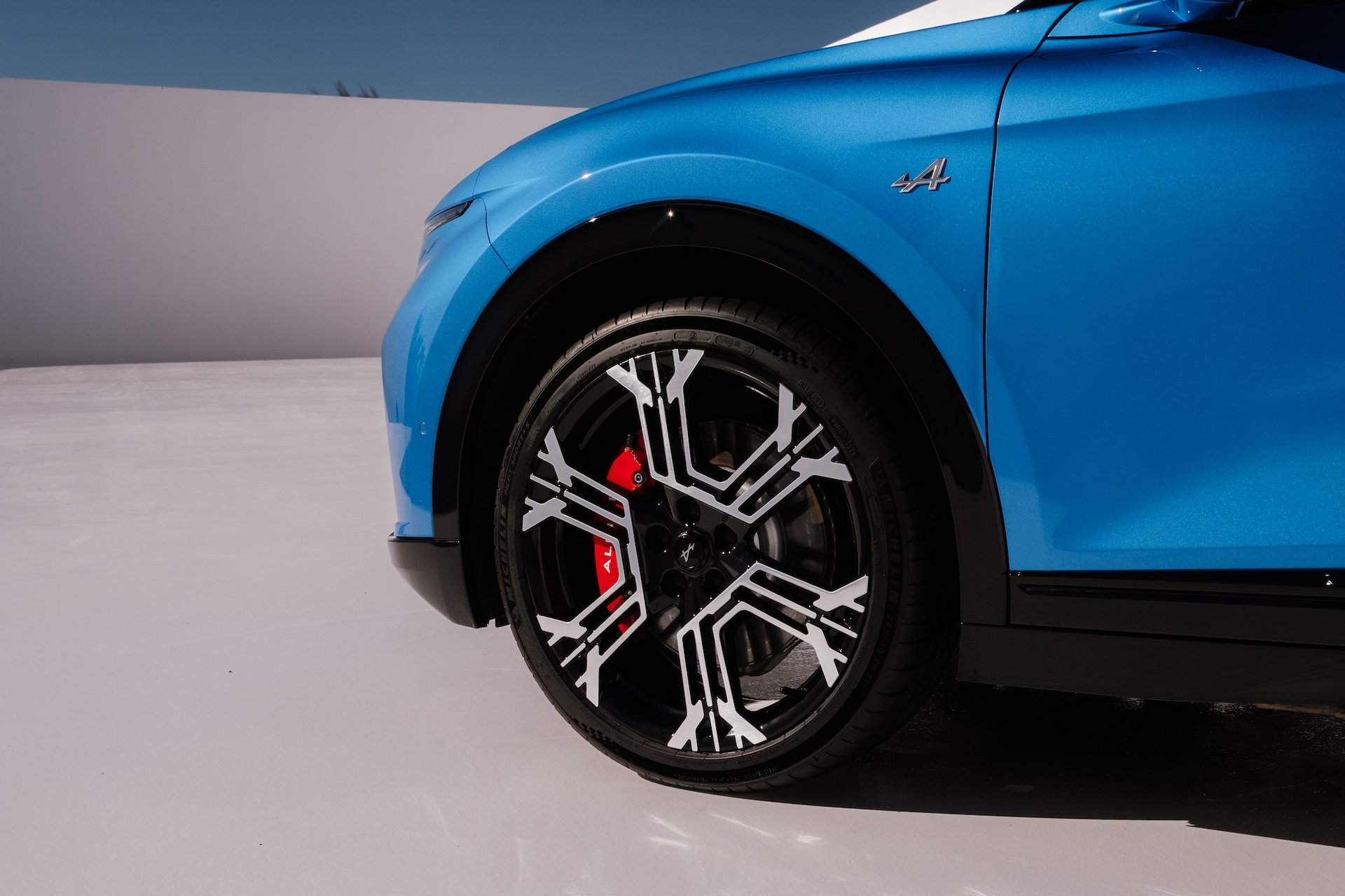
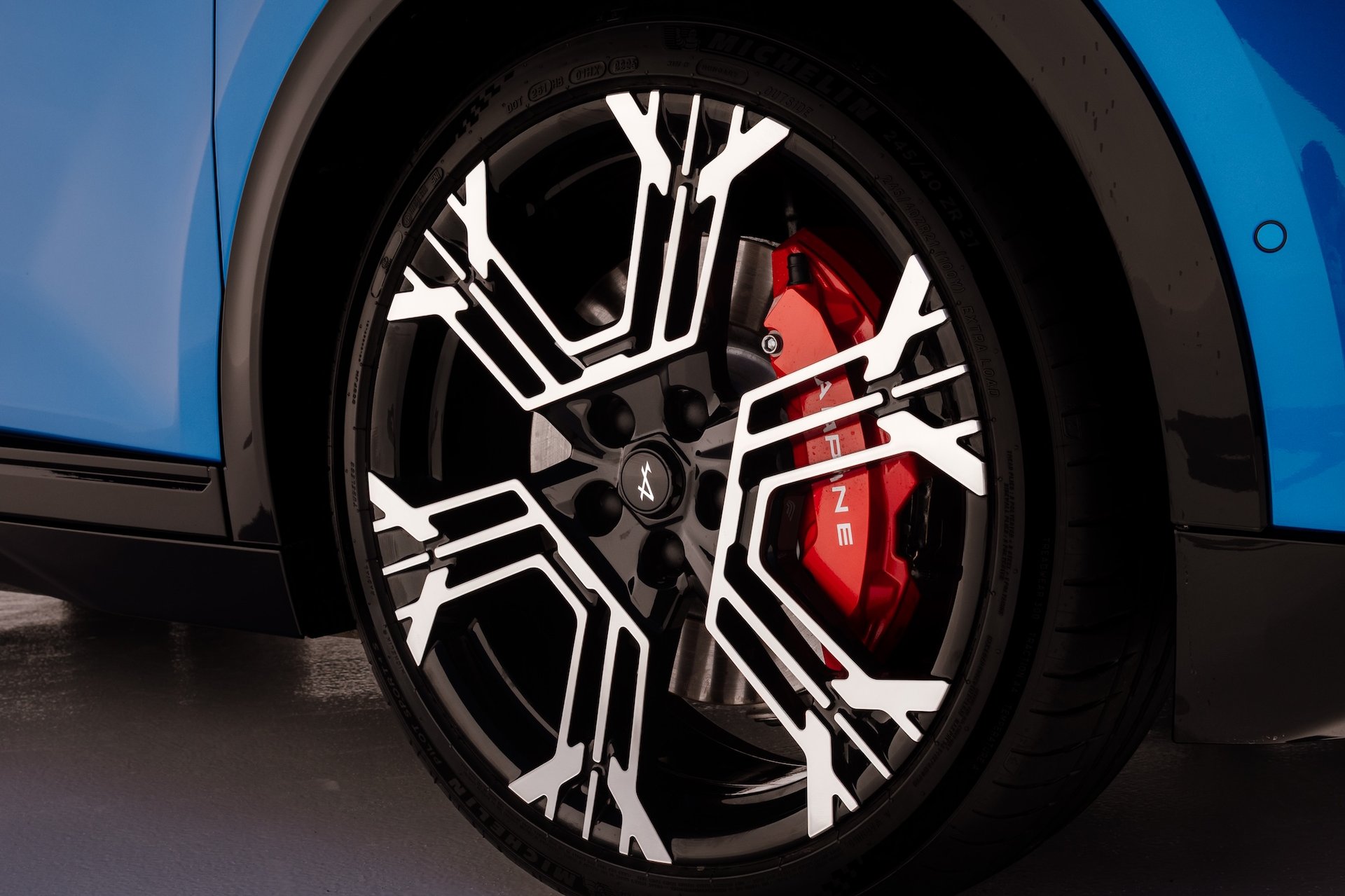
As for the Alpine Vision Blue paintwork, it performs its usual magic: a hue that densifies the shapes, catches light without reflecting it harshly, and instantly transforms the object into something undeniably sporty before the start button is even pressed.
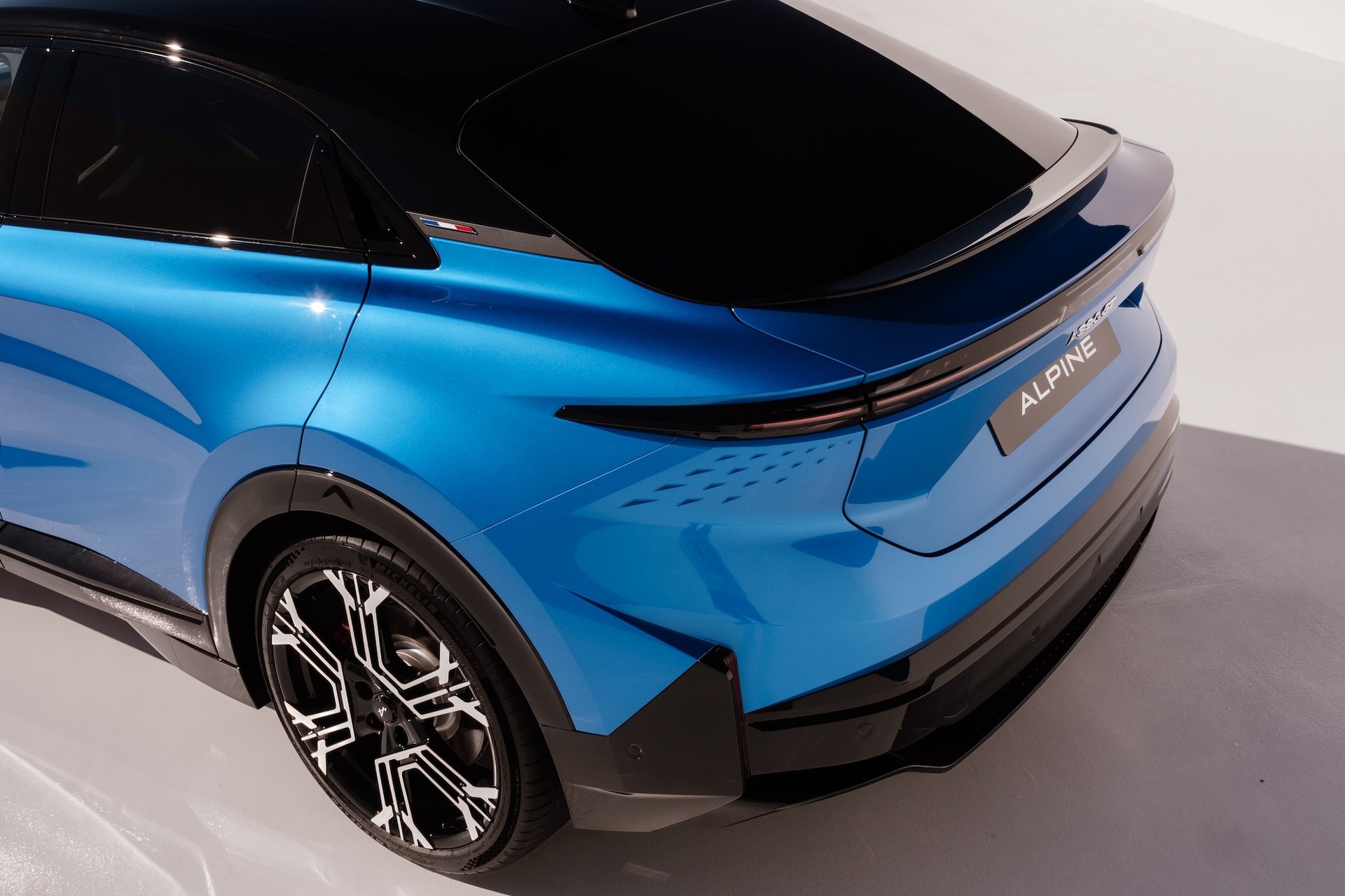
The rear quarter window deserves special mention. It is the only area where one finds an almost literal gesture from the A110: a curve, a flow, a direct lineage to the berlinette. It encapsulates the A390’s design ethos: a completely new car that still acknowledges where it comes from — not through easy quotes, but through a few carefully placed lines, like a discreet confession.
In truth, the A390 GT looks far more convincing in person than in images. The proportions tighten, the volumes sharpen, the stance gains purpose. It has nothing of the heavy or awkward object its dimensions could have suggested. It belongs to a different visual category entirely: that of sporty fastbacks, those hybrid forms that don’t need to remind you of their size to project character.
And it’s precisely here that this Alpine makes its point: it has presence. Real presence.
III. Interior
Opening the door of the A390 GT immediately brings a sense of familiarity: the atmosphere and layout recall what we discovered in the A290. Same overall tone, same dashboard architecture, same ergonomic logic — except here, Alpine has moved the bar noticeably higher.
Materials feel more substantial, assembly quality has improved, and the whole cabin looks more mature and more convincing than anything the brand has offered before. It’s still not a full premium cocoon — and at €67,500, some cost-cutting remains audible — but the progress is undeniable. And fortunately so, many will say, as the A110’s level of finish would no longer be acceptable in 2025.
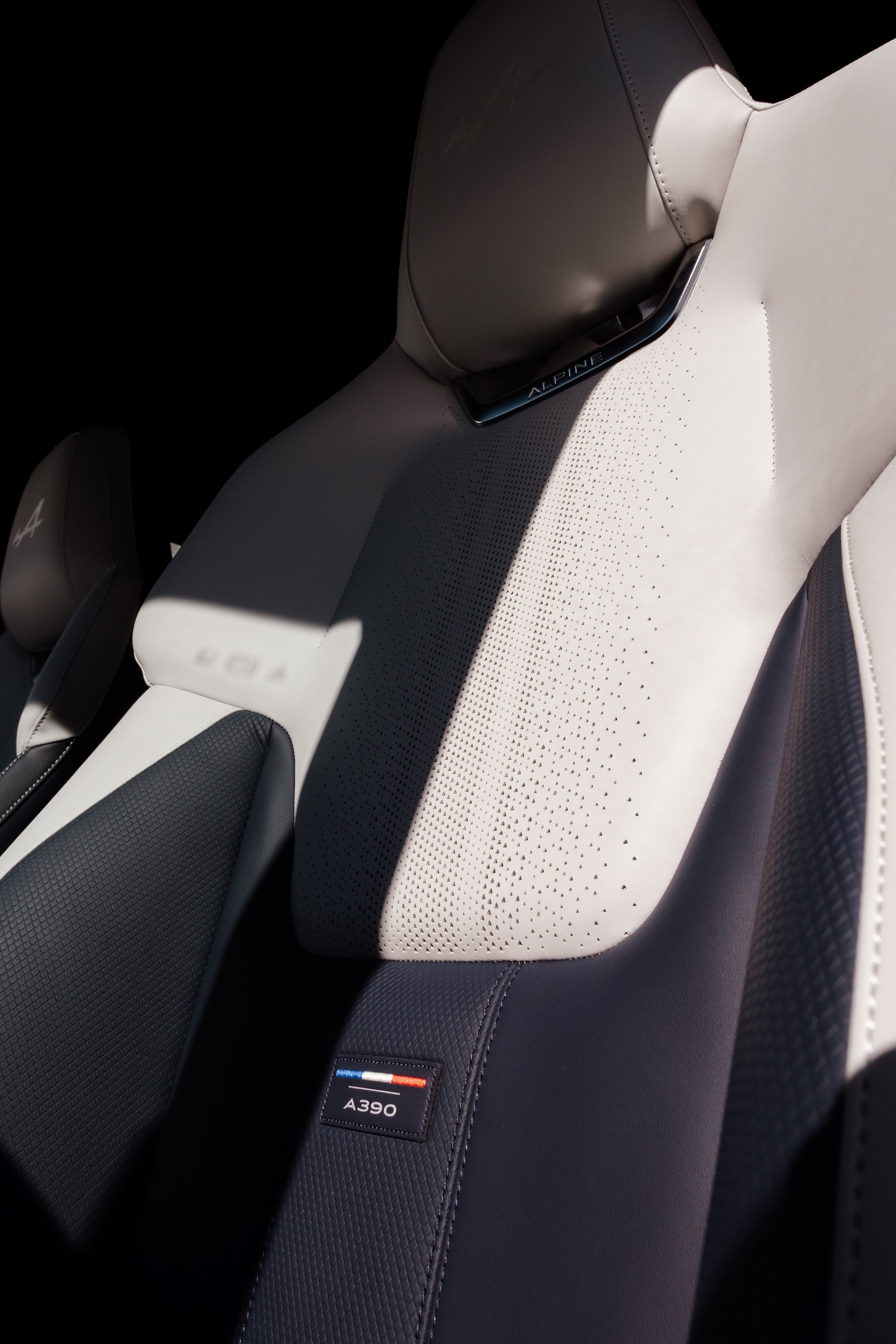
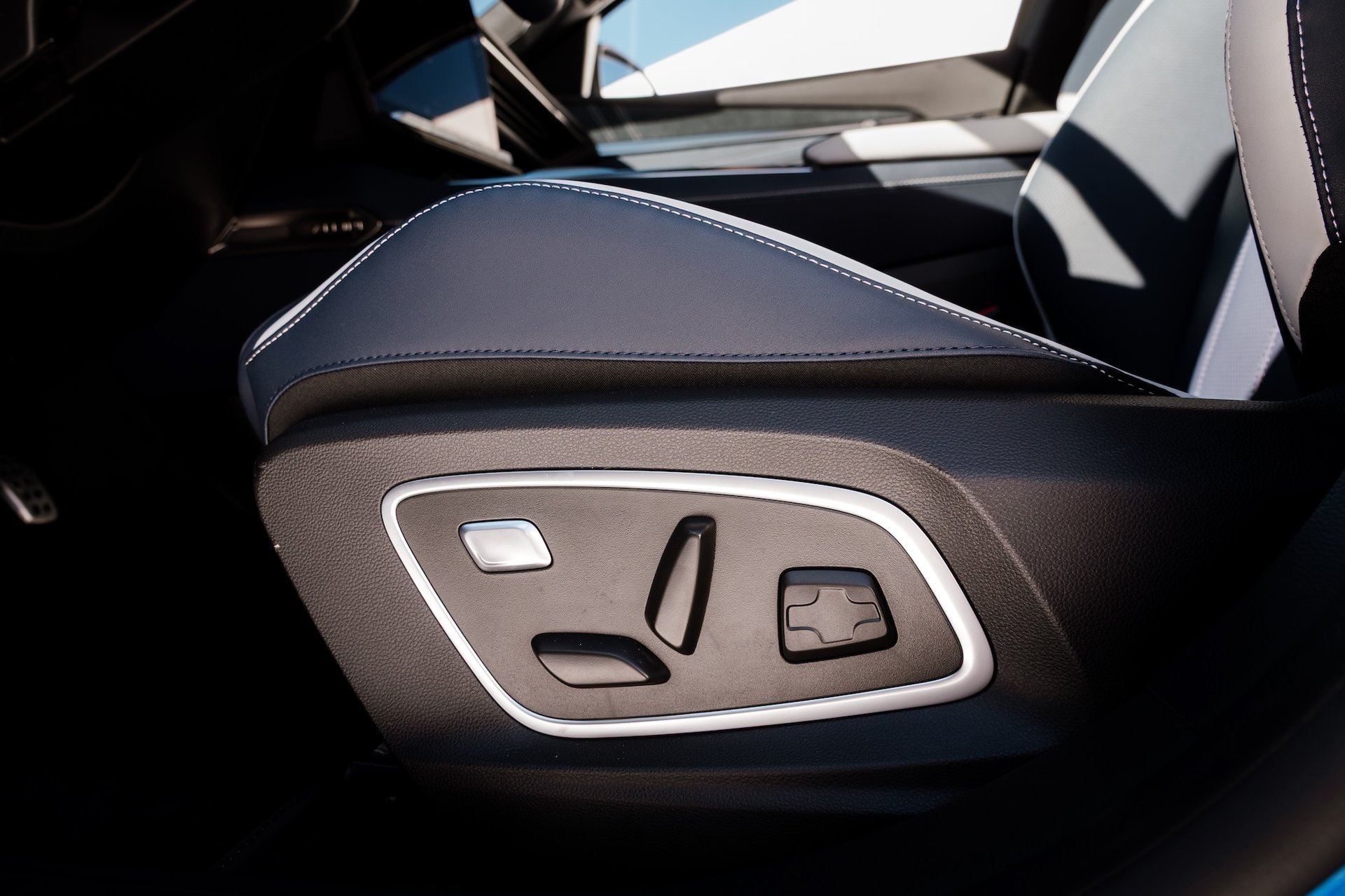
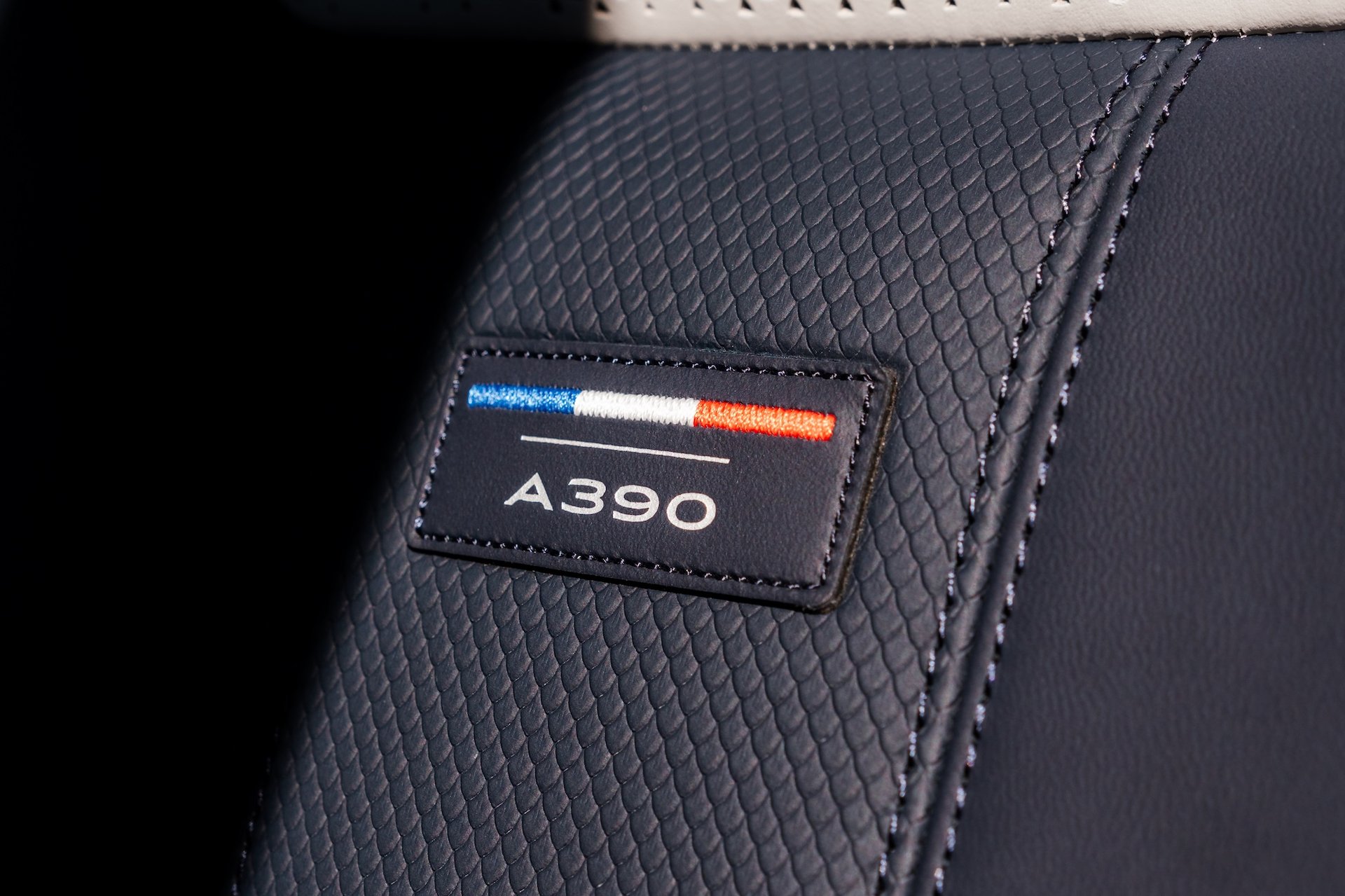
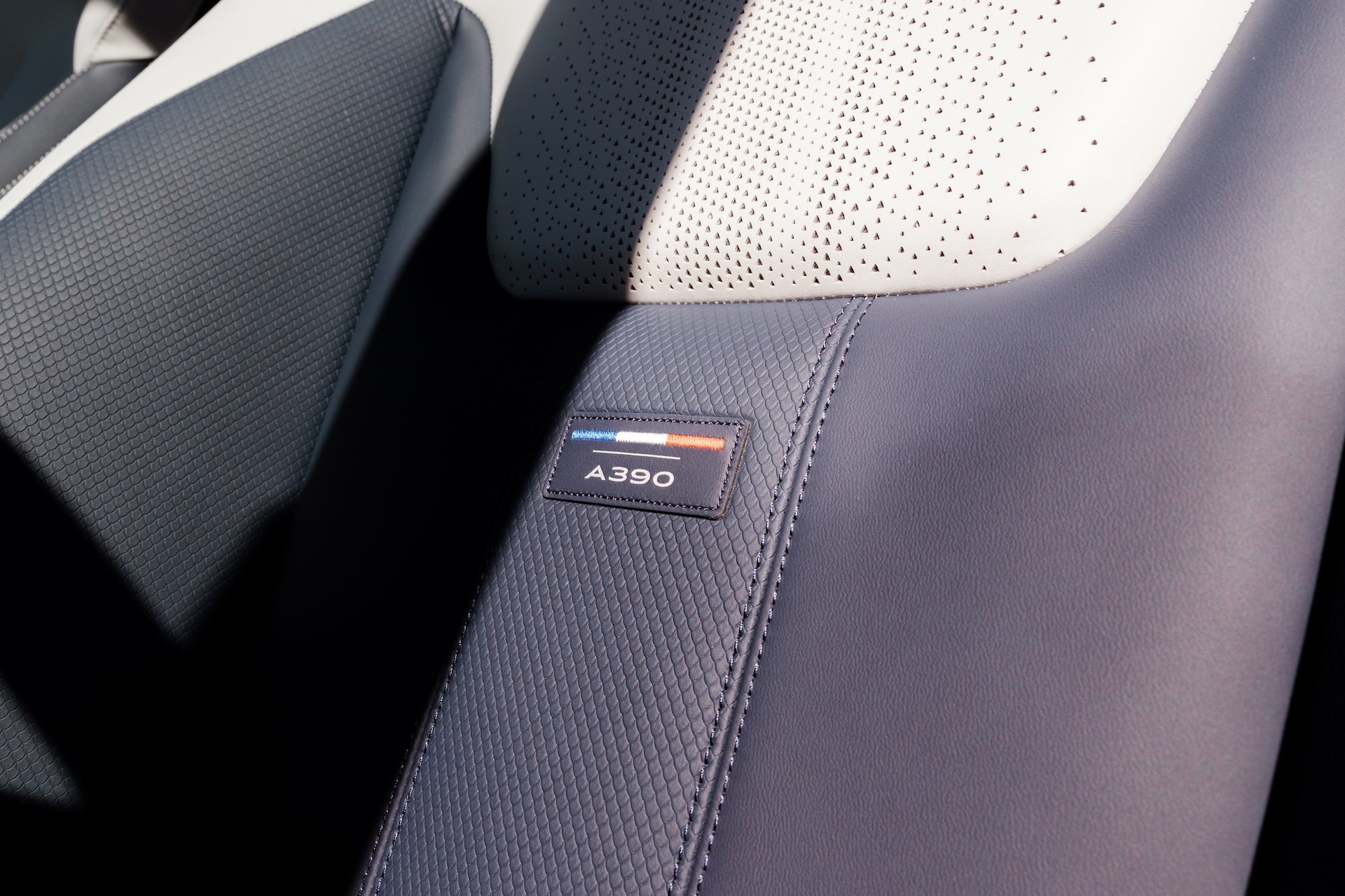
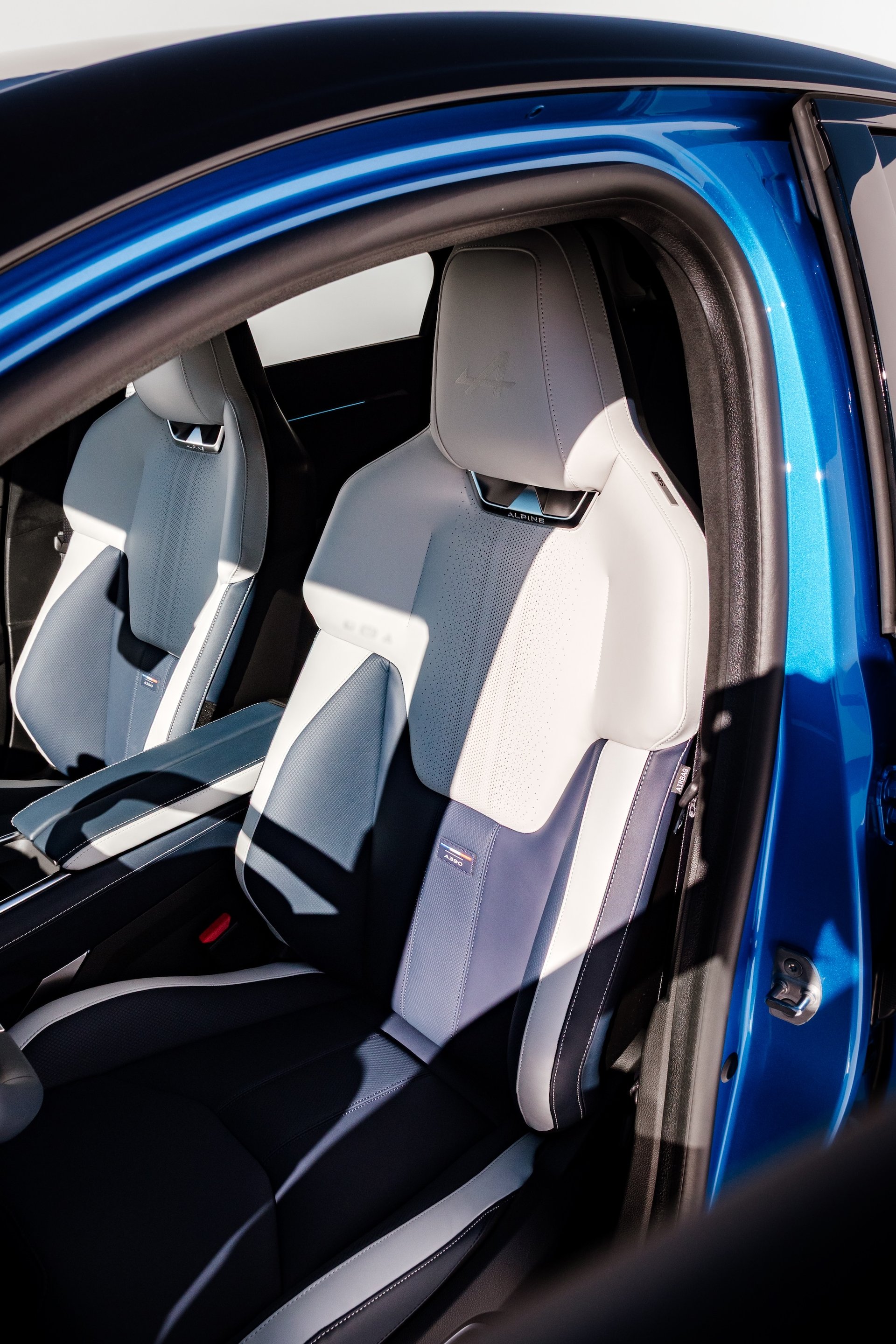
Alcantara inserts, Nappa leather touches, well-executed stitching and a few aluminium details bring the visual density now expected from a modern Alpine. Yet the Renault lineage remains visible: the overall structure, some lower plastics, and of course the dual-screen setup sourced from the group’s parts bin. Not a surprise — and not necessarily a flaw: it’s proven, ergonomic, reliable, even if the interfaces themselves are more functional than elegant.
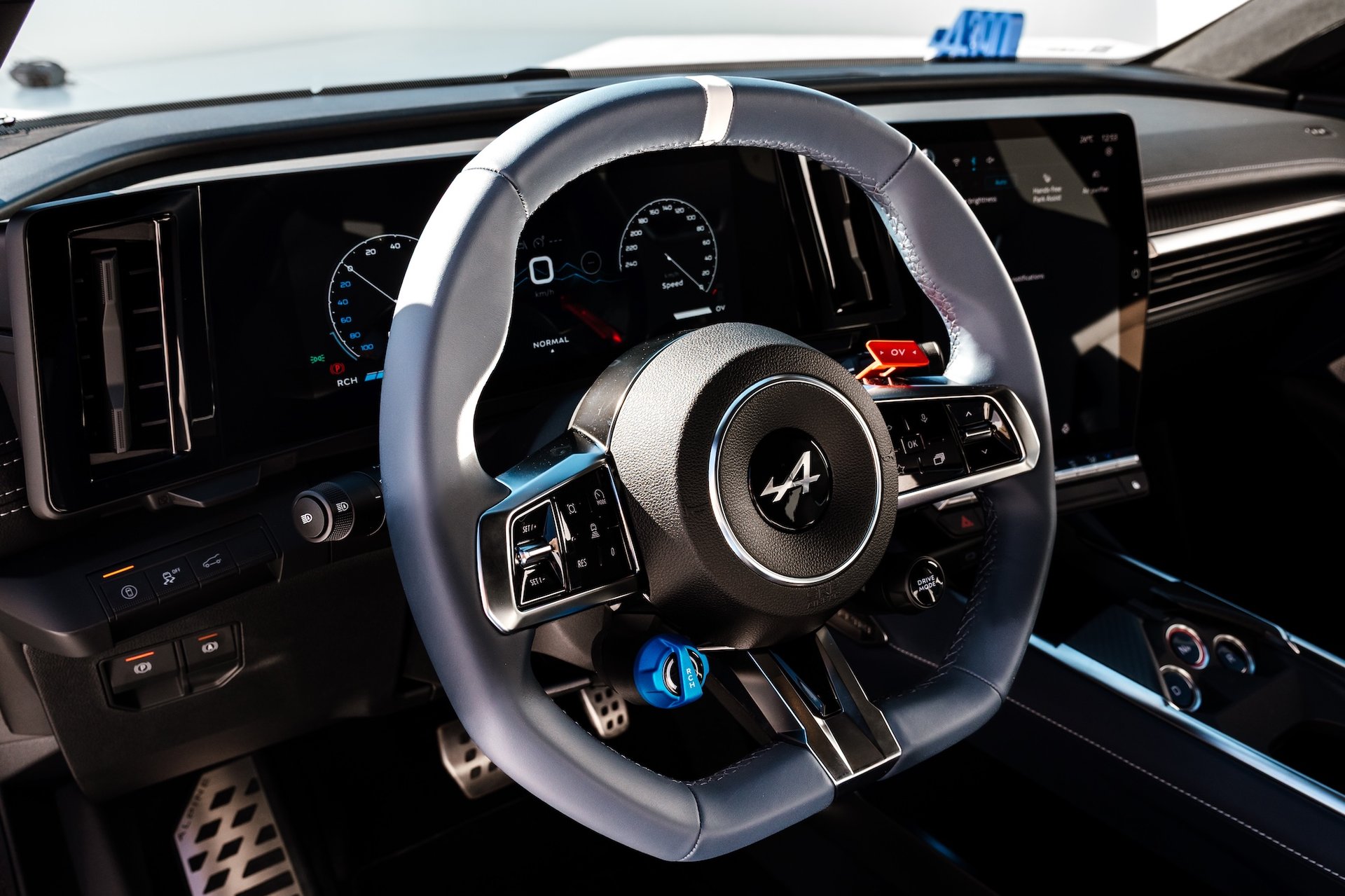
The steering wheel, shared with the A290, follows the same philosophy. Handsome but a little bulky, it lacks the visual finesse of some premium rivals. Still, the grip is excellent: thick rim, pleasant texture, well-positioned controls. The integrated buttons — including the now-famous OV “Overtake” — work properly, though the latter is more of a playful gimmick than a true performance tool. Press the accelerator firmly and you will get exactly the same result.
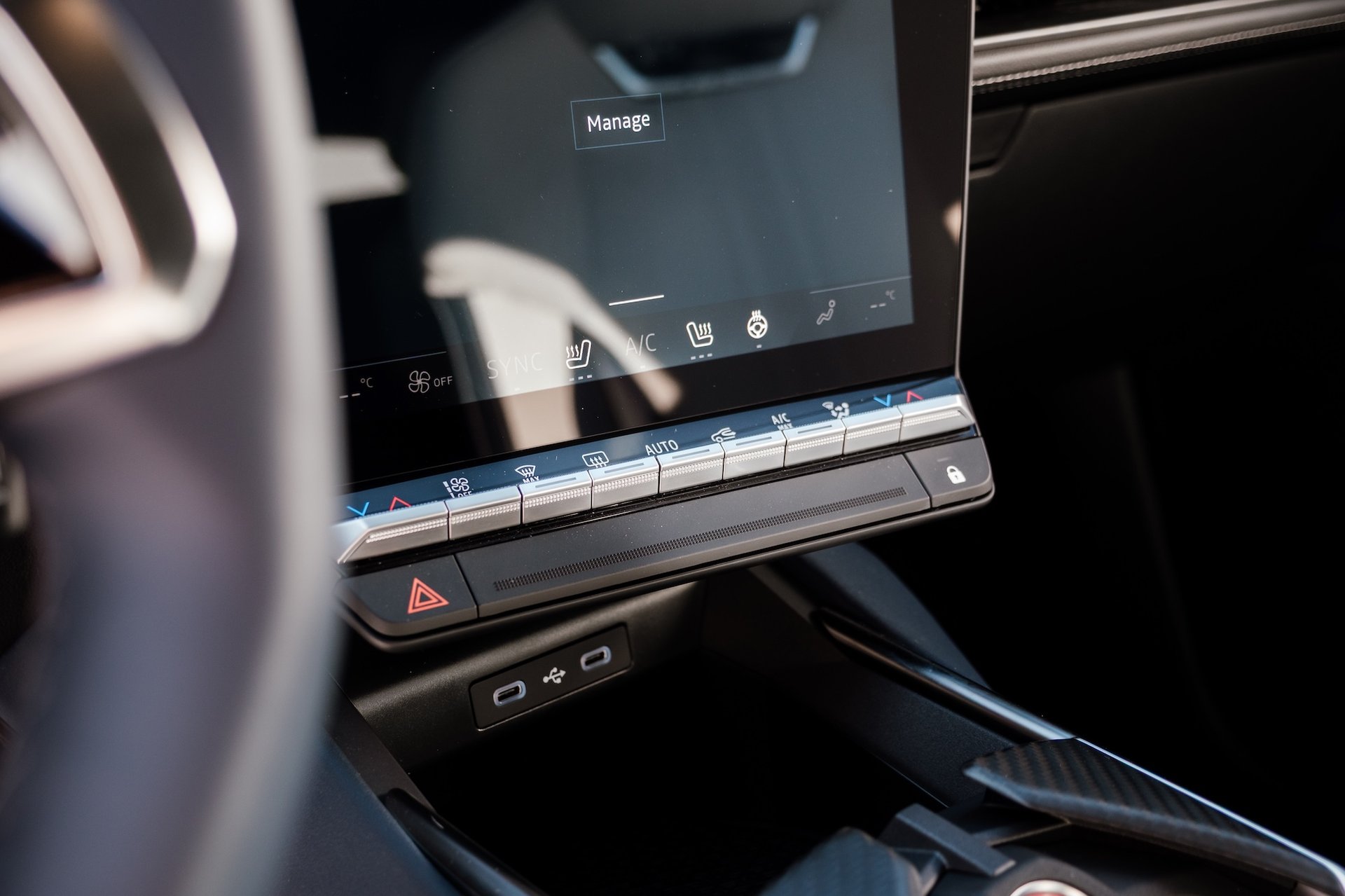
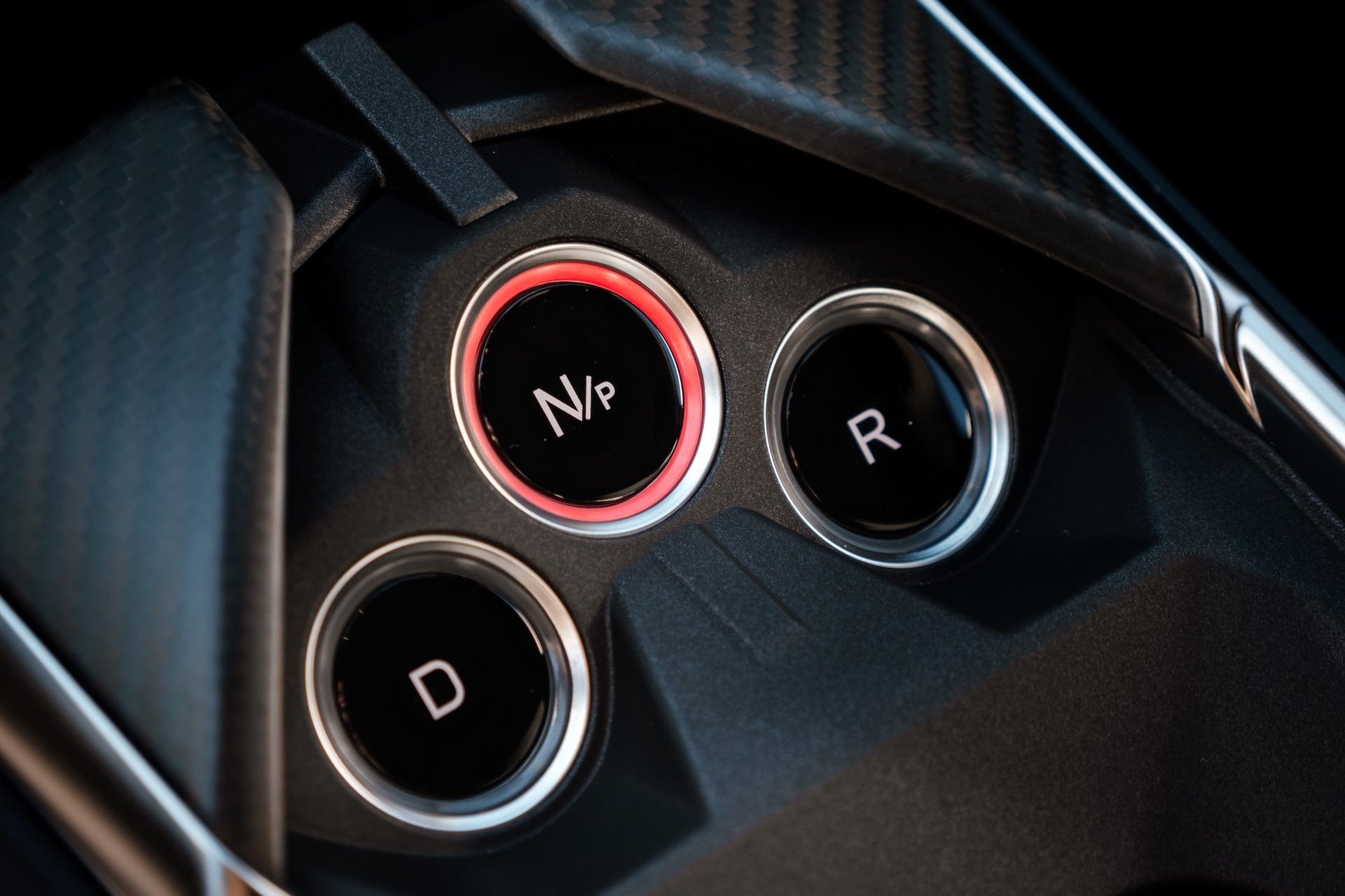
Physical controls, meanwhile, deserve real praise. Alpine wisely kept proper Renault switches for climate control, driving aids and quick-access functions. In an age obsessed with full-touch interfaces, such pragmatism almost feels luxurious. And of course, the floating console still features the iconic D–N–R trio borrowed from the A110 — a simple, powerful link to the brand’s lineage.
The driving position completes the experience. You sit low without feeling confined, well supported without being restricted, with far greater adjustment range than in either the A110 or A290. The sweet spot sits somewhere between the two: sportier than a hatchback, less extreme than a coupé, and very naturally integrated into the car. The seats — comfort-oriented in the GT or Sabelt buckets as an option — offer excellent support without tipping into harshness. Long drives pose no problem, and that essential “physical connection” to the car remains intact.
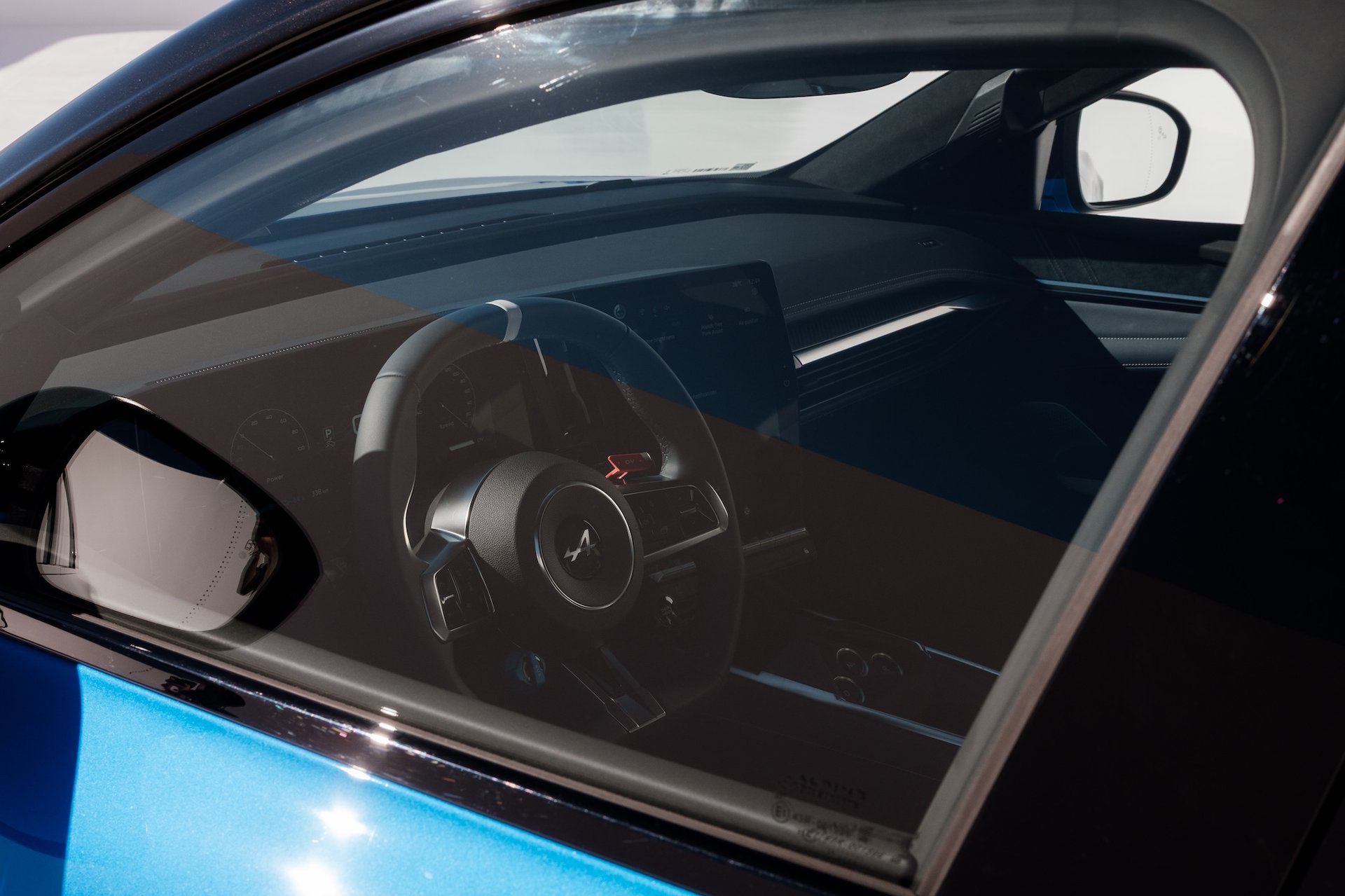
Laminated glass, standard across the range, adds an unexpected layer of calm. It filters high-frequency noise, softens the cabin and creates a nearly cocoon-like atmosphere at low speed. Nobody expected this level of refinement from the A390, yet it stands out as one of its great strengths: the ability to welcome, to soothe, without denying the dynamic character hiding beneath the surface. A grand-touring EV that embraces its role fully, equally at ease in daily driving and on Andalusian mountain roads.
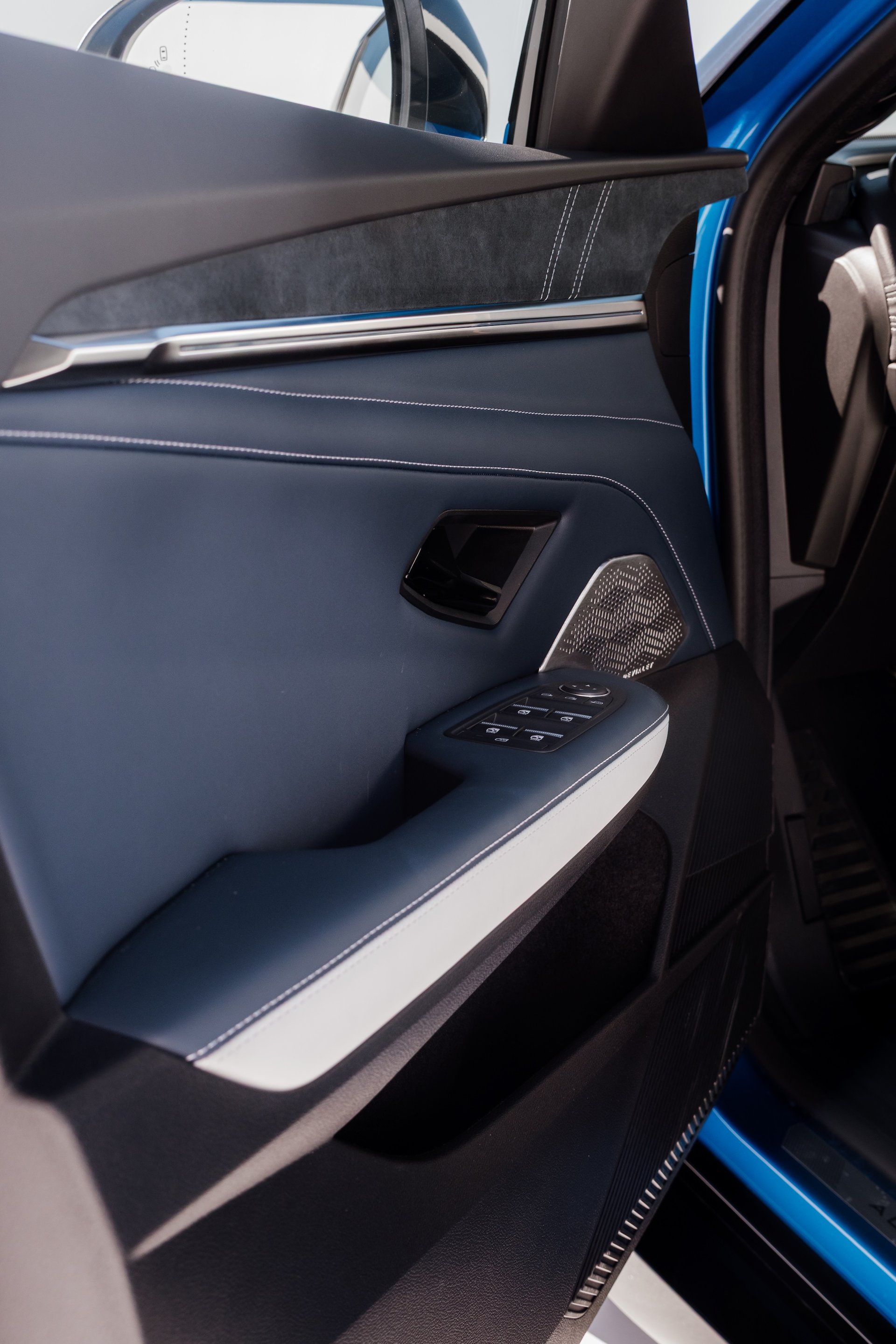
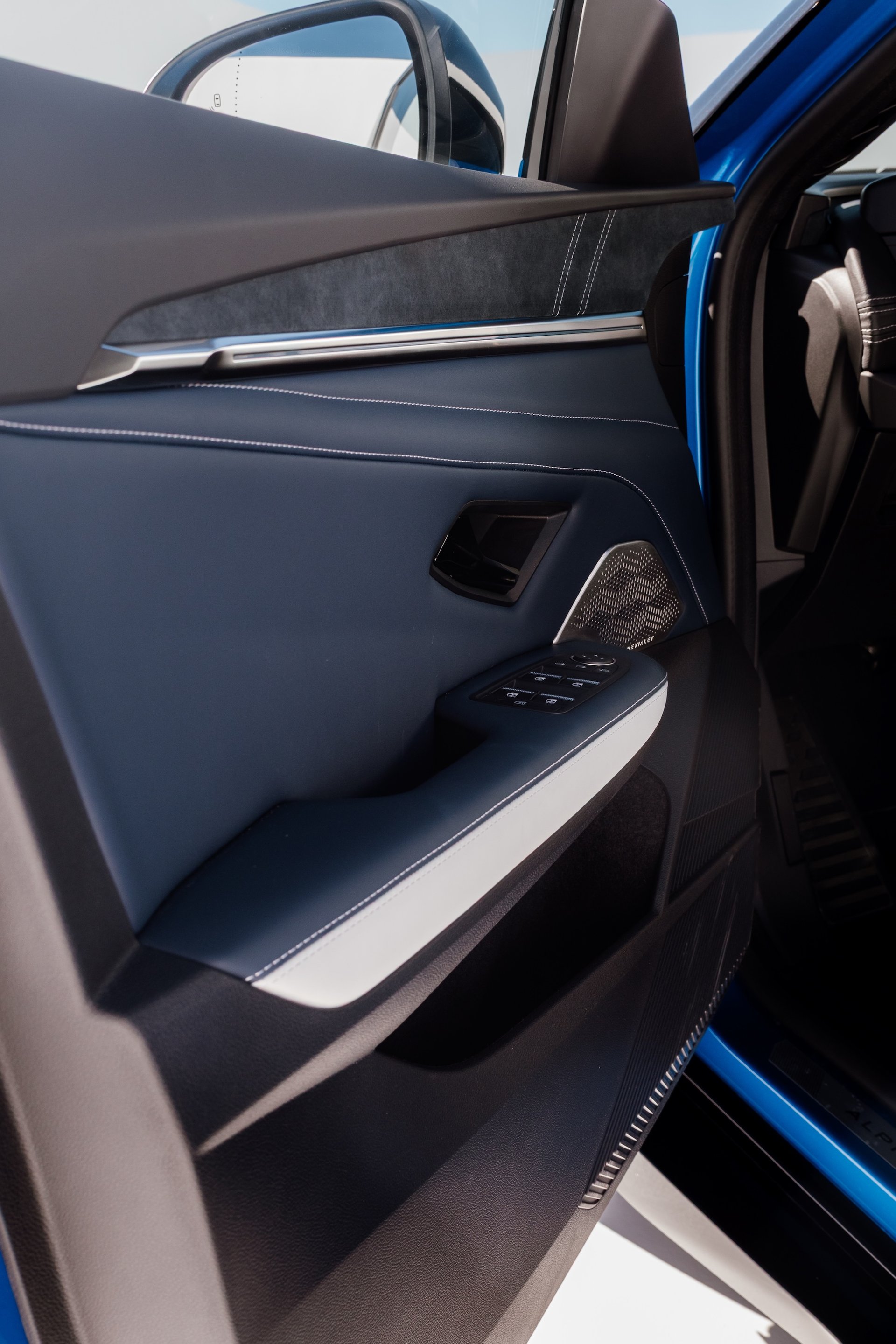
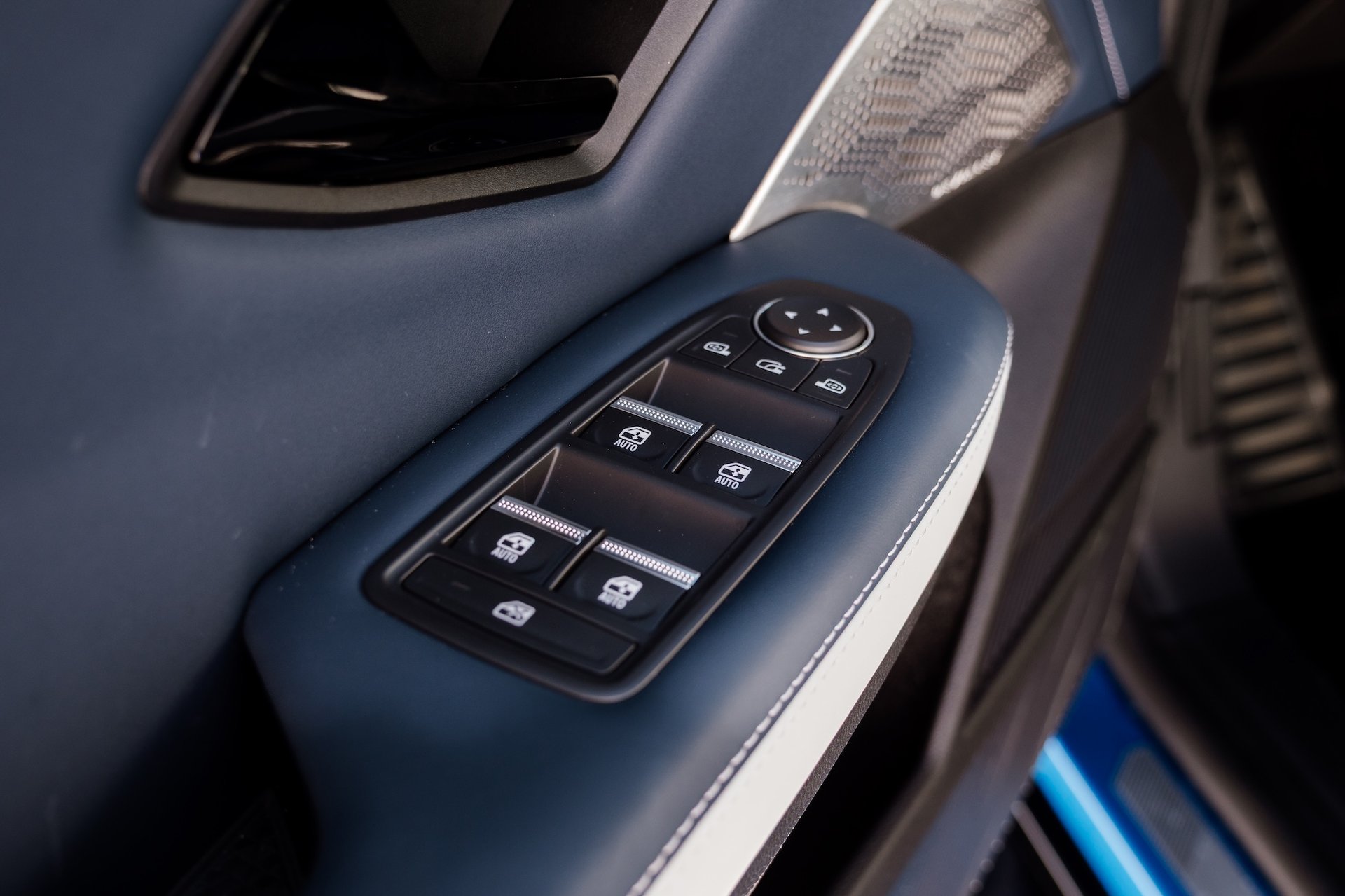
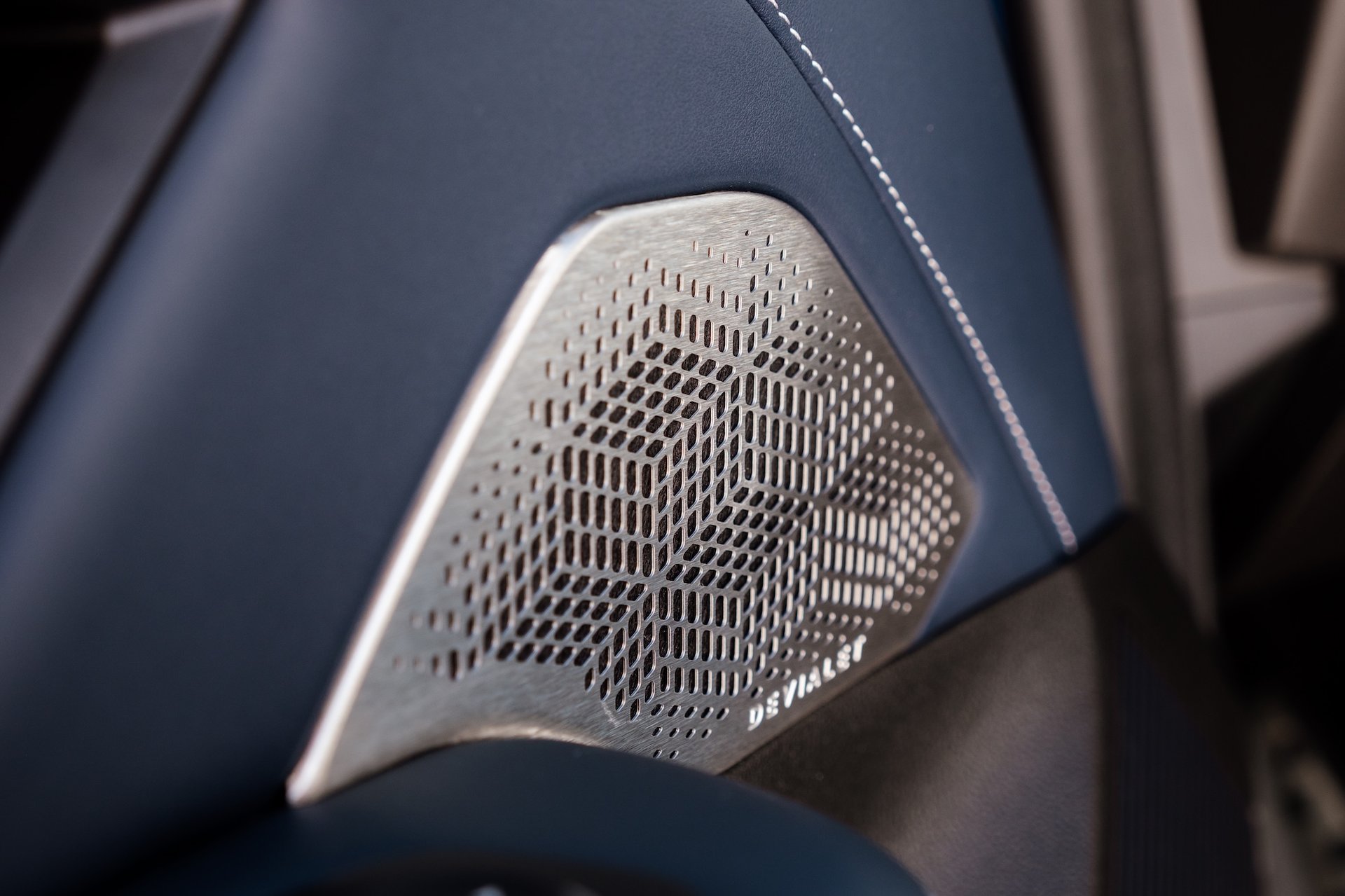
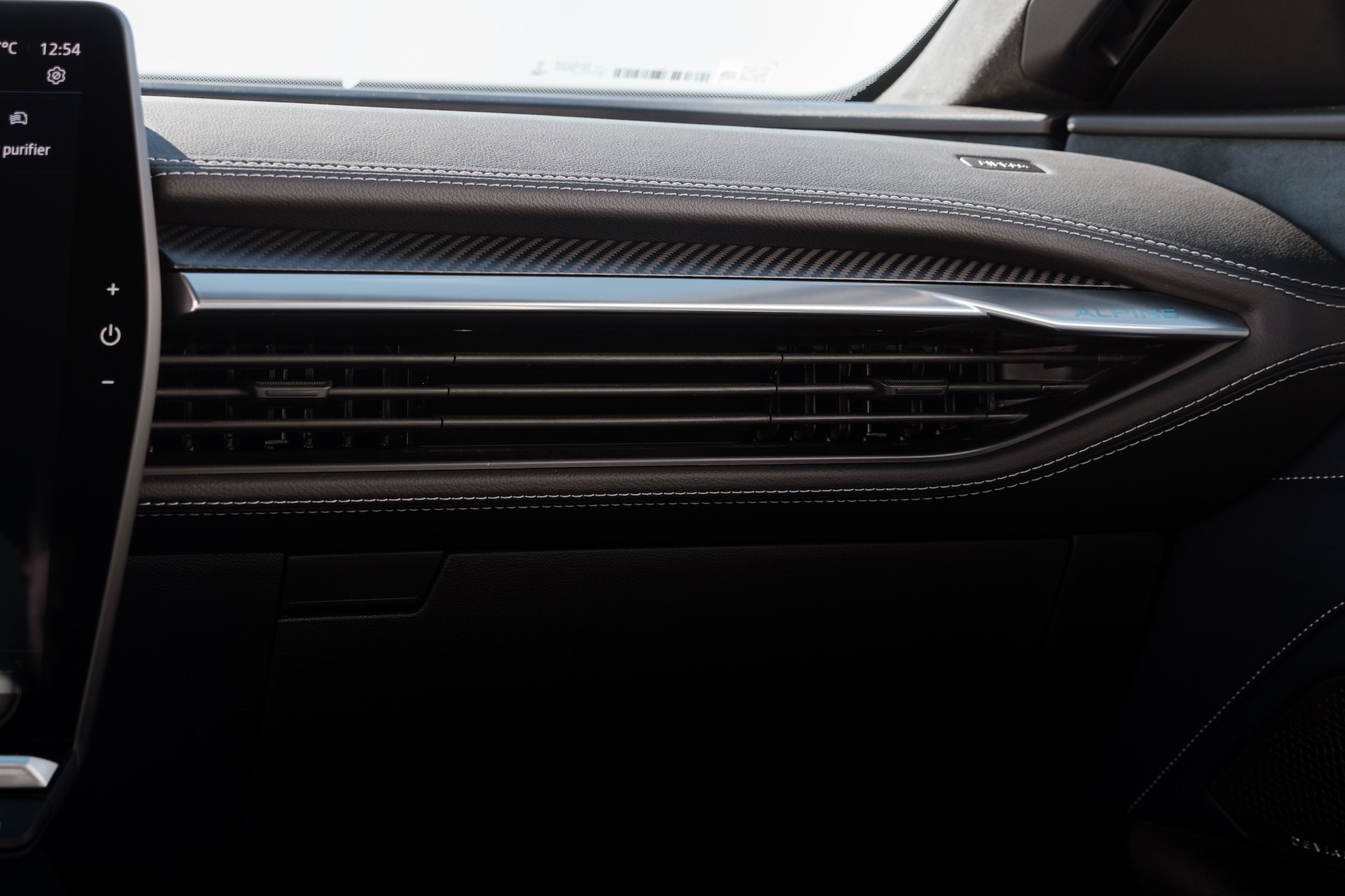
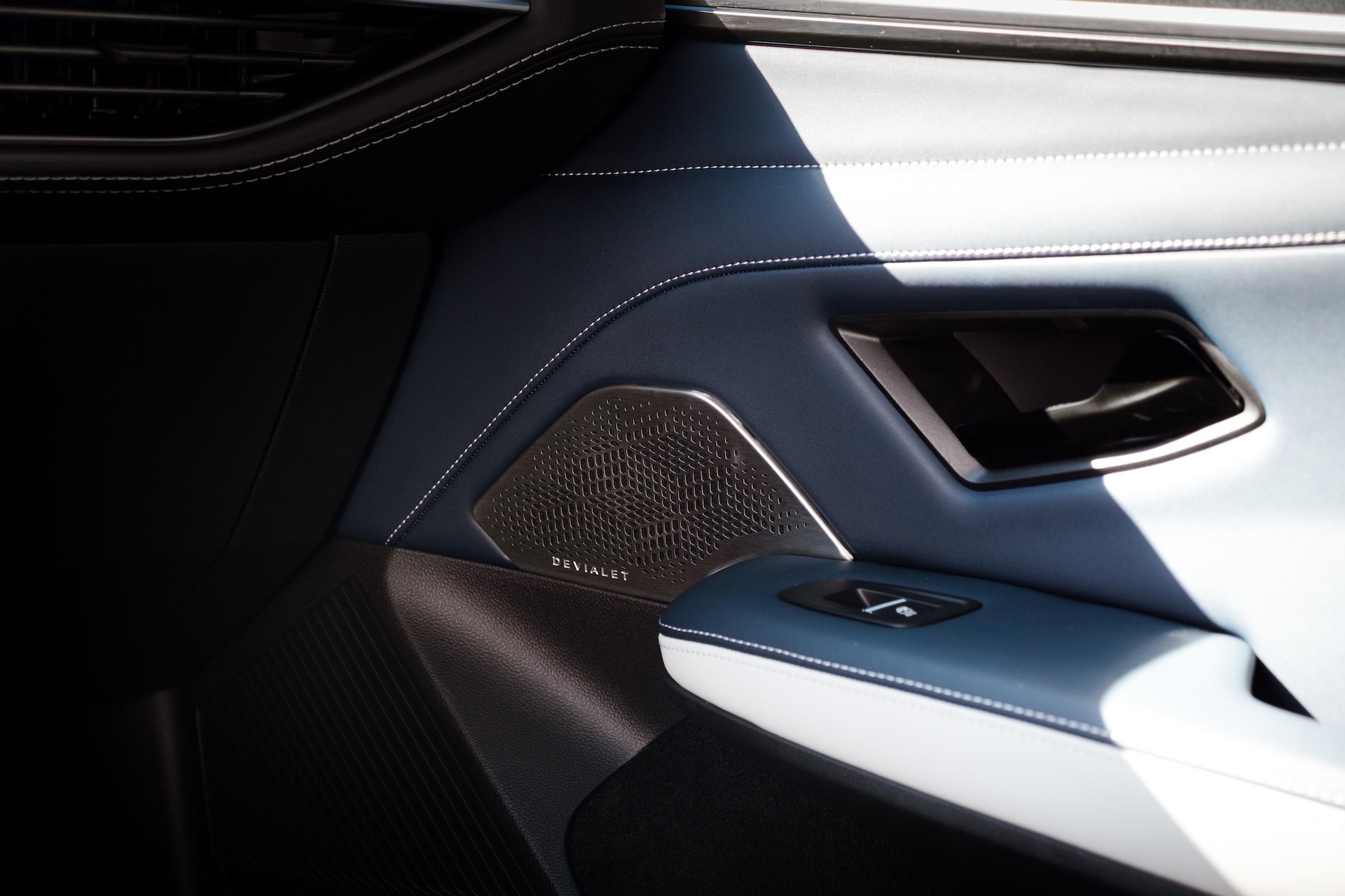
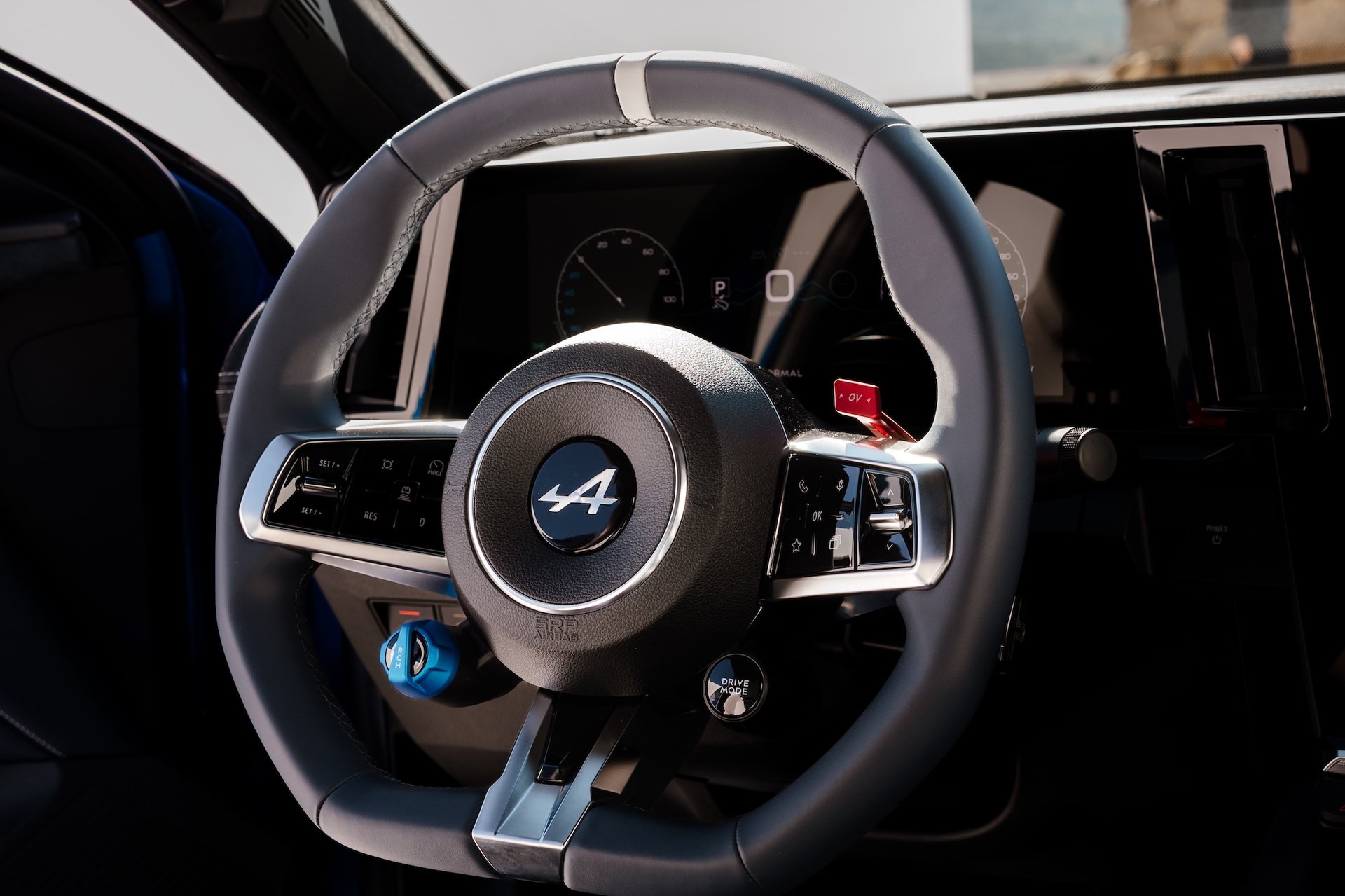
Not everything is perfect — some lower plastics lack sophistication, and a few details remind us of the platform sharing — but the essentials are here: coherence, improved perceived quality, well-judged ergonomics, and a cabin identity that now feels genuinely Alpine, mixing measured sportiness with newfound maturity.
Ultimately, the A390’s interior does not try to be something it is not. It remains honest, efficient, thoughtfully designed, and enriched just enough to feel like the brand has taken a meaningful step forward. A more welcoming, more grown-up Alpine that loses none of the purpose or clarity that define its signature.
IV. On the Road
As the kilometres unfold, one thing becomes immediately clear: the A390 GT hasn’t been tuned to impress, but to remain manageable, fluid and coherent. Its three motors — a front wound-rotor unit and two rear permanent-magnet motors — deliver a combined 400 hp and 661 Nm, yet Alpine chose a deliberately softened calibration. The shove is there, strong and steady, but never abrupt.
It’s an intentional philosophy, summed up in a single idea: “A GT must remain a GT.” The car is designed for versatility, comfort and long-distance composure rather than stopwatch theatrics.
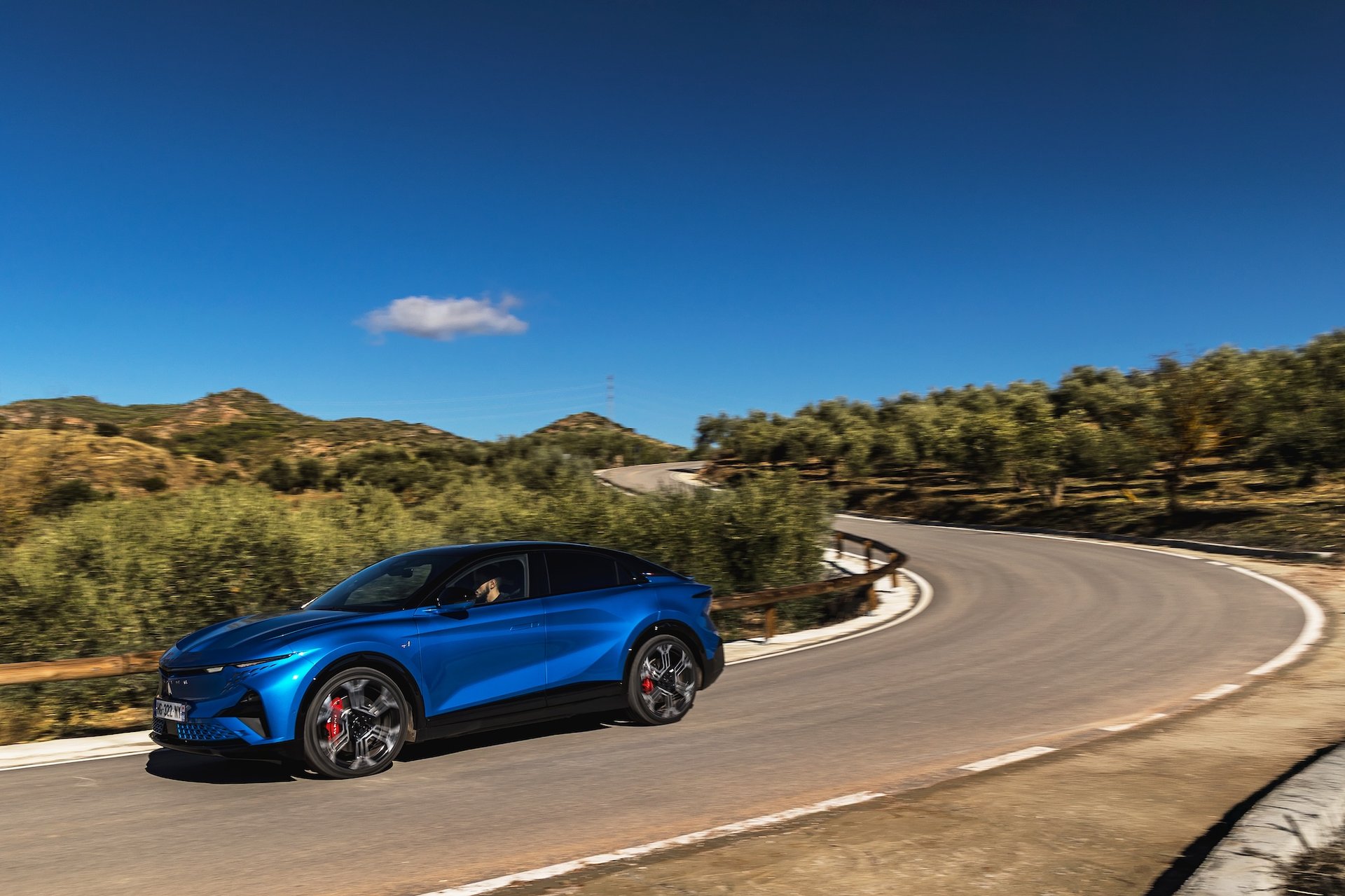
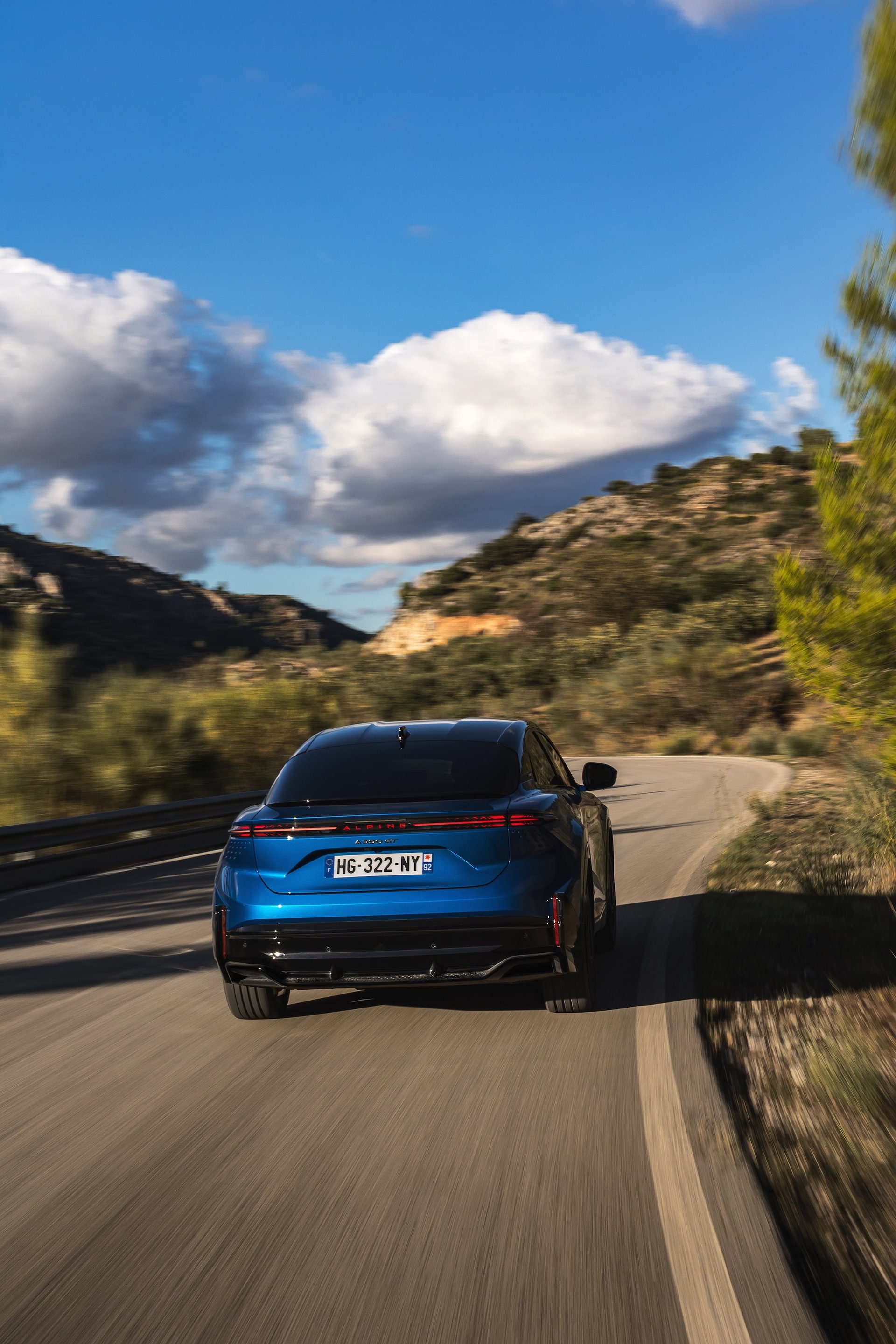
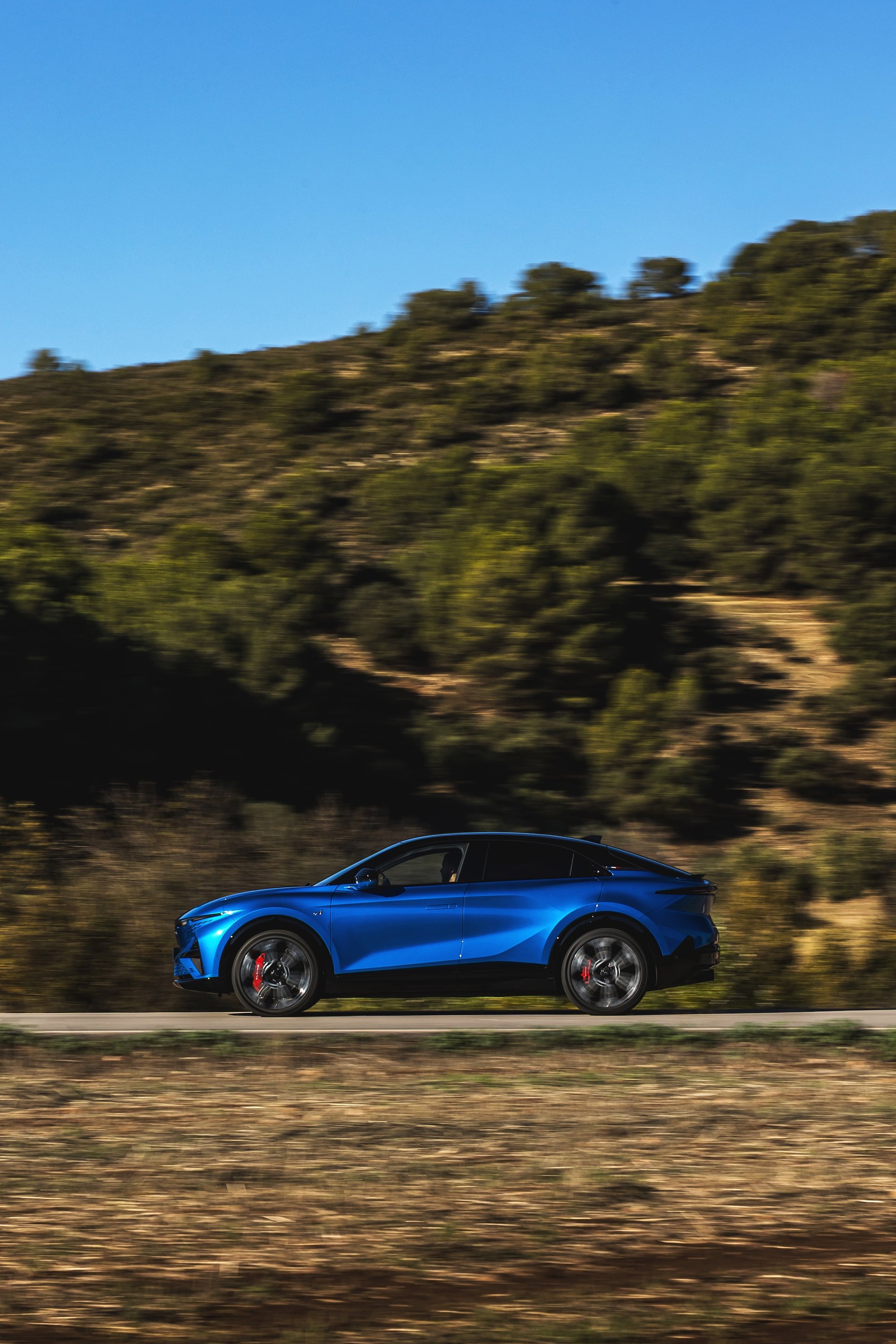
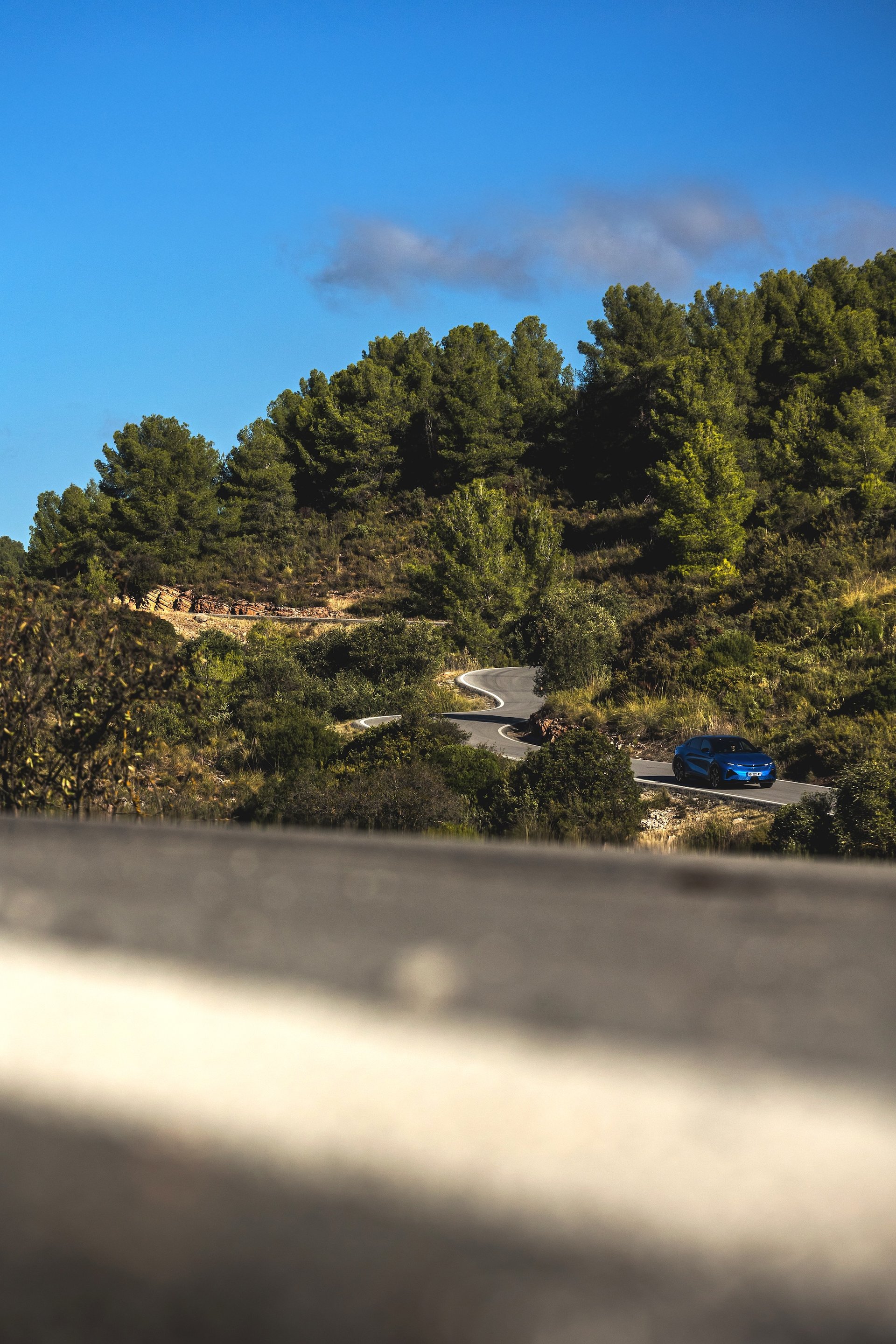
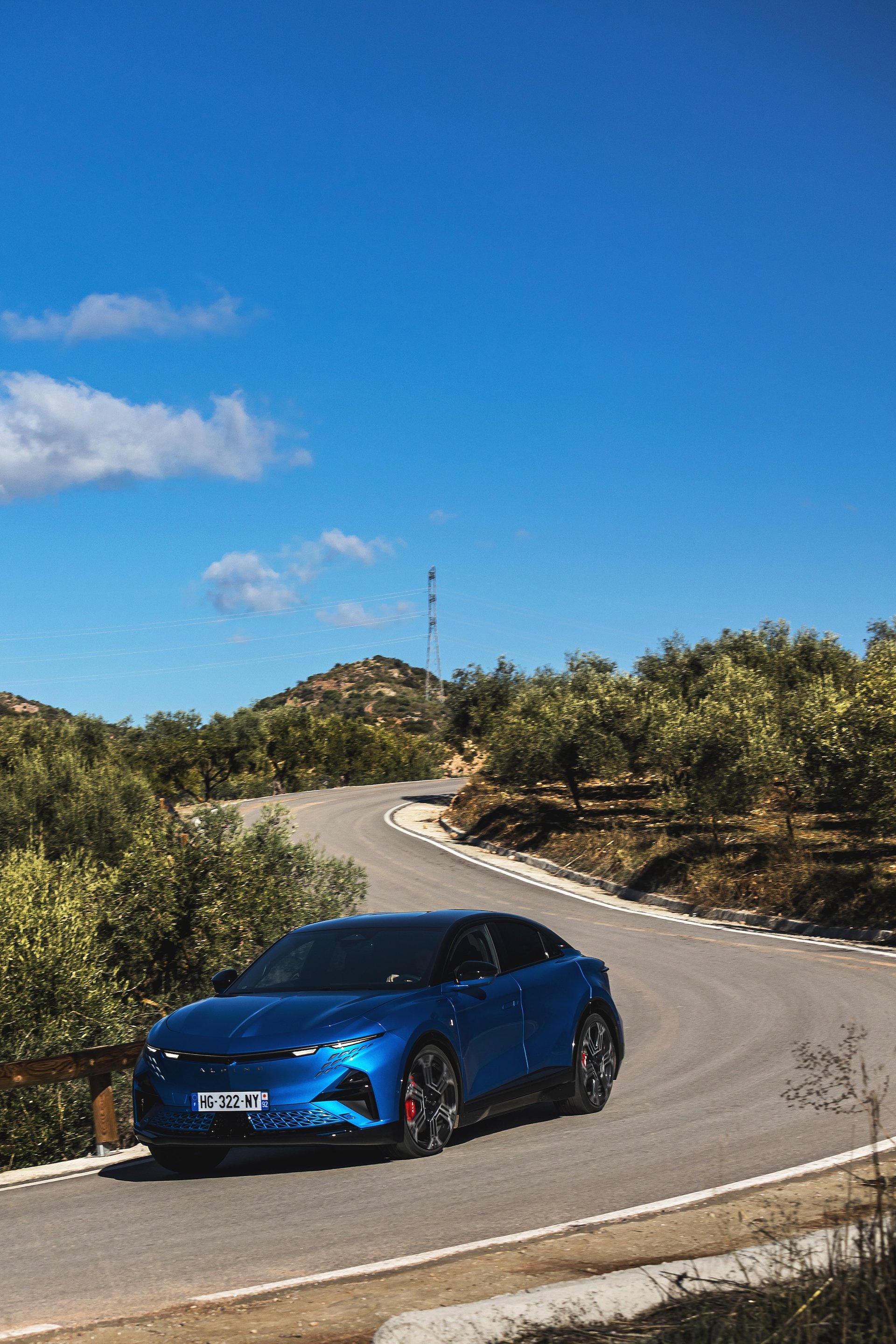
The various driving modes (Eco, Normal, Sport, Track and a configurable Personal mode) don’t fundamentally change the car’s character. They adjust throttle response, steering weight, energy recuperation and the synthetic onboard sound, but the underlying approach remains the same: progressiveness over aggression, even in the sharpest setting.
A notable distinction awaits with the upcoming GTS: 470 hp, 824 Nm and a raised top speed from 200 to 220 km/h. Thanks to its higher-performance Verkor battery, capable of taking 190 kW of DC charge, the GTS promises a more incisive personality — a clear effort to differentiate the two versions without betraying the GT’s mission.
On paper, the GTS also claims 0–100 km/h in 3.9 seconds and a slightly shorter WLTP range (503 km), compared with the GT’s 557 km on 20-inch wheels. It reinforces the idea: the GT is the all-rounder; the GTS, the character model.

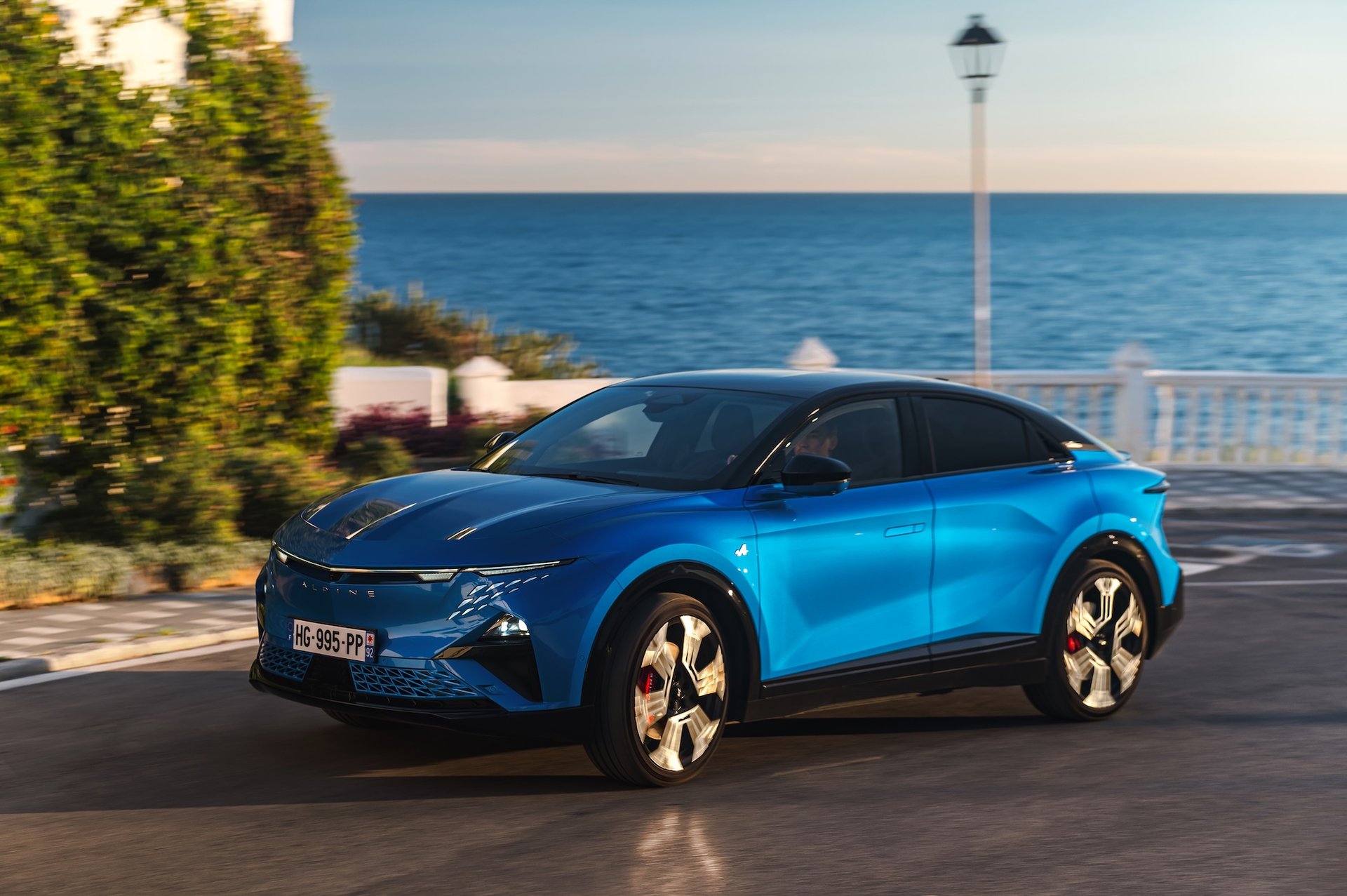
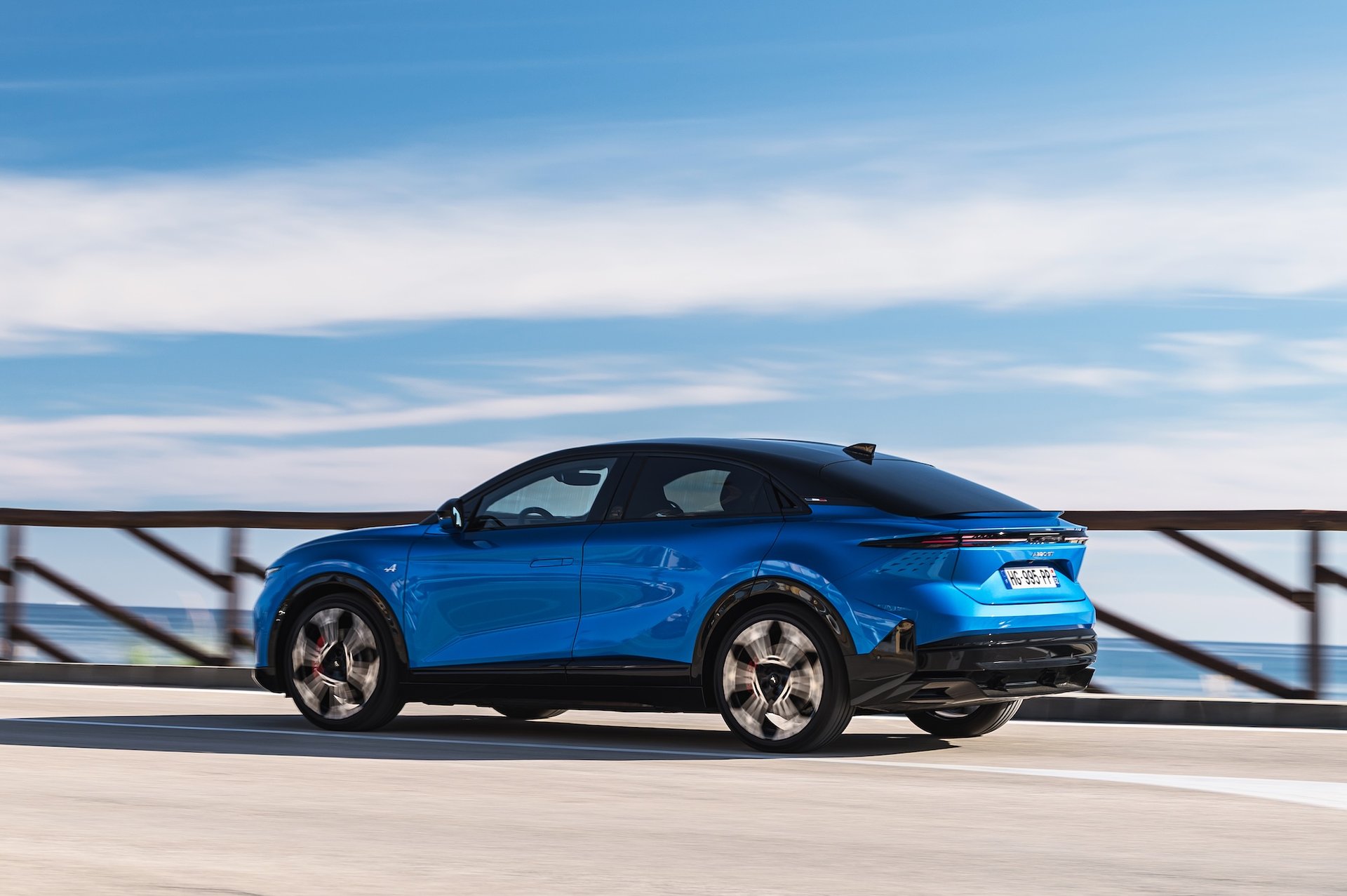
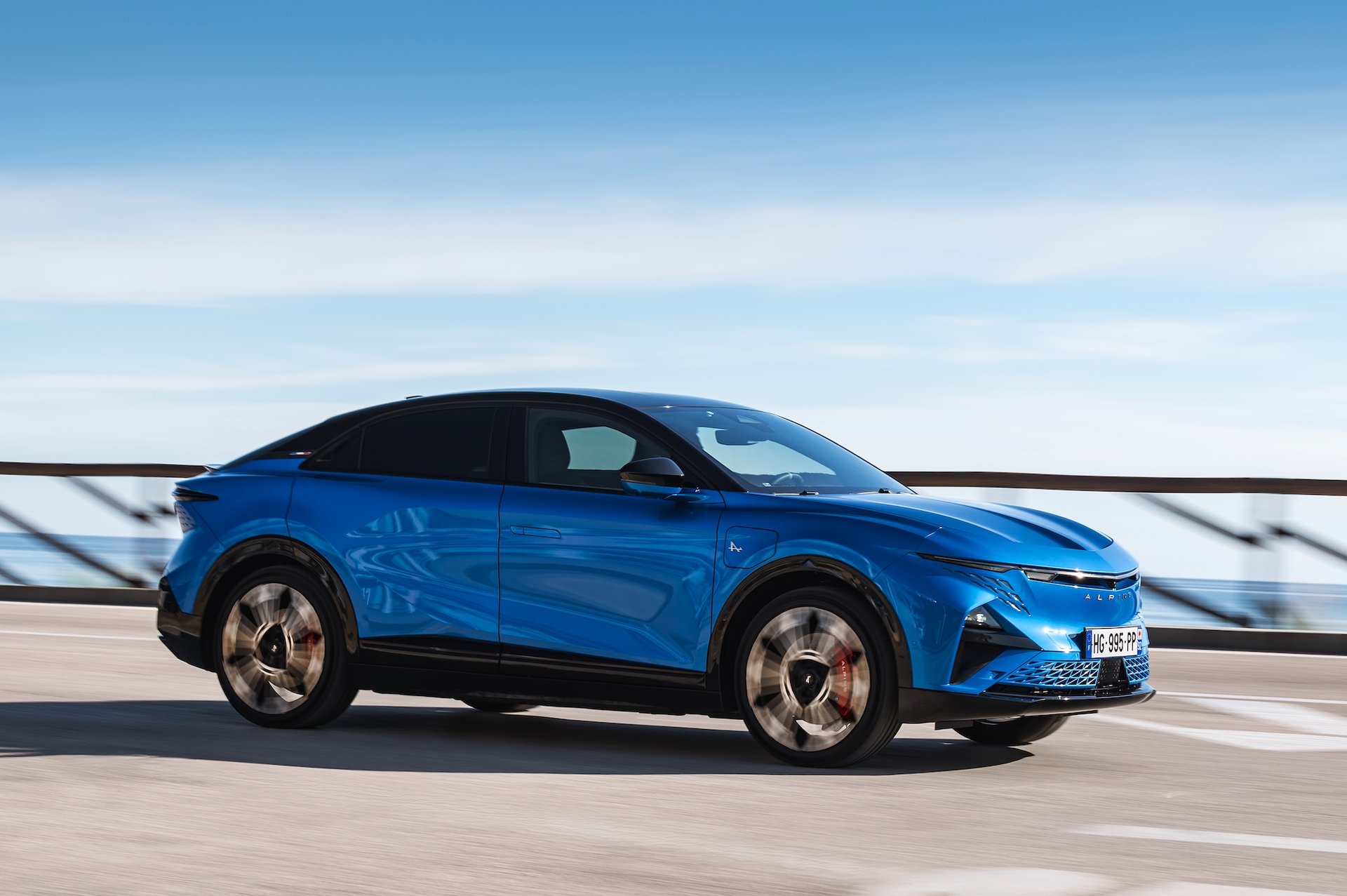
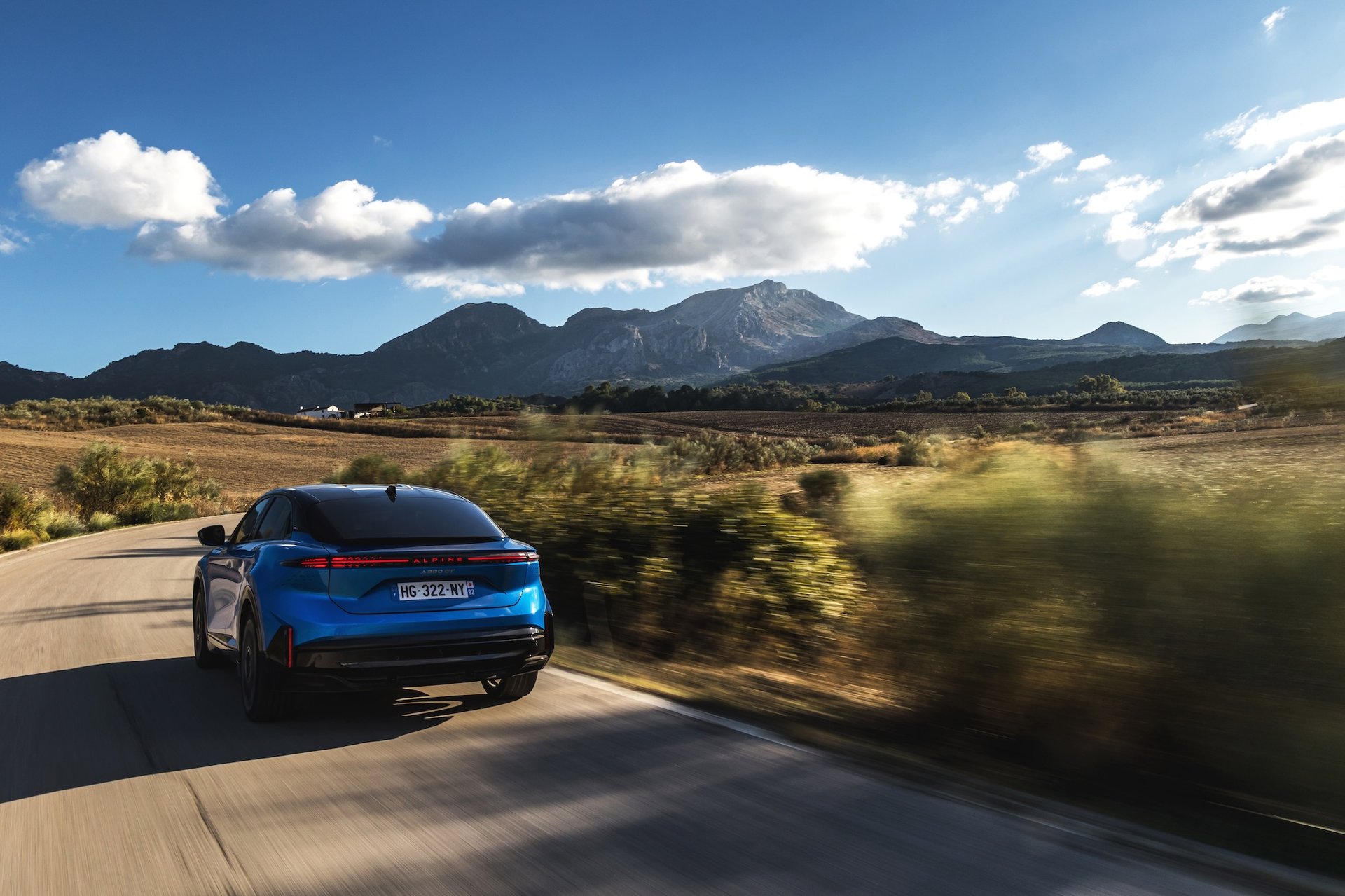
Not that the GT lacks performance. With a 0–100 km/h time of 4.8 seconds, it more than meets the expectations for a sporty family EV. What it doesn’t deliver is shock value: acceleration is linear rather than explosive. Those craving a more visceral punch will naturally gravitate toward the GTS.
Top speed is capped at 200 km/h — perfectly adequate in real-world use — but it’s the GT’s 60–140 km/h surge that stands out. No gaps, no hesitations, just a clean, continuous wave of torque that makes the most of the three-motor configuration without feeling strained.
On the road, the first real surprise comes from the front end. Despite the 2,124-kg kerb weight, the steering — very direct thanks to a 12:1 ratio — offers remarkable precision, though it feels a bit too light for my taste. Translating the delicacy of an A110 into a family EV was always going to be ambitious.
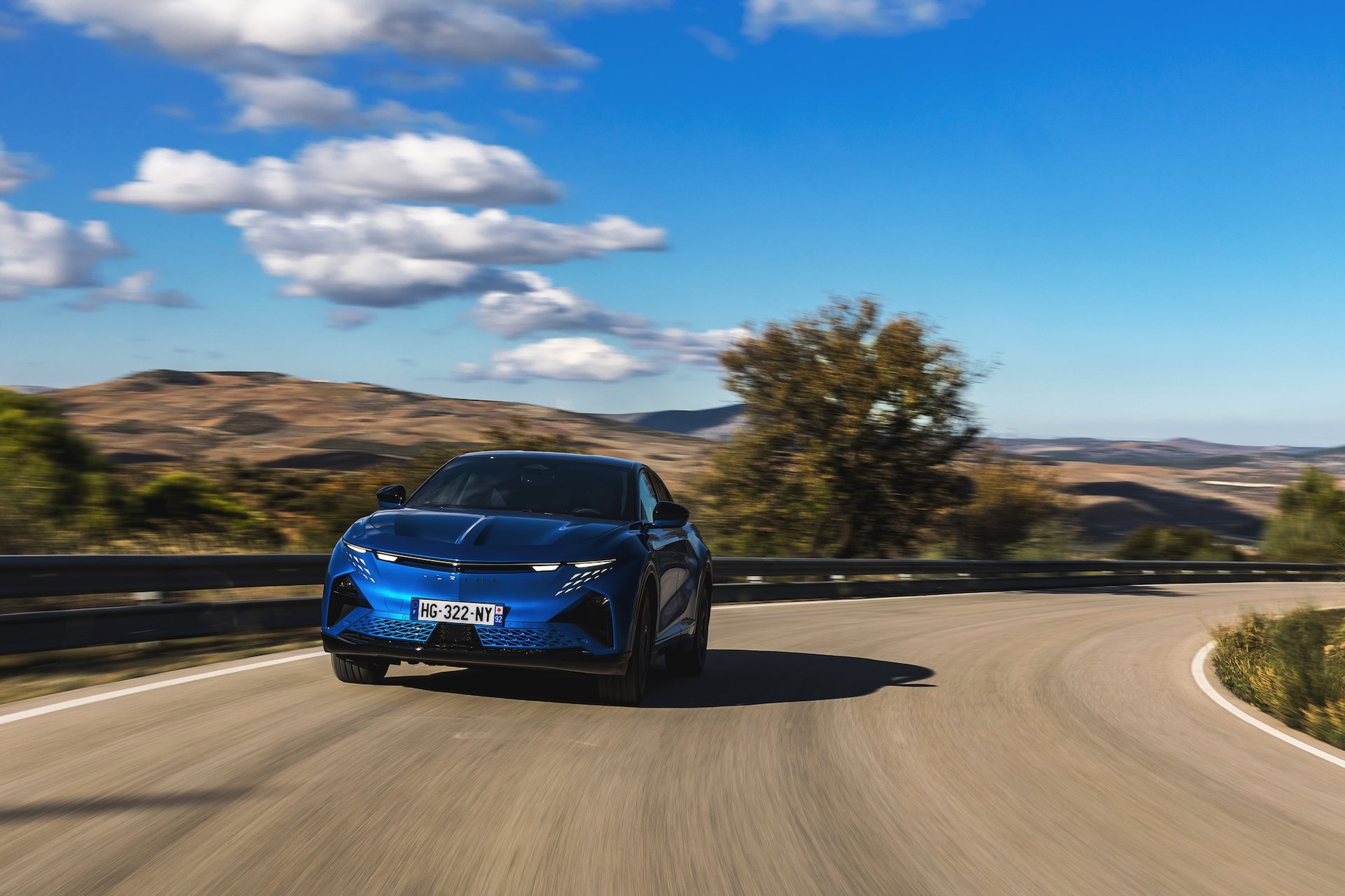
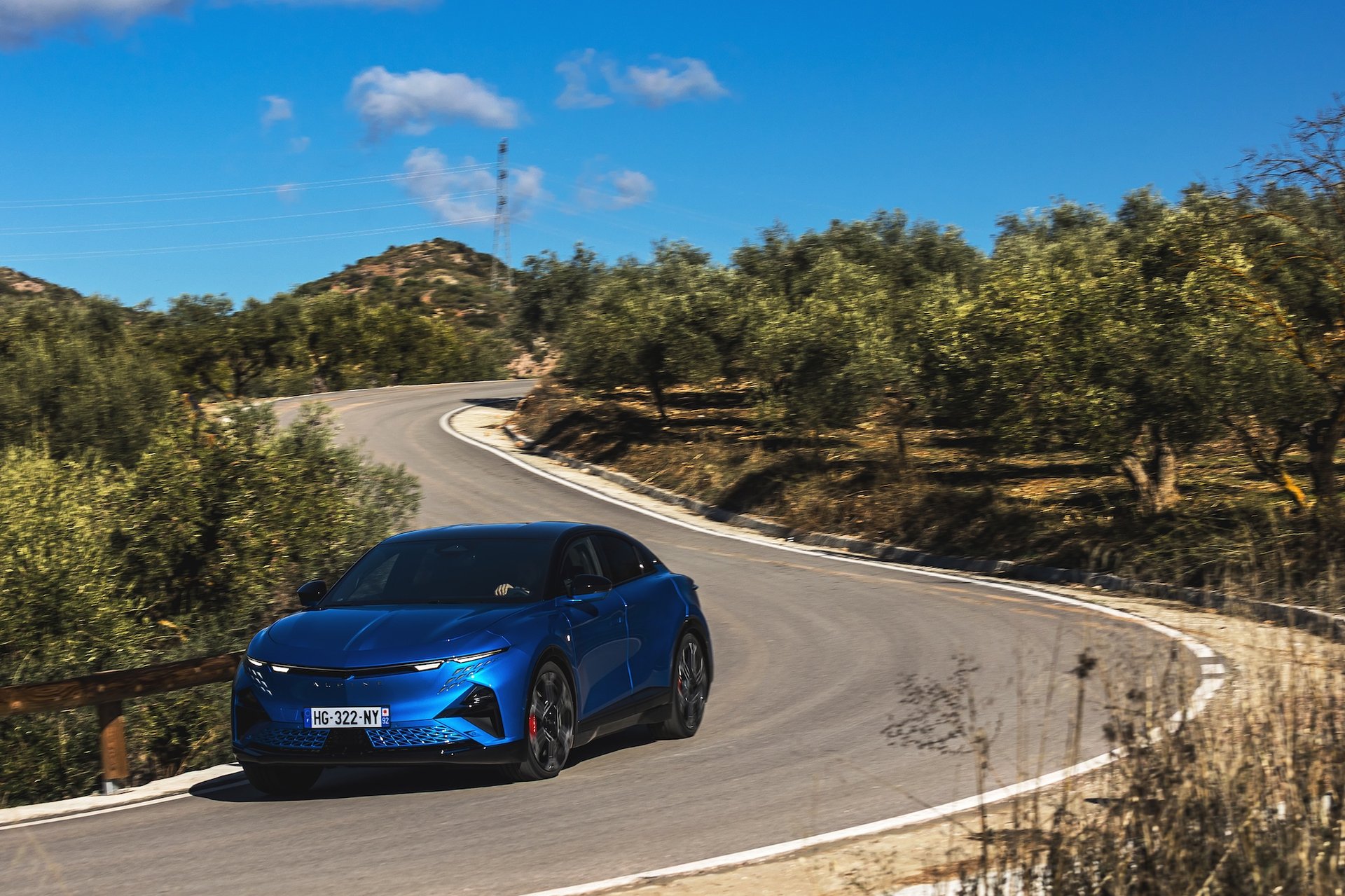
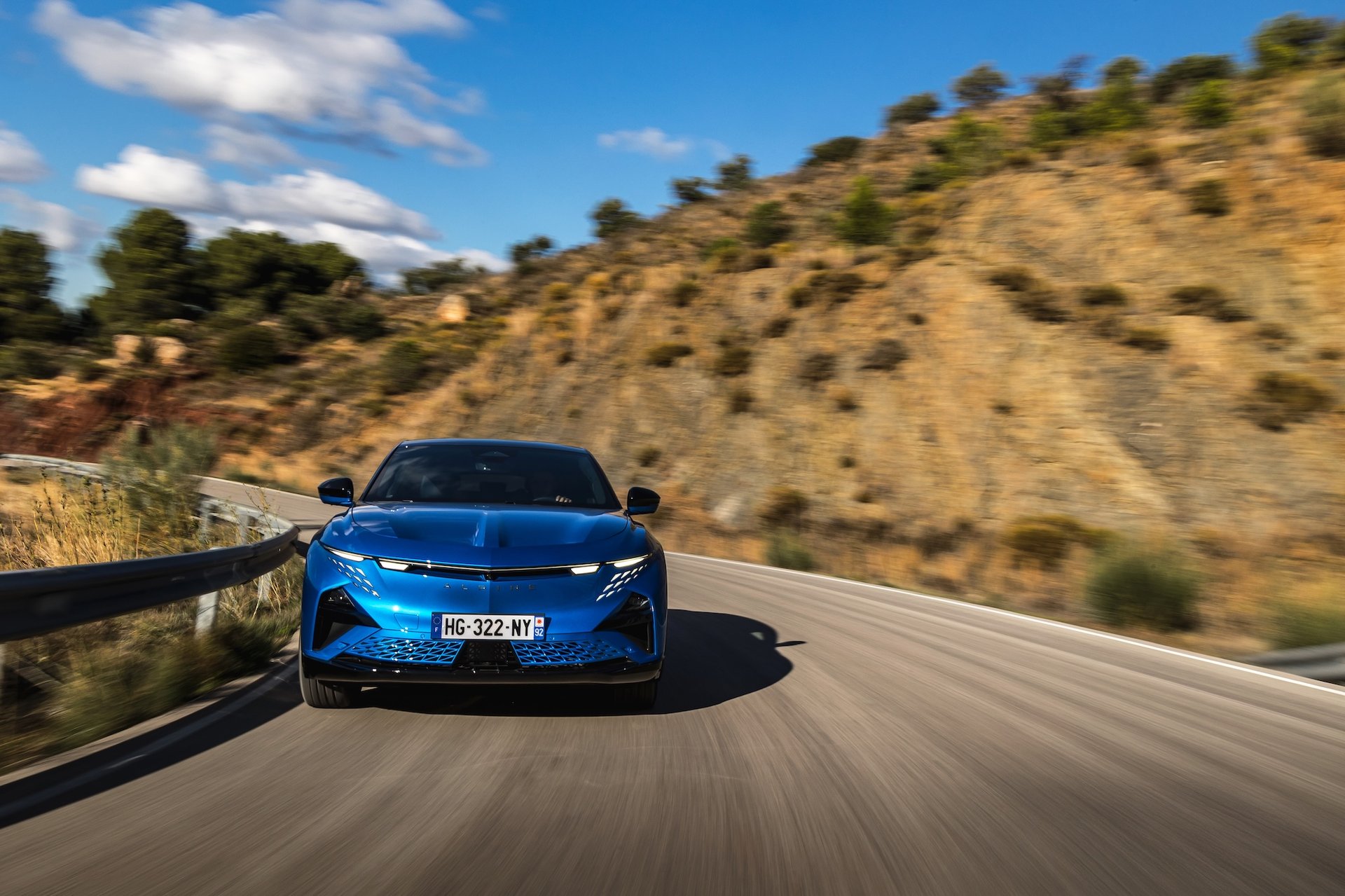
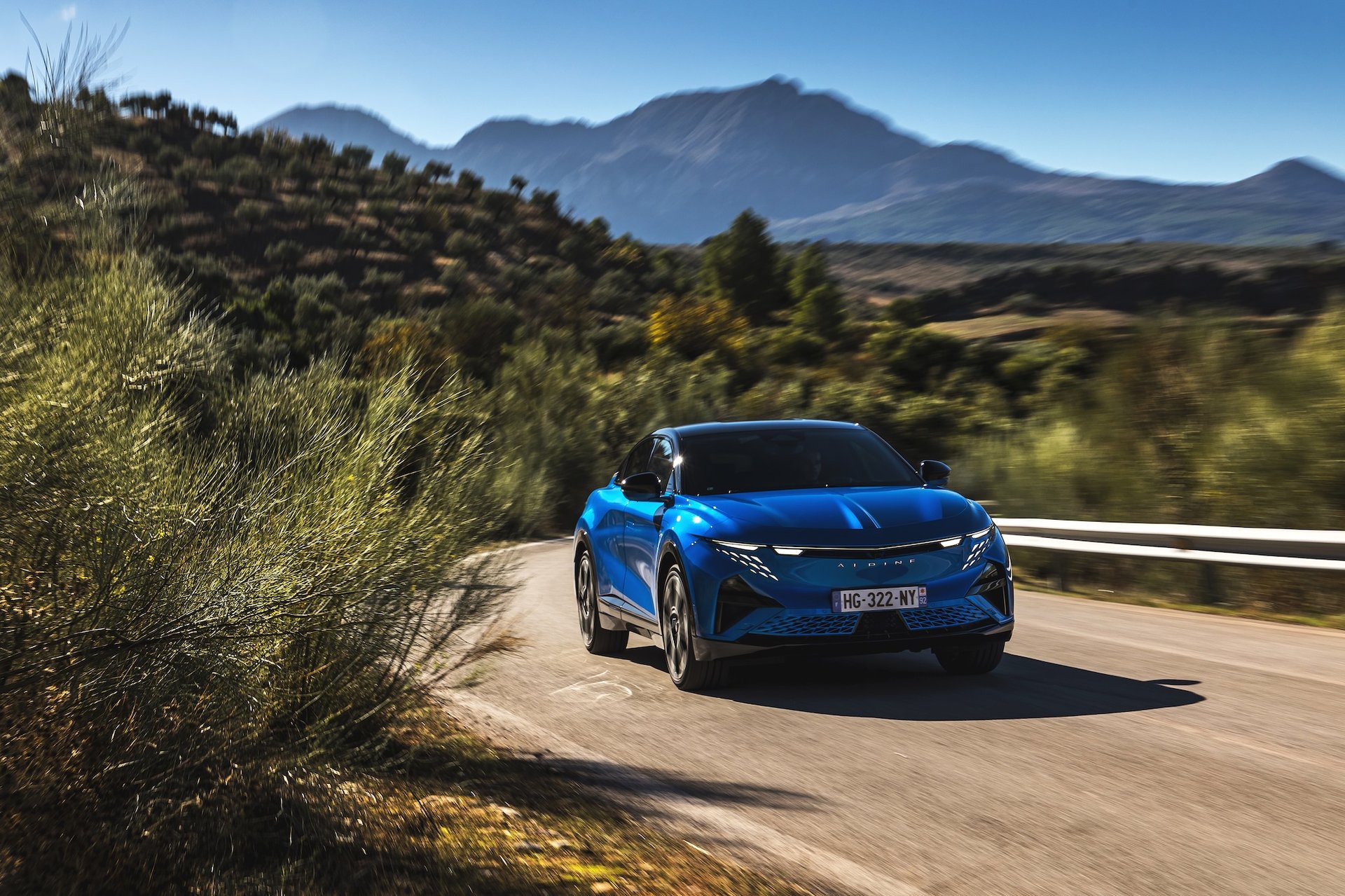
In daily driving, that lightness is a real asset, especially in town or tight manoeuvres. But those who enjoy a weightier steering feel may wish for more resistance in Sport mode, particularly in rapid transitions.
Feedback remains measured rather than rich, yet clear enough to place the car exactly where you intend. The front end tucks confidently into corners, holds its line and never collapses onto its outside wheel. Understeer appears only in genuinely hard driving — and even then, progressively and predictably.
Push a bit too eagerly into a bend, and the front resists slipping for longer than expected, giving the driver ample time to correct and settle the car. It’s more reassuring than thrilling — entirely in line with the GT’s philosophy.
Increase the pace and the Alpine Active Torque Vectoring system begins to reveal its contribution. Each rear motor meters its torque individually, stabilising the car on corner entry and locking it cleanly into the apex. In feel, AATV recalls the effectiveness of Renault Sport’s four-wheel steering systems, though
“without ever giving the impression that the rear wants to overtake the front.”
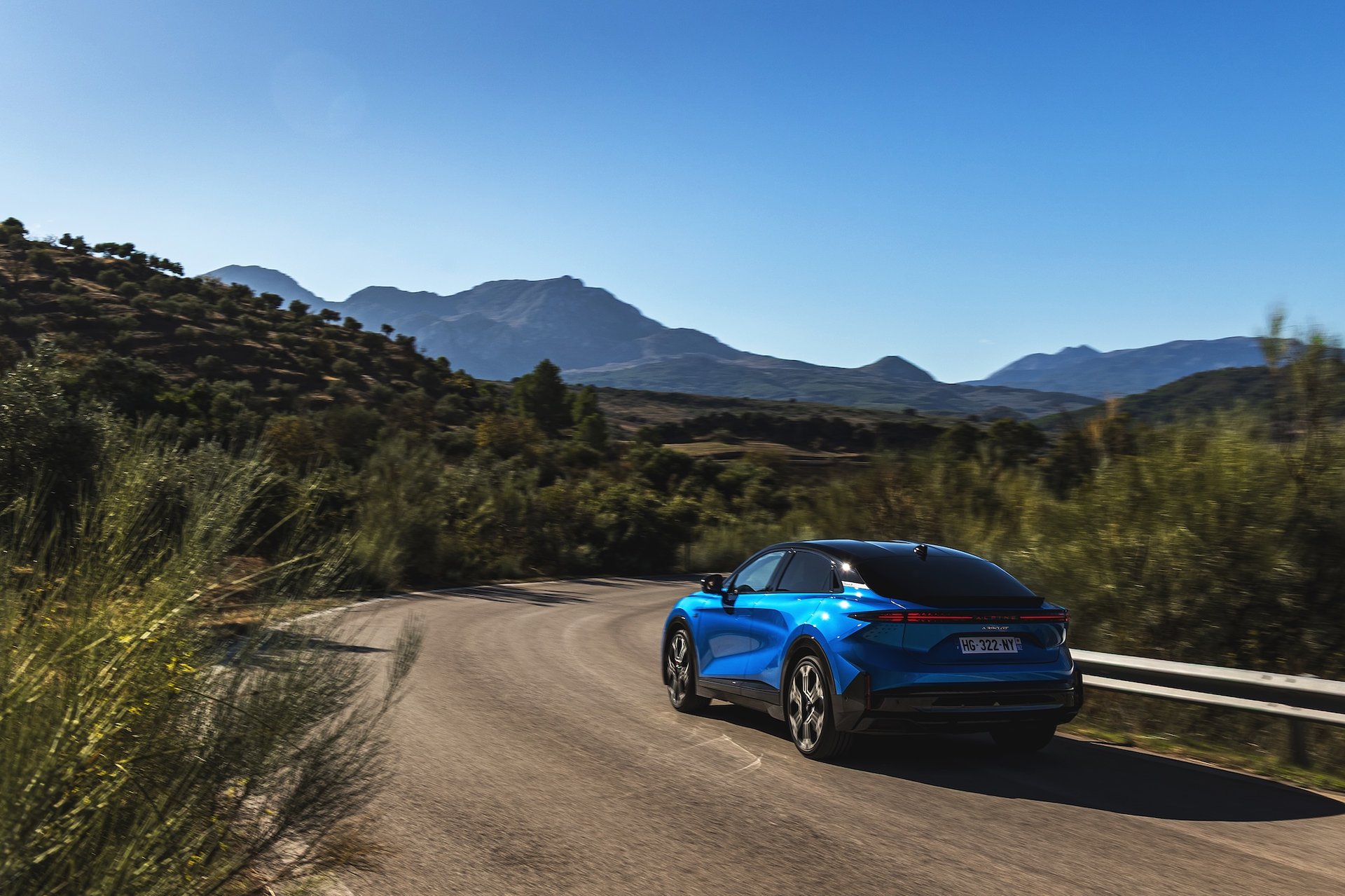
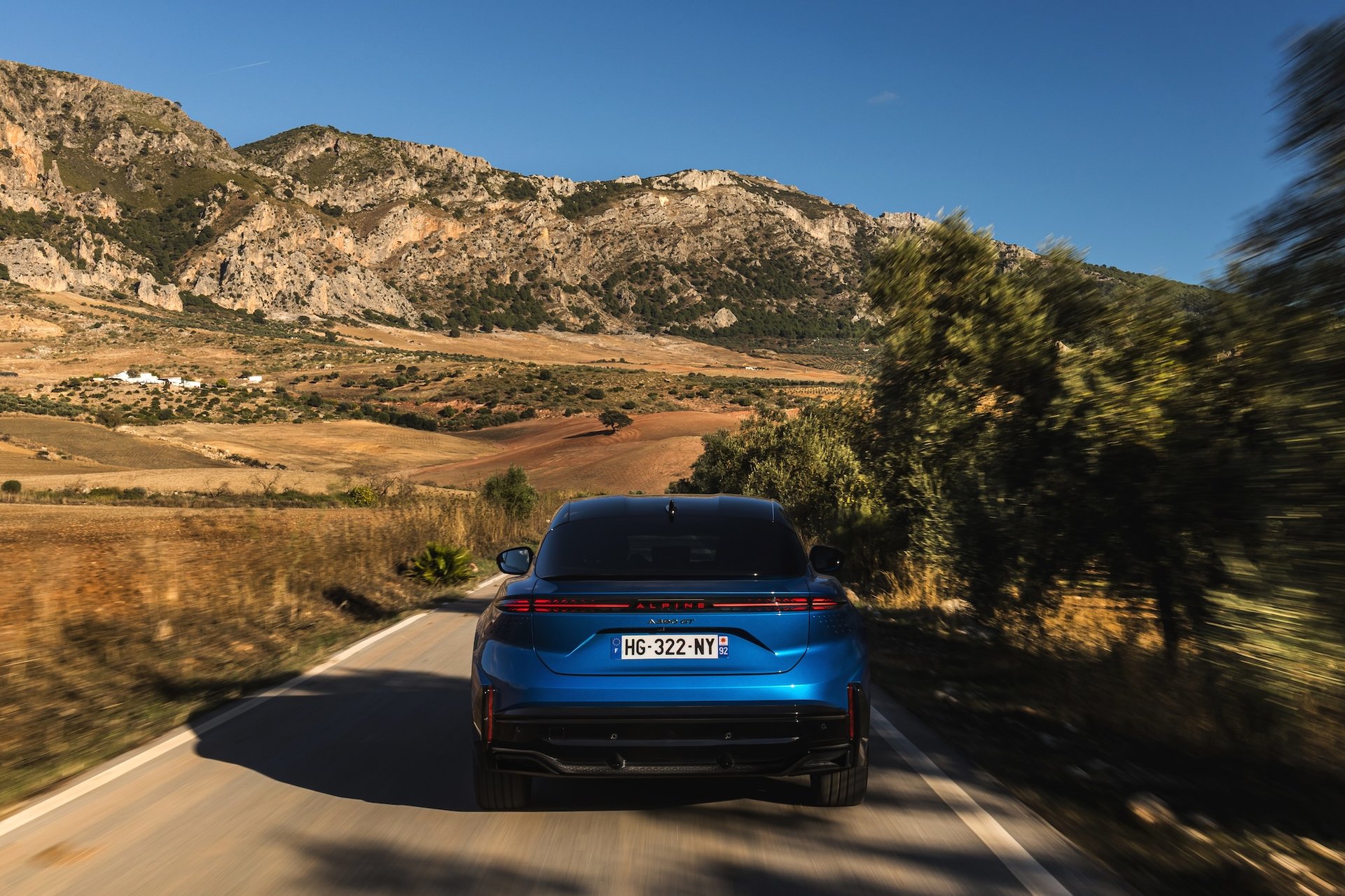
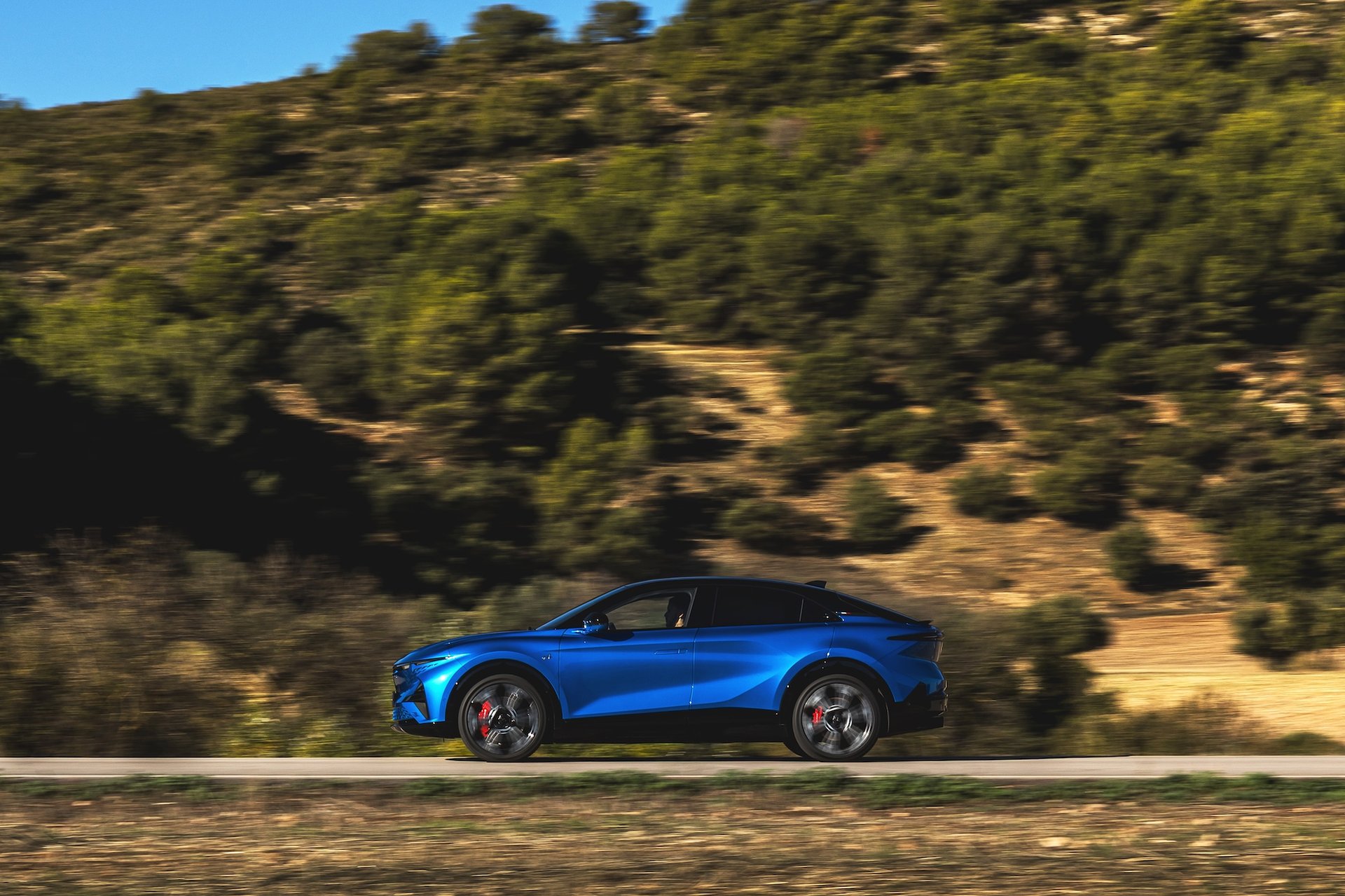
Where rear-steer systems can feel a touch artificial — a hint of rotation disconnected from the front axle — Alpine’s approach keeps everything aligned. The rear follows the front rather than dictating the movement. On corner exit, stability is exceptional, and traction remains intact even when you reapply torque generously mid-corner.
The overall effect is clear: a neutral, remarkably stable car that remains readable under all cornering loads. At moderate pace, this discreteness might seem surprising; push harder, and it becomes unmistakable. In fact, the chassis’ capabilities reach well beyond what’s exploitable on public roads.
It’s equally obvious that the engineers chose to limit playful behaviour on open roads, favouring safety and composure. The deeper potential is there, but it’s on a track or a closed environment that it will fully surface.
The suspension reinforces this personality. Non-adaptive but supported by hydraulic bump stops, it holds the body with impressive discipline without slipping into harshness — not unlike the standard A110’s philosophy. On smooth tarmac, the A390 glides with unexpected polish. On rougher surfaces, the 20-inch wheels — and the optional 21s — add noticeable firmness, yet overall comfort remains entirely acceptable.
Energy recuperation settings, including a near one-pedal mode, integrate naturally into this dynamic balance. The strongest level may feel abrupt in town until you get used to it, but it quickly becomes a useful ally for controlling consumption and easing the load on the brakes, especially given the car’s mass.
Viewed honestly, the A390 GT cannot replicate the instinctive agility or playful motion of an A110. Physics forbids it. What it offers instead is rare among electric family cars: a deep sense of stability, a feeling of control, and a neutrality that builds confidence. Some colleagues even judged it more cohesive than the electric Porsche Macan, particularly in how it manages rear-axle behaviour under load.
Add to that an almost unshakeable level of traction — even on imperfect surfaces — and you’re left with a car that can cover ground quickly, for long periods, without ever feeling like you’re wrestling its weight.
In the end, the A390 GT doesn’t try to dramatise its abilities. It prioritises efficiency, stability and clarity. It offers “sufficient” power, not excessive, and a chassis that extracts the best from its technology without resorting to gimmicks. A very Alpine interpretation of electrification: mature, poised, but still capable of surprising those who genuinely enjoy driving.
One might personally wish for a touch more character in the way power is delivered, but this very restraint allows the GT to fulfil its purpose: a family-friendly Alpine that can stack kilometres, carve through mountain roads and remain confidence-inspiring in all circumstances.
Here is the English translation, faithful, natural, and without added commentary — just the translated text, as requested.
IV. Efficiency and Charging
An essential aspect of any electric Alpine lies in how it consumes energy and how it recharges.
On the demanding Andalusian roads — with their constant elevation changes and abrasive surfaces — consumption easily settles between 23 and 27 kWh/100 km in mixed driving, with peaks beyond 30 kWh/100 km as soon as the pace increases on climbs or through tight sequences. The official 20.4 kWh/100 km WLTP figure is best viewed as an idealised benchmark rather than a real-world value.
This is the trade-off of the three-motor architecture: exemplary traction, surprising agility — but an undeniable energy cost, especially when driven dynamically.
The advertised 557 km WLTP range (on 20-inch wheels with Pilot Sport EV tyres) represents a theoretical maximum. With the optional 21-inch wheels and the grippier Pilot Sport 4S tyres, the figure drops to 504 km WLTP.
In real Andalusian conditions, mixing motorway stretches, sustained climbs and repeated cornering, observed range typically falls between 300 and 380 km, which remains reasonable for a 2.1-tonne vehicle propelled by three motors.
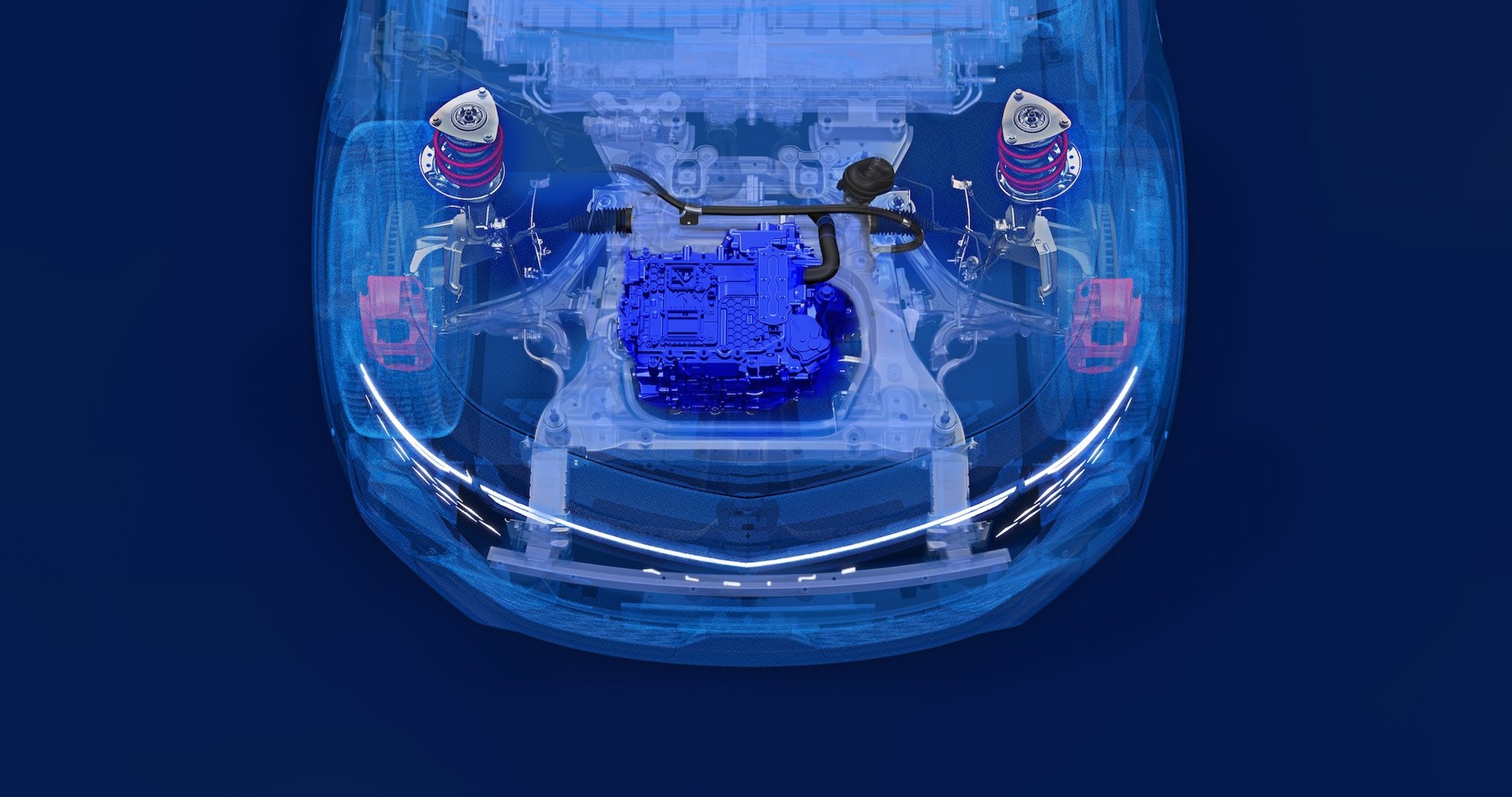
Charging highlights one of the GT’s limits. With a 400-V electrical architecture, the 89-kWh usable LG battery cannot compete with the segment’s fastest DC systems.
A charge from 15 to 80% takes 29 minutes — a respectable figure, though unremarkable in a category where some rivals approach 250 kW or more.
In AC, however, the A390 GT proves more versatile. The 11-kW onboard charger allows a 20–80% charge in 5 h 20, while the optional 22-kW charger cuts this down to 2 h 40 — a genuine advantage for those with suitable home or workplace infrastructure.
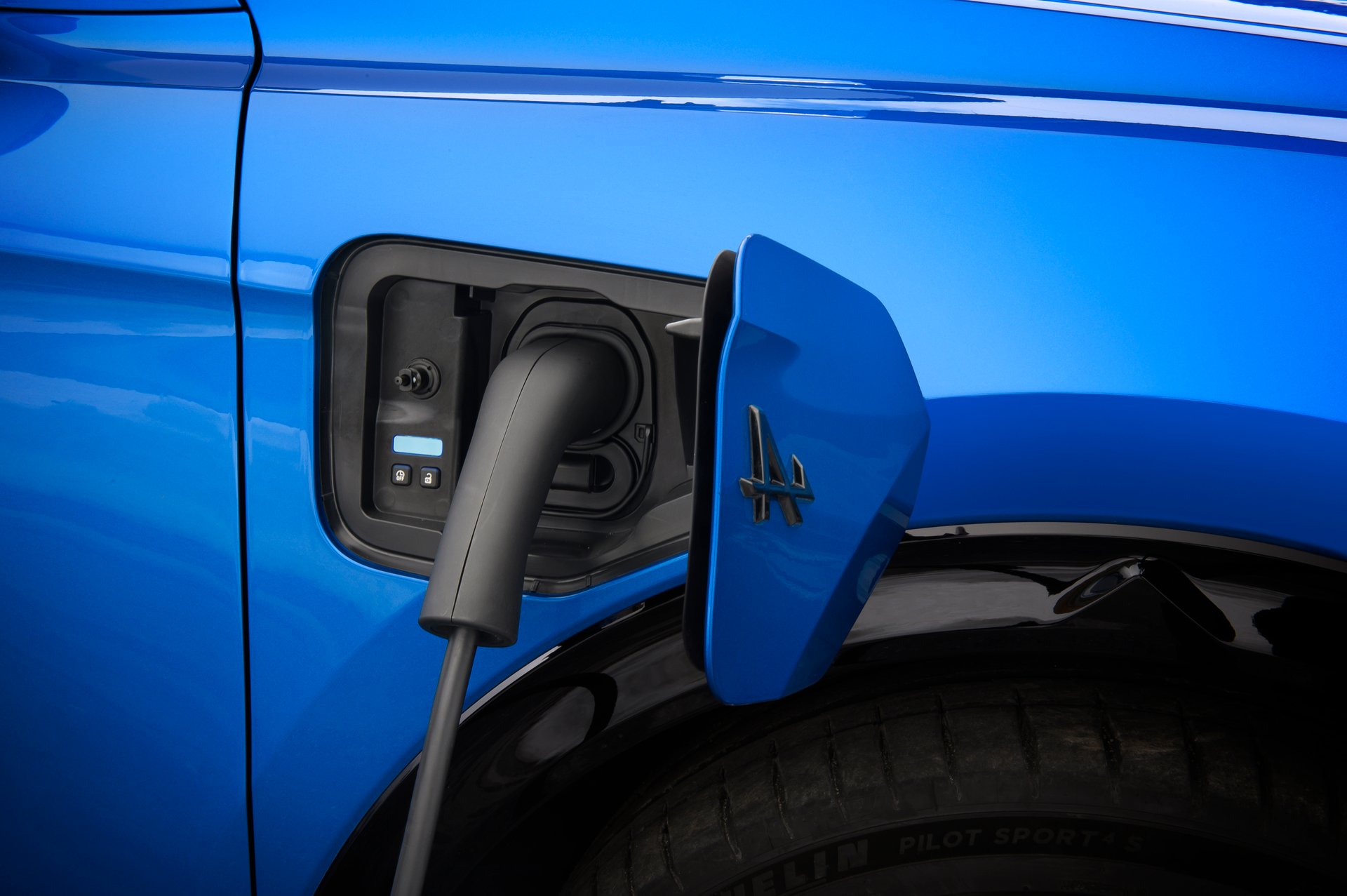
The bidirectional V2L function also opens up new possibilities — a technical detail, yes, but one that signals Alpine’s intent to blend sportiness with everyday usability.
At a steady cruising pace on flowing roads, the A390 becomes noticeably more efficient. The front wound-rotor motor disconnects at constant speed, letting the rear motors handle propulsion alone — a configuration that consumes less on such steady-state stretches. It’s a smart choice to contain consumption, even if the benefit remains moderate over long distances.
Look only at the numbers and one could conclude: the A390 consumes more than it should. But in practice, everything depends on expectations.
This isn’t a car designed to squeeze every kilometre from a kilowatt-hour. It’s a car that uses its electrons to deliver a rhythm, a personality, a way of reading the road.
It is not the most economical, nor the fastest to recharge.
But it knows exactly what to do with the energy it takes: transform it into a quality of motion that very few family electric vehicles can offer.
Here is the clean English translation, faithful, natural and without added commentary — just the translated text.
V. Technology & Infotainment
You might assume that by sharing much of its technical base with several Renault models, the A390 would lose part of its identity to industrial efficiency. But Alpine takes what works, refines it with careful touches, and assembles a surprisingly coherent technological package — one that suits a car aiming to be precise, playful, and genuinely usable every day.
First, there’s the familiar dual-screen setup:
A 12.3-inch digital cluster ahead of the driver and a 12-inch vertical touchscreen in the centre. Their design won’t shock anyone, but the ergonomics are so well executed that you quickly forget they come from the Renault ecosystem. Menus respond instantly, the interface is clear, and the whole system runs on Android Automotive, still one of the best operating systems for navigating in an electric vehicle.
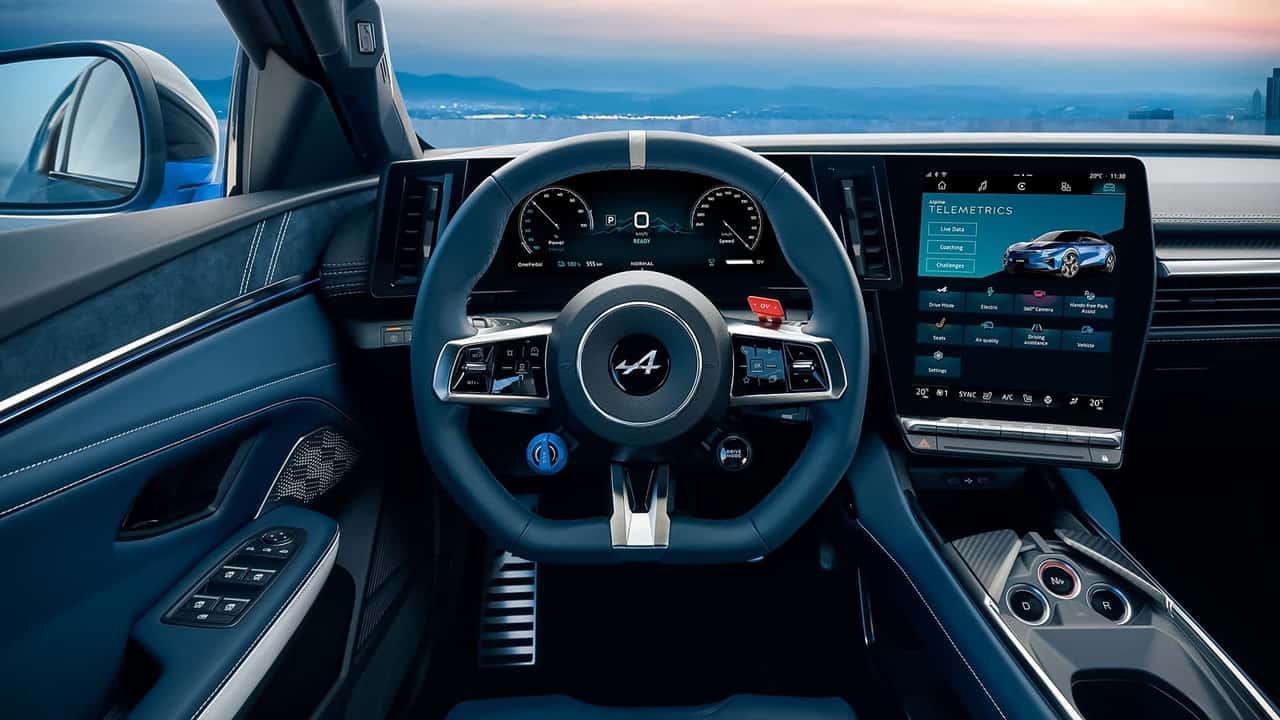
Google Maps, integrated natively, doesn’t just display a route: it anticipates charging stops, estimates consumption based on speed, preconditions the battery when a rapid charger is set as the destination, and automatically adjusts the itinerary depending on the charging network’s availability. In a sporty electric car, this matters — the tech quietly handles the logistics so the driver can remain focused on the road.
The A390 adds its own Alpine-specific flavour. The digital cluster features bespoke layouts, including a Minimal mode showing only essential data on a backdrop inspired by Alpine mountain reliefs. Visually elegant, functionally calming — and in an electric sports car, how information is presented can matter almost as much as what is presented.
But Alpine’s real technological signature lies elsewhere: in the Alpine Telemetrics suite, available as an option. Its value depends on how deeply you want to dive, but it reveals the true character of the A390.
Through multiple submenus, you can monitor motor temperatures, torque distribution, the activity of all three motors, regeneration phases, tyre pressures, and even the battery’s thermal behaviour. For the technically curious, it’s fascinating. For others, a gadget. In any case, it roots the car in a culture of driving, not merely mobility.
Telemetrics also adds a more playful — almost educational — aspect:
- Coaching mode, to refine driving precision
- Challenges mode, to play with braking, efficiency, or rhythm
These tools encourage you to understand the car, to work with its capabilities, to make it yours. A rare philosophy in a world where most onboard apps simply mimic a smartphone.
Finally, a word on the Devialet audio system, standard in its basic form and available in a higher-end version. Spatial imaging is convincing, bass is well controlled, but some may regret the very clean signature that sometimes lacks mid-range fullness. Still, Alpine’s acoustic tuning — including four distinct sound ambiences — shows real care in how audio is staged, whether it’s multimedia or the subtle sounds of the electric powertrain.
Overall, the A390 doesn’t try to impress with gadgetry. It offers something better: mature, stable, well-integrated technology.
A tool that supports driving, rather than replacing it.
An interface that simplifies without dumbing down.
A layer of tech that enhances the experience without overshadowing it.
And that is perhaps where this digital Alpine feels most accurate: in its ability to modernise the brand without diluting it.
Here is the clean and faithful English translation of your ADAS section, without added commentary — just the translated passage.
Driver Assistance Systems (ADAS)
The Alpine A390 relies on a set of driver assistance features very much in line with current standards, without trying to compete with the most demonstrative systems in the segment. The adaptive cruise control operates smoothly, managing deceleration and re-acceleration without the abruptness sometimes found in rival setups. Paired with the active lane-keeping assist — discreet enough not to feel like you’re fighting the car — it forms an effective Level 2 semi-autonomous driving system on highways, provided you keep your hands on the wheel.
The 360° camera, useful in urban settings, provides a reassuring view of the surroundings, although the image definition could be sharper, particularly in the rear views where some grain is noticeable. The A390 compensates with a full suite of parking aids — front, rear and side sensors — and, depending on the configuration, an automatic parking function for simple manoeuvres. Nothing flashy, but a modern, coherent set of tools that integrates well into the car’s overall user experience.
Conclusion – Les Alpinistes
The Alpine A390 marks a turning point — not only for the brand, but for what we imagine a French sports car can be in the electric age. And the question that hovered for months — is this still an Alpine, or just a good electric car wearing a sporty badge? — finally gets a clear answer: yes, there is Alpine blood in it. Not the pure, feather-light, almost innocent DNA of the A110, but a broadened, reinterpreted version, adapted to a format the brand had never explored.
What the A390 reveals is a car that doesn’t try to disguise itself. It doesn’t pretend to be a five-seat A110 — and thankfully so, because the attempt would have ended in caricature. Instead, it embraces a different form of sportiness: calmer, more technical, more mature. An Alpine for those who have a family, yet refuse to believe that electrification must dull driving pleasure.
Will A110 owners feel at home here?
Yes — but not for the same reasons.
If they crave instinctive agility, that natural rear-axle mobility, that constant game with weight and inertia… then no, the A390 will never replace the berlinette. But it offers something else: continuous efficiency, remarkable stability, and that fluidity through fast sequences that quietly whispers, “Yes — this is Alpine.”
The most striking moment of the test came in a long, sweeping bend in the Sierra Blanca, where the car settled in one clean motion, as if the rear motors were reading the road a heartbeat ahead of me. Nothing flashy, no drama — just that mechanical clarity that turns a competent EV into a genuine driver’s car.
Then comes the question of price.
At more than €67,000 to start, the A390 is far from a popular offering. Some will see an artificially premium positioning; others, an unavoidable inflation. But the context matters: Alpine must grow to survive.
Developing new platforms, future sports models and new technologies requires volumes and margins that the A110 alone could no longer support. The A390 is therefore a necessary step — a more profitable, more widespread model that funds the brand’s ambitions, including the A110’s successor and the two upcoming roadsters.
And there is a symbol: the A390 is built in Dieppe, alongside the A110 until the berlinette ends production in June 2026. A brief coexistence, but one loaded with meaning — a passing of the torch between two eras, two ways of loving the road.
So what is the A390, really?
A letter-perfect Alpine? No.
A credible, well-executed fastback sports EV? Absolutely.
A good electric car? Yes — coherent, pleasant, surprisingly alive.
It doesn’t try to please everyone; it tries to prove that an EV can still make you feel something. And in its own way, it succeeds.
The evolution of the Alpine range makes this trajectory clear.
The A290 — very close to the Renault 5 — laid the foundations: compact footprint, promising dynamics, the first electric breath. The A390 takes a far more ambitious step: the first three-motor Alpine, the first in-house Active Torque Vectoring system, the first model that doesn’t merely borrow the group’s technologies but contributes its own. It’s the car that truly opens the chapter of “second-generation” electric Alpines.
The next stage will be even more decisive: the A110 successor, due at the end of 2026, will sit on APP — the first 100% Alpine platform. Engineers mention a target weight around 1,400 kg, almost unreal for an electric sports car, and a strong sign that Alpine hasn’t abandoned the DNA of lightness, precision, and mechanical intimacy.
Then comes the matter of powertrains.
If Europe ultimately allows combustion engines running exclusively on biofuels or e-fuels after 2035, a dual thermal/electric strategy could become viable again for small-series sports cars. Nothing is guaranteed: production costs are high, technologies uneven, distribution models uncertain.
But this narrow opening is enough to remind us that the future is not monolithic. Yes, it is possible — even if far from confirmed — that tomorrow’s Alpine might come in two flavours: one electric, the other running on decarbonised fuels.
Not a promise.
A possibility.
And sometimes, a possibility is enough to bring genuine excitement back into the picture.
TECHNICAL SPECIFICATIONS — Alpine A390 GT (2025)
| Specification | Official / Verified Data |
|---|---|
| Powertrain architecture | 3 electric motors (1 front + 2 rear) |
| Combined power | 400 hp |
| Combined torque | 661 Nm |
| Motor layout | Front: wound-rotor synchronous motor / Rear: two permanent-magnet synchronous motors |
| Drivetrain | All-wheel drive (AWD) |
| Dynamic system | Alpine Active Torque Vectoring (AATV) |
| Battery | 89 kWh usable (LG Chem) |
| Electrical architecture | 400 V |
| 0–100 km/h | 4.8 s |
| Top speed | 200 km/h (limited) |
| Kerb weight | 2,124 kg |
| WLTP range | 557 km (20”) / 504 km (21”) |
| WLTP consumption | 20.4 kWh/100 km |
| DC fast-charging | 150 kW (155 kW measured peak) |
| 15–80% DC charging time | 29 min |
| AC charging | 11 kW onboard (22 kW optional) |
| Brakes | Ventilated discs + regenerative braking |
| Wheels | 20” standard, 21” optional |
| Tyres | Michelin Pilot Sport EV (20”) or Pilot Sport 4S (21”) |
| Length | approx. 4.66 m |
| Width | 1.92 m |
| Height | approx. 1.60 m |
| Boot capacity | approx. 500 L (depending on configuration) |
| Production | Dieppe, France (built alongside the A110 until June 2026) |
Alpine A390 — France Pricing (official, October 2025)
1. Base Prices
| Version | Price (France, VAT incl.) |
|---|---|
| A390 GT | €67,500 |
| A390 GTS (early 2026) | €78,000 |
2. Exterior Customisation Options
Paint Colours
| Paint | GT | GTS |
|---|---|---|
| Topaze White metallic | Standard | Standard |
| Deep Black metallic | €1,600 | €1,600 |
| Mercury Silver metallic | €1,600 | €1,600 |
| Abyss Blue metallic | €1,600 | €1,600 |
| Alpine Vision Blue metallic | €1,600 | €1,600 |
| Black Roof (Deep Black) | €1,200 | €1,200 |
| Thunder Grey Matte (Atelier) | €3,900 | €3,900 |
Wheels & Tyres
| Wheels / Tyres | GT | GTS |
|---|---|---|
| 20’’ Cristal + Michelin Sport EV | Standard | €400 |
| 21’’ Snowflake forged + Michelin PS4S | €1,800 | Standard |
| 20’’ Cristal (matte black – Atelier) | €400 | €400 |
| 21’’ Snowflake (matte black – Atelier) | €2,200 | €400 |
| Michelin CrossClimate 3 Sport (20’’) | €400 | €400 |
Brake Calipers
| Option | GT | GTS |
|---|---|---|
| Anodised 6-piston calipers | Standard | — |
| Alpine Blue | €500 | €500 |
| Racing Red | €500 | Standard |
3. Interior & Comfort
Interior Trims
| Option | GT | GTS |
|---|---|---|
| Alcantara + bi-tone Nappa leather | Standard | Standard |
| Alcantara headliner | €750 | Standard |
| Forged or twill carbon inserts (Atelier) | €600 | €600 |
Seats
| Option | GT | GTS |
|---|---|---|
| Alpine Sabelt Sport seats (Nappa leather), heated & massaging | €2,500 | Standard |
| Alpine Sport seats in perforated Alcantara | Standard | €400 |
4. Multimedia
| Option | GT | GTS |
|---|---|---|
| Devialet 13-speaker audio | Standard | — |
| Devialet XtremeSound (Space) | €1,200 | Standard |
| Alpine Telemetrics Expert | €490 | Standard |
5. Driver Assistance (ADAS)
| Option | GT | GTS |
|---|---|---|
| Driving Pack (extended ADAS + hands-free parking) | €1,200 | Standard |
6. Charging & Electric Features
| Option | GT | GTS |
|---|---|---|
| 11 kW bidirectional AC charger | Standard | Standard |
| 22 kW AC charger | €1,200 | €1,200 |
| V2L adapter | €400 | €400 |
Source : Alpine Cars