🇫🇷 Cet article est également disponible en français : Lire en français
Alpine has chosen to pull back the covers on its own secret a few days before Goodwood, rather than let the long lenses do the job for them. Christened Alpine A110 FUTURE, the development mule for the third-generation A110 will run every day from 9 to 12 July on the hill in front of the Sussex Downs — and for the marque from Dieppe, it’s as much a calculated gamble as an admission: this particular car matters more than the rest.
A mule that’s anything but incidental
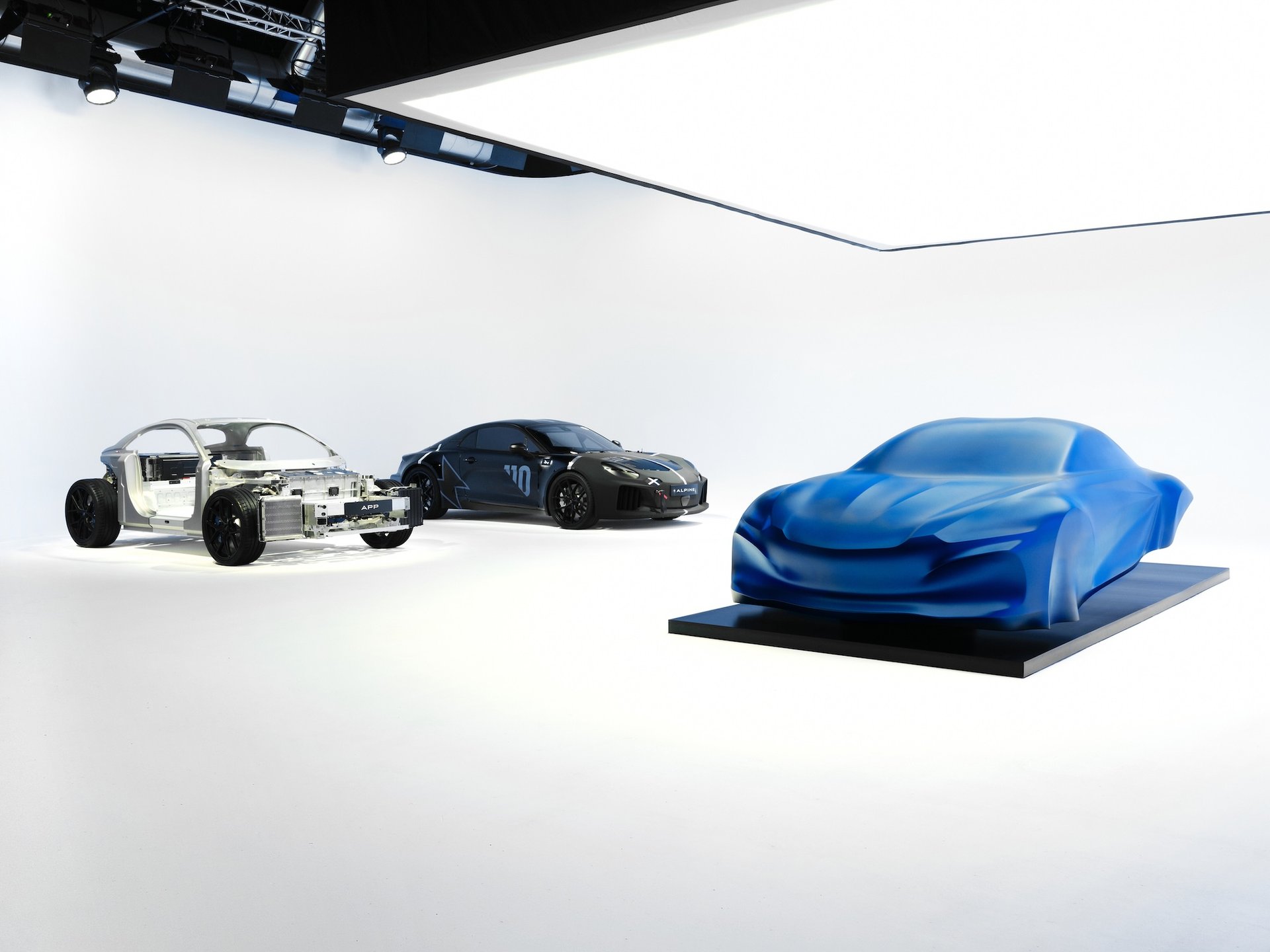
In manufacturer parlance, a “mule” is a running prototype, often cobbled together from an existing bodyshell, tasked with proving out the mechanicals of a still-secret model under real-world conditions. Nothing glamorous, on the face of it. Except Alpine’s version carries, beneath a shape that already hints at the taut lines of the future A110, the entirety of the Alpine Performance Platform (APP) — the architecture on which the French sports car maker’s entire electric future now rests.
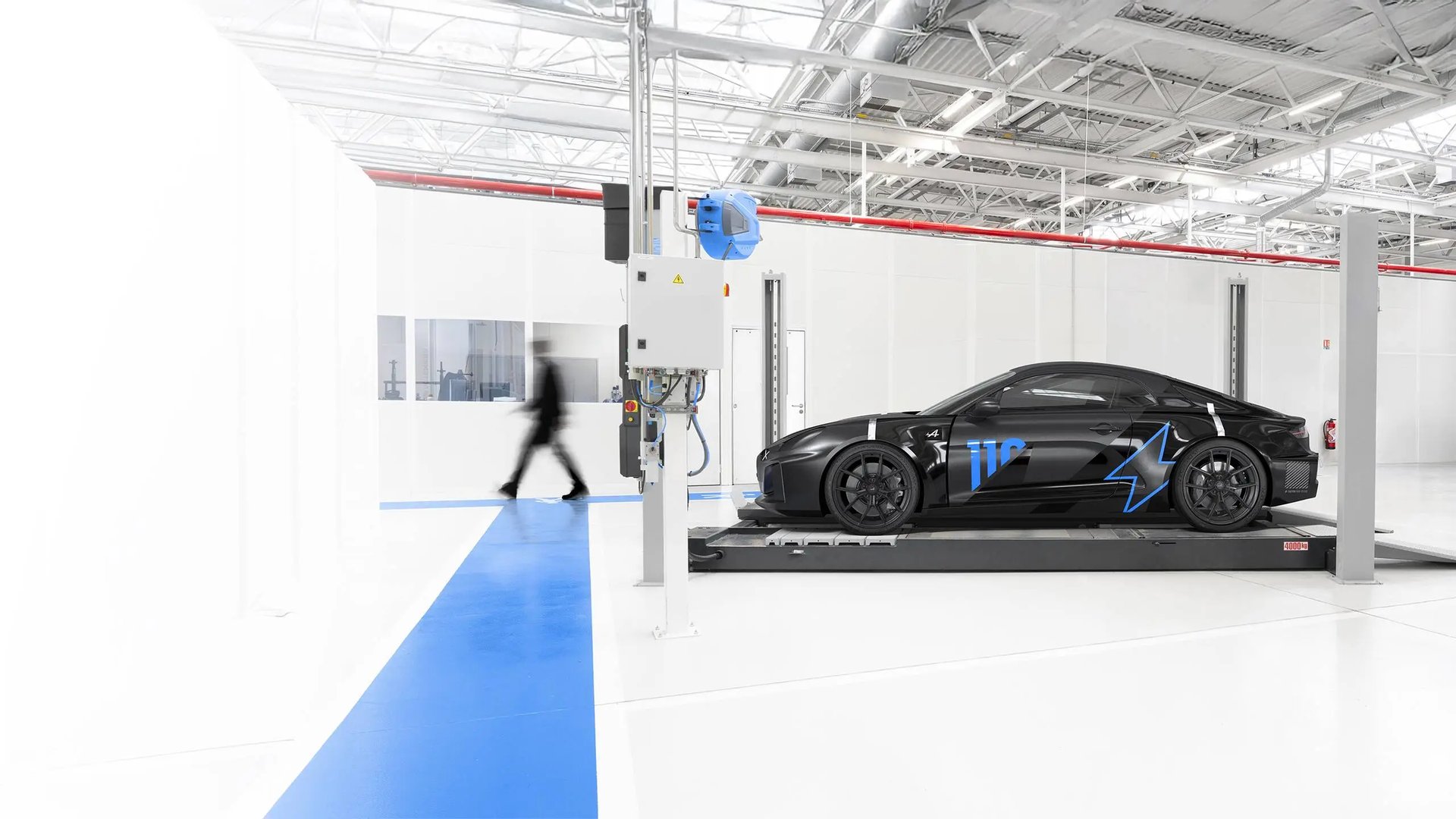
A telling sign that time is pressing harder than styling at Alpine right now: the bodyshell chosen for this mule is none other than that of the A110 Phase 2, reworked at either end to accommodate the new mechanicals. The front and rear bumpers have been redesigned — a necessity, given the need to house power electronics and charging ports — while a black finish, matt in places and gloss in others, does its best to scramble the surfaces for even the most seasoned spy photographers.

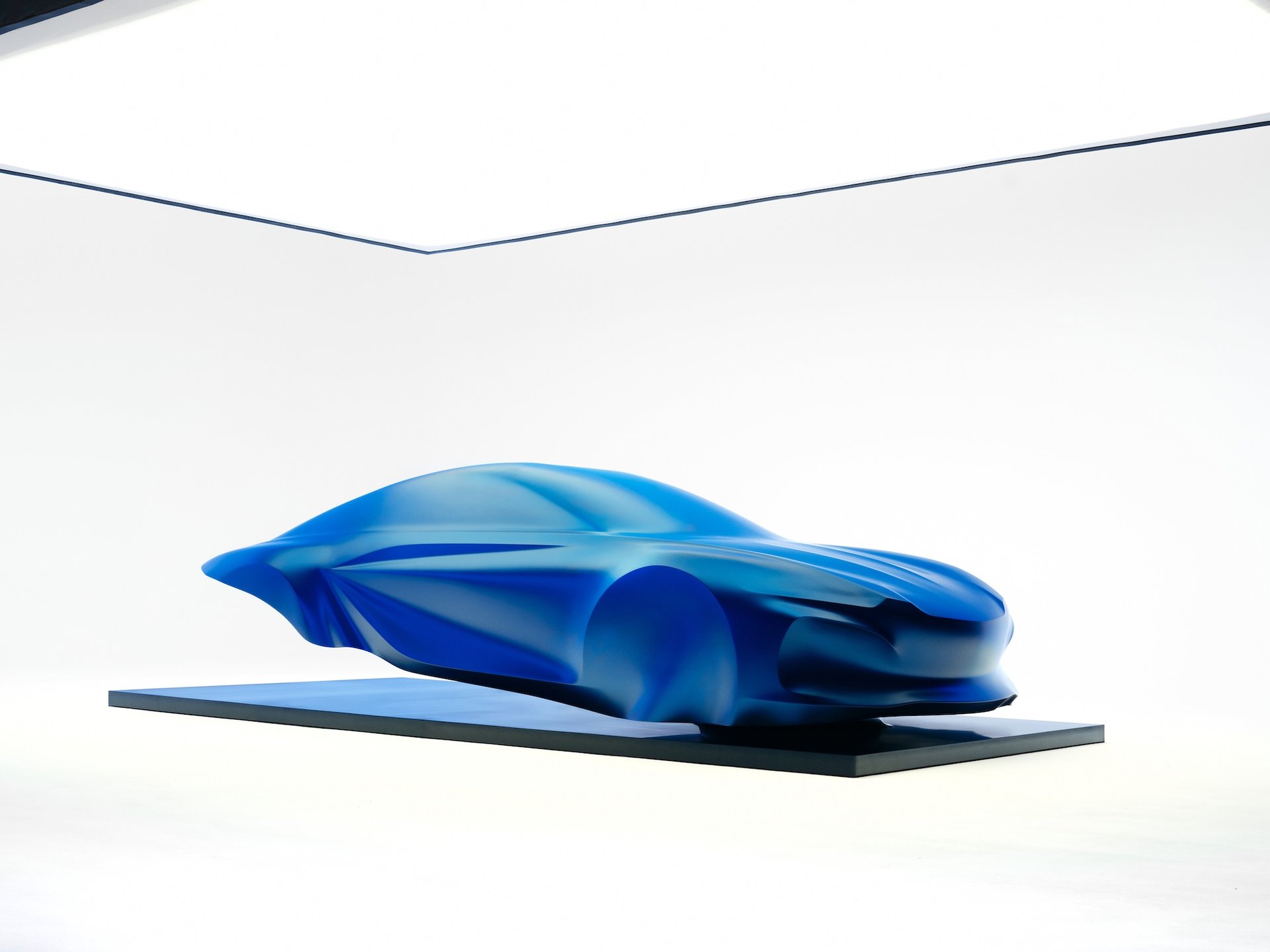
Along the flanks, the “A110 FUTURE” lettering appears in blue and grey, flanked by grey stripes that run across the front and rear wings; a third, more discreet stripe traces the full length of the bodywork, from the nose right through to the rear spoiler, like a hyphen linking what the car once was to what it’s about to become. A deliberate, almost theatrical piece of camouflage — one that doesn’t stop anyone from picking out, beneath this work overall, the already tauter proportions of an A110 whose story is far from finished.
The timing is no accident. Goodwood, the largest outdoor motoring gathering in the world since it began in 1993, gives Alpine a global stage at precisely the moment the marque is claiming it will deliver “the first genuine 100% electric sports car on the market.” The ambition on display is considerable; the proof, meanwhile, will play out live, on the famous hillclimb, in front of an audience of enthusiasts not exactly known for going easy.
The Alpine Performance Platform: electrifying without betraying the A110’s DNA
The question that’s dogged Alpine ever since it announced the A110 would go electric can be boiled down to one line: how do you keep the agility of a car that barely tips the scales past a tonne once you’ve grafted batteries onto it? The answer goes by the name of APP, the Alpine Performance Platform, an in-house architecture designed from the outset for high-performance electric sports cars — not a bolted-on adaptation of some generalist Renault Group platform.

Its aluminium structure, combining extruded sections with cast components, owes a fair amount to assembly methods borrowed from aerospace: structural bonding paired with riveting, a technique that adds stiffness without piling on the kilos.
Alpine’s stated goal is simple enough on paper — maximise rigidity while minimising mass — and the platform has been built with modularity in mind, capable of eventually underpinning several body styles (coupé, spider, 2+2) across multiple product generations. The production A110 will, in any case, roll off the line at the Alpine Manufacture Dieppe Jean Rédélé, just as every one of its forebears has done since 1955.
Two battery packs, in search of a true sports car’s balance
This is arguably the most distinctive engineering choice in the whole architecture. Where the vast majority of EVs house a single flat battery pack under the floor, Alpine has opted to split the pack in two: a smaller module up front, and the larger, primary pack sited at the rear — precisely where the combustion engine used to live in the A110. The logic is simple enough on paper, fiendishly difficult to execute in practice: replicate the 40/60% front/rear weight distribution that has always underpinned the Berlinette’s handling reputation, while retaining the low driving position that’s every bit as much a part of the car’s signature.

Electrically, Alpine is moving to an 800-volt architecture — a first for a sports car anywhere in the Renault Group — paired with cell-to-pack technology and high-energy-density cells. In practical terms: less weight for a given capacity, quicker charging, and better thermal management, hardly a minor point once you factor in repeated laps of a circuit. Figures cross-referenced with the Renault 5 Turbo 3E, which shares certain platform elements, point to capacity in the region of 70kWh, with a claimed range beyond 350 miles on the WLTP cycle.
An e-axle built for enjoyment, not just outright performance
At the rear, a new 3-in-1 e-axle packages two electric motors and their associated electronics, controlled by a silicon carbide (SiC) inverter — technology that guarantees a near-instant response and excellent thermal resilience, even under hard use. For the base version at least, Alpine has stuck with pure rear-wheel drive rather than giving in to the lure of all-wheel-drive traction, keeping faith with the slightly mischievous character that has always been part of the A110’s appeal.
Torque vectoring, badged Alpine Active Torque Vectoring, redistributes drive between the two rear wheels every 10 milliseconds — a rate that’s dizzying set against anything a human reaction could manage. Overseeing it all is the Alpine Dynamic Model (ADM), a central brain that coordinates motors, battery, regenerative braking, steering and active aerodynamics in real time. On paper, it reads rather more like a single-seater’s control system than anything you’d find in a conventional road car.

On power, Alpine is being deliberately coy. Pressed by the British press, CEO Philippe Krief would go no further than promising the future A110 would have “plenty” of horsepower, and that it would be “more than enough.” A politician’s answer, granted, but one that suggests the 345bhp offered by today’s A110 R Ultime — already the most hardcore car in the petrol-powered range — will be comfortably eclipsed.
It’s worth being upfront about this: at a confirmed 1,450kg kerb weight from Philippe Krief, the future electric A110 will carry roughly 300–350kg more than today’s petrol-engined car, which sits between 1,100 and 1,140kg depending on specification. That’s the well-documented trade-off that comes with electrifying any lightweight car, and Alpine isn’t pretending otherwise — the marque is instead banking on instant torque delivery and finely tuned torque vectoring to keep the driving sensation true to the Alpine ethos, even if the number on the scales is less flattering.
Chassis and running gear follow the same philosophy of controlled lightness: fully aluminium double-wishbone suspension, along with newly integrated and reworked braking and steering systems, all in service of a rigidity Alpine claims comfortably exceeds that of today’s A110.
Goodwood: a full-scale showcase for a marque in transition
Alpine isn’t simply sending a prototype up the hill. The marque is mounting its most ambitious presence yet at the event, bringing its entire current range alongside a selection of cars that have shaped its history, from the rally icons of the 1970s through to this still-camouflaged electric pioneer.
The A290, now the brand’s best-selling electric supermini, and the A390, the 463bhp five-seat fastback that’s driven a good deal of Alpine’s recent growth, round out the line-up on both the track and the stand.

The headline moment lands on Thursday 9 July: the “Alpine Moment,” a parade bringing the A110 FUTURE together with historic A110s, capped off with a demonstration run of the E20 Formula 1 car. It’s hard to imagine a more explicit staging of the thread linking the marque’s motorsport past to its electric future.
On the human side, Alpine is fielding five drivers from the BWT Alpine Formula One Team for the occasion. Pierre Gasly and Franco Colapinto will lead the charge, joined by Nina Gademan, Paul Aron and Alex Dunne, all drawn from the Alpine Academy or serving as reserve drivers.
The Alpine stand, running across all four days, will offer interactive simulators, daily driver appearances, autograph sessions and lunchtime DJ sets — the full package for a manufacturer treating Goodwood as much as a brand moment as a technical demonstration.
Alpine at the Festival
| Car | Sessions | Locations |
|---|---|---|
| A390 | First Glance (every day) / Manufacturer Batch (Thursday only) | First Glance Paddock, Alpine Stand, Cathedral Paddock |
| A110 FUTURE | First Glance | First Glance Paddock |
| A290 | Manufacturer Batch (Thursday only) | Cathedral Paddock, Alpine Stand |
| A110 | Alpine Moment (Thursday only) | Alpine Stand |
| A110 Celebration | Alpine Moment (Thursday only) | — |
| A110 Berlinette | Alpine Moment (Thursday only) | Alpine Stand |
| F1 Showcar | F1 Session | F1 Paddock |
| A110 R70 | — | Alpine Stand |
| A110 R Le Mans | Alpine Moment (Thursday only) | Alpine Stand |
The verdict
The A110 FUTURE isn’t yet the car customers will find at their local dealer, and Alpine makes no secret of that — the recycled Phase 2 bodyshell and its blue, grey and black camouflage livery are a reminder of it at every corner.
But between the 800V architecture, the twin battery packs engineered for balance rather than range alone, and a dynamic management system that owes a clear debt to the marque’s motorsport heritage, the technical picture unveiled on 3 July should go some way to reassuring even the most sceptical purists about electrification.
Whether the driving experience lives up to the numbers remains to be seen, from 9 to 12 July on the hill at Goodwood. The appointment’s been made.
Source: Alpine Cars